On This Page
Description
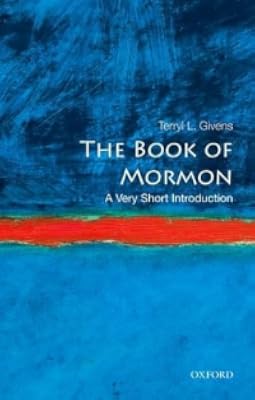
Written by Terryl Givens, a leading authority on Mormonism, this compact volume offers a concise, accessible introduction to the 'Book of Mormon'. Givens examines the work in terms of the claims that its narrators make for its historical genesis and its purpose as a sacred text.Tags
Recommendations














Member Reviews
The Book of Mormon (BoM) occupies a unique place as a piece of sacred scripture in the American religious milieu since it was published in 1830. To its critics and detractors, it is at best a piece of dull fiction ("chloroform in print", according to Mark Twain), and at worst, a blasphemous religious text that guarantees to put anyone believing in it on the sure road to perdition. But, to those that staunchly affirm the biblical truths contained and expounded in it, it contains the inspired Word of God. As such, to provide an introduction - "a very short introduction", as a matter of fact - and a fair synopsis to such a piece of religious text is a daunting task, to say the least.
Givens has done an admirable job in summarizing the show more essentials of the BoM to both its believers and non-believers. His book contains in all ten chapters, the last one being the conclusion, that introduce the reader to themes, narratives, contexts, authors, as well as a few of the central characters responsible for bringing the BoM to its inception. For instance, chapter 2 titled 'Themes', contains brief expositions of five core themes around which the the BoM is structured, thus providing the reader with a useful map for navigating through the text. These five themes, viz. personal revelation, focus on Christ, varieties of Zion, new configurations of scripture, and the centrality of family, "constitute the backbone of five distinct narratives that comprise the sacred record" (p20). This is a quite valuable bird's eye view for anyone reading the BoM. In other chapters, we briefly meet some of the characters responsible for getting the BoM to print. It is hard not to mention Joseph Smith when writing about the BoM, but Givens also introduces other personalities, such as Oliver Cowdery, Martin Harris and David Whitmer, that played significant roles in the book's publication.
Then, there is a chapter on the BoM's many family stories and the characters contained therein that bring to light some of the profound theological doctrines of the LDS Church, along with their far-reaching ramifications, which highlight both the commonalities and the dissimilarities of Mormon doctrines with those of other current-day mainstream Christian churches.
Another chapter on BoM teachings highlights, among other things, how surprisingly similar most of the BoM doctrines are to those of the Holy Bible. For instance, faith, repentance, baptism, Christ and the Holy Ghost are recurring salvifying themes that pervade the BoM and the Holy Bible, even more so in the former. At the same time, some novel doctrines, such as "The Fortunate Fall", wherein "the Fall [of Adam and Eve] is not a catastrophe to be fixed and rectified, [but]... the necessary and glorious pathway to humanity's eternal advancement" (p76), are quite dissimilar to those of other Christian churches. This sentiment is perhaps best described in Nephi 2, chapter 2, verse 25: "Adam fell that men might be; and men are, that they might have joy."
There are plenty of other passages in Givens' book that bring out the essentials of the BoM, providing any non-LDS person with the necessary tools to understand not only the sacred text but also provide a window to the minds and religious aspirations of the text's adherents.
In conclusion, Givens' introduction to the Book of Mormon is a well-written book that I would highly recommend to anyone with even a modicum of interest in the Book of Mormon or in Mormonism in general. show less
Givens has done an admirable job in summarizing the show more essentials of the BoM to both its believers and non-believers. His book contains in all ten chapters, the last one being the conclusion, that introduce the reader to themes, narratives, contexts, authors, as well as a few of the central characters responsible for bringing the BoM to its inception. For instance, chapter 2 titled 'Themes', contains brief expositions of five core themes around which the the BoM is structured, thus providing the reader with a useful map for navigating through the text. These five themes, viz. personal revelation, focus on Christ, varieties of Zion, new configurations of scripture, and the centrality of family, "constitute the backbone of five distinct narratives that comprise the sacred record" (p20). This is a quite valuable bird's eye view for anyone reading the BoM. In other chapters, we briefly meet some of the characters responsible for getting the BoM to print. It is hard not to mention Joseph Smith when writing about the BoM, but Givens also introduces other personalities, such as Oliver Cowdery, Martin Harris and David Whitmer, that played significant roles in the book's publication.
Then, there is a chapter on the BoM's many family stories and the characters contained therein that bring to light some of the profound theological doctrines of the LDS Church, along with their far-reaching ramifications, which highlight both the commonalities and the dissimilarities of Mormon doctrines with those of other current-day mainstream Christian churches.
Another chapter on BoM teachings highlights, among other things, how surprisingly similar most of the BoM doctrines are to those of the Holy Bible. For instance, faith, repentance, baptism, Christ and the Holy Ghost are recurring salvifying themes that pervade the BoM and the Holy Bible, even more so in the former. At the same time, some novel doctrines, such as "The Fortunate Fall", wherein "the Fall [of Adam and Eve] is not a catastrophe to be fixed and rectified, [but]... the necessary and glorious pathway to humanity's eternal advancement" (p76), are quite dissimilar to those of other Christian churches. This sentiment is perhaps best described in Nephi 2, chapter 2, verse 25: "Adam fell that men might be; and men are, that they might have joy."
There are plenty of other passages in Givens' book that bring out the essentials of the BoM, providing any non-LDS person with the necessary tools to understand not only the sacred text but also provide a window to the minds and religious aspirations of the text's adherents.
In conclusion, Givens' introduction to the Book of Mormon is a well-written book that I would highly recommend to anyone with even a modicum of interest in the Book of Mormon or in Mormonism in general. show less
Ratings
Members
- Recently Added By
Author Information

31+ Works 1,301 Members
Terryl L. Givens is Professor of Literature and Religion and James A. Bostwick Chair of English, University of Richmond. Some of his other books on Mormonism and American religious culture are By the Hand of the Mormon: The American Scripture that Launched a New World Religion, Paradox: A History of Mormon Culture, Parley P. Pratt: The Apostle show more Paul of Mormonism (with Matthew Grow), and The God Who Weeps: How Mormonism Makes Sense of Life (with Fiona Givens). show less
Series

Common Knowledge
- Canonical title
- The Book of Mormon: A Very Short Introduction
- First words
- The Book of Mormon, first published in 1830 in upstate New York, is at the center of a complex tapestry of intersecting narratives, each with a very different beginning.
- Last words
- (Click to show. Warning: May contain spoilers.)For these reasons especially, the Book of Mormon's work of dislocation and decentering may resonate in a twenty-first century world increasingly resistant to old boundaries and the categories of the past.
Classifications
- Genres
- Nonfiction, Religion & Spirituality, General Nonfiction
- DDC/MDS
- 289.3 — Religion Christian denominations Other denominations and sects Mormonism
- LCC
- BX8627 .G57 — Philosophy, Psychology and Religion Christian Denominations Christian Denominations Protestantism Other Protestant denominations Mormons. Church of Jesus Christ of Latter-Day Saints
- BISAC
Statistics
- Members
- 104
- Popularity
- 300,245
- Reviews
- 1
- Rating
- (3.31)
- Languages
- English
- Media
- Paper, Audiobook, Ebook
- ISBNs
- 6
- ASINs
- 2