
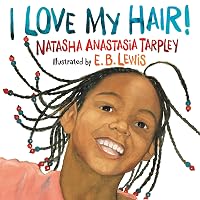
I Love My Hair!
by Natasha Anastasia Tarpley
On This Page
Description
A young African American girl describes the different, wonderful ways she can wear her hair.Tags
Recommendations


Member Reviews
I enjoyed reading "I Love My Hair" because of the writing style and the message behind the text. The story is about a young, African American girl who we meet as she is sitting between her mother’s legs getting her hair styled before bed; she describes how tedious this task is, how her mom must rub coconut oil into her scalp while combing through each section, how much it hurts in particularly tangled places. She tells the reader about each of the styles she likes to have—sometimes she wears her hair in tiny braids with beads at the ends, other times she lets her hair be free in an afro, but her favorite is in two ponytails. The language is rich with imagery, similes and metaphors as she compares her hairstyles to a globe, a forest, show more cotton candy, or a pair of wings. All of these details amount to a great representation of a cultural staple in the African American community—the way that their hair is styled is individualized and specific to what they feel, who they are and how they wish to be perceived. African American hair is difficult to tame, as the young girl describes the pain she endures from her mother, as she tries to be as gentle as possible, and many African American man or woman can relate to the young girl’s struggle to sit through it. The book is a necessary resource to provide confidence to little girls who may see themselves in the character and could use a relatable friend to show them the beauty of their natural hair. Black children may see fellow classmates of different races easily sweeping their hair up into a ponytail or twisting it into a braid and could feel it is unfair that their hair cannot do the same. The message of the story is to any African American girl who needs a little help in appreciating their hair and the way their hair represents their culture and their history; everyone is beautiful in their own way and hair is just one of the many freedoms we all have to show the world who we are. show less
Whether it be braided or Afro-ed, or straightened, Natasha Tarpley really captured the beauty of black girls' hair. I remember as a little girl going get my hair braided and the smell of coconut oil on my scalp following me all the way back home. I could still hear the clicky clacky of the beads that adorned the ends of my braids. Plastic beads held on by aluminum foil. I remember braiding my daughters' hair, too. Same beads. Same clicky clacky. Our hair is just like us. Black girls come in all shades of beautiful colors and our hair comes in all types of wonderful textures. We could style it. Profile it. Our hair could even be fried, dyed, and laid to the side. I love, love, love this book. I Love My Hair is a book, in my opinion, that show more is simply...unbe"weave"able! show less
I read this book to a group of children at my school, and I really enjoyed their positive reactions and informed questions. I loved the honesty that Tarpley displayed in this picture book; it was refreshing as a reader and as a teacher who prefers to be upfront with her students. I also love books that embrace differences and explain them as something that should be celebrated not hidden. I think that there are a lack of picture books on topics like this, and I would personally like to see more in my classroom libraries.
I liked the book I Love My Hair! by Anastasia Tarpley because the story is very believable. One way a book can acquire a readers interest is when the story is relatable. The story tells about a little girl with a different hair type. I like how the author takes readers through a mini journey to help with attaining self-love and appreciation. She learns about her culture and learns about her heritage. The illustrations enhance the story. It helps readers put the picture to the words. I would highly recommend this book because it helps readers see the importance behind one's culture.
I loved this multi-cultural book and plan on having it on my future shelf. The main idea of this story is to share with African-American girls the beauty and pride of their hair. I loved reading the character development of the main character, Keyena. The book is told in a first person narrative, which makes readers feel like they are invited into the personal thoughts of Keyena. What I loved about the author's writing is how she used figurative language. For example, “I can spin your hair into find, soft yarn, just like our grandmothers did at their spinning wheels, and weave it into a puffy little bun.” Another example is, “Or I can part your hair into straight lines and plant rows of braids along our scalp, the way we plant the show more seeds in our garden, then wait and watch for them to grow.” The author's writing made me go, “Wow, her hair is so great.” I started to appreciate hair myself! Along with the author's great message and writing, I enjoyed the illustrations. For example, with the two quotes that I shared, the illustrator drew a picture of Keyena's hair going into a spinning wheel. In another illustration, the illustrator drew Keyena's hair gradually turning into real plant rows. The figurative language of the book becomes complete with the illustrations. show less
My older niece loves this book, all about a black girl who, as you expect, loves her hair.
She describes it in various poetic and imaginative terms - her hair can be like a globe, or be spun into a braid; it's curly like a vine winding into space; she likes to wear her hair in "ponytails like wings".
There are some unnecessarily didactic elements - kids at school teased her, so her teacher talked to them about having Pride in Your Heritage (a good concept, the whole book is about that, but that page wasn't so well-handled, I think), and her mother starts talking to her directly about how she's "lucky to have this head of hair" when she complains that haircombing *hurts* sometimes.
Also, some of the illustrations have odd perspective - I'm show more thinking specifically of one where she's going down the street with beads in her hair.
However, overall this is a really great book. And my nieces (aged five and 2.5) agree. They love reading this book. show less
She describes it in various poetic and imaginative terms - her hair can be like a globe, or be spun into a braid; it's curly like a vine winding into space; she likes to wear her hair in "ponytails like wings".
There are some unnecessarily didactic elements - kids at school teased her, so her teacher talked to them about having Pride in Your Heritage (a good concept, the whole book is about that, but that page wasn't so well-handled, I think), and her mother starts talking to her directly about how she's "lucky to have this head of hair" when she complains that haircombing *hurts* sometimes.
Also, some of the illustrations have odd perspective - I'm show more thinking specifically of one where she's going down the street with beads in her hair.
However, overall this is a really great book. And my nieces (aged five and 2.5) agree. They love reading this book. show less
In my opinion, this book is a positive, simple yet empowering narrative for young African American girls. I really liked the illustrations because it enhanced and brought the story to life. The main character, Keyana, explicitly described how she could wear her hair in different styles through simile and how the imagery really expressed what she was describing, even if there hadn’t been any words written: “Love my hair because it is thick as a forest, soft like cotton candy, and curly as a vine winding upward, reaching the sky and climbing towards outer space”. I also liked the plot of this story because I really connected with it. As Keyana explained, in the beginning, how her mom would comb her hair and oil her scalp with show more coconut oil each night, it literally brought up memories of how my parents would sit me in front of them and have my hair combed, oiled, and styled for me. Even when she expressed how it would hurt when it got to the tangled parts, I explicitly remember the pains of having my tangled hair combed through as well. Overall, I really enjoyed how this narrative was teaching African American girls to not be ashamed of their hair. Even when people tease you like Keyana was in the story, she was taught to stand up for what she believed in and be proud of it because it represented where she came from. A lot of young African American girls today get picked on and judged based off their hair, and this book sends a message that they are so lucky to have such beautiful hair that they can style however they want. show less
Members
- Recently Added By
Lists

Children's picture books with kids of color
129 works; 15 members

African American
99 works; 3 members

Banned or Challenged Books
400 works; 41 members
VBL Picturebooks
110 works; 1 member

Books by Black Women
108 works; 2 members
Author Information

15+ Works 2,172 Members
Awards and Honors
Awards
Notable Lists
Classifications
Statistics
- Members
- 1,174
- Popularity
- 21,292
- Reviews
- 109
- Rating
- (4.48)
- Languages
- English
- Media
- Paper
- ISBNs
- 9
- ASINs
- 3