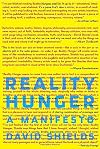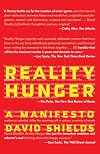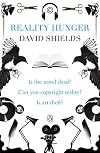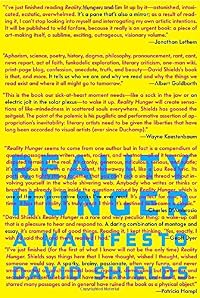
Reality Hunger: A Manifesto
by David Shields
On This Page
Description
An open call for new literary and other art forms to match the complexities of the twenty-first century. Author David Shields argues that our culture is obsessed with "reality" precisely because we experience hardly any. The questions Reality Hunger explores--the bending of form and genre, the lure and blur of the real--play out constantly all around us. Think of the controversy surrounding the provenance and authenticity of the "real": A Million Little Pieces, the Obama "Hope" poster, the show more boy who wasn't in the balloon. Reality Hunger is a rigorous and radical attempt to reframe how we think about "truthiness," literary license, quotation, appropriation. Shields has written this for a burgeoning group of interrelated but unconnected artists in a variety of forms and media who, living in an unbearably manufactured and artificial world, are striving to stay open to the possibility of randomness, accident, serendipity, spontaneity.--From publisher description. show lessTags
Recommendations



Member Reviews
Gerçeklik Açlığı insanı düşünmeye itmekten fazlasını yapıyor. Uzun zamandır okuduğum en iyi kitaplardan biri.” JONATHAN SAFRAN FOER
Gerçeklik Açlığı, Nietzsche’den Beckett’a, Godard’dan von Trier’e birçok önemli figürü ve Eminem, Larry David, Beastie Boys gibi popüler kültür ikonlarını, tam da artık onu deneyimleyemediği için “gerçeklik” konusunda takıntılı hale gelmiş Facebook ve Google nesliyle buluşturuyor.
David Shields hararetli tartışmalara yol açan kitabında, çağdaş sanat ve edebiyatın merkezindeki meselelere çığır açan bir bakış açısıyla yaklaşarak, kurgu-dışı ile kurgu, anlatı ile deneme arasındaki sınırlardan kurtulmayı öneriyor. Shields’a göre, show more başka şarkılardan alınmış parçalardan oluşan şarkılar, kolajlar, serbestçe alıntılanan metinler ve dijital teknolojiyle üretilmiş sonsuz kopyalar çağında artık bir yapıtın ya da fikrin sahibi olmanın tanımı; gerçekliğin, özgünlüğün anlamı değişiyor, telif hakkı talebi neredeyse bir kutsal kitap ya da efsane üzerinde hak iddia etmeye dönüşüyor. Devir paylaşımların, kendine mal etmenin, hatta “aşırma”nın devri.
Gerçeklik Açlığı, sınırlara meydan okuyarak başka yazarlara ait alıntılardan, aforizmalardan, anekdotlardan serbestçe “faydalanan”, okurları hakikilik, özgünlük ve yaratıcılığa dair geleneksel fikirler üzerine yeniden düşünmeleri için kışkırtan çarpıcı bir manifesto, kendi gerçekliğine sahip yeni bir çağa özgü yeni edebiyat ve sanat formları icat etmek için açık bir davet.
“Gerçeklik Açlığı’nı yeni bitirdim ve beni şaşırttı, mest etti, bozguna uğrattı. Kısacası, aydınlandım. Gerçekten de, önemli ve ileriyi gören bir kitap: Kendi kendini yaratan bir sanat eseri, görkemli, heyecan verici ve acımasız.” show less
Gerçeklik Açlığı, Nietzsche’den Beckett’a, Godard’dan von Trier’e birçok önemli figürü ve Eminem, Larry David, Beastie Boys gibi popüler kültür ikonlarını, tam da artık onu deneyimleyemediği için “gerçeklik” konusunda takıntılı hale gelmiş Facebook ve Google nesliyle buluşturuyor.
David Shields hararetli tartışmalara yol açan kitabında, çağdaş sanat ve edebiyatın merkezindeki meselelere çığır açan bir bakış açısıyla yaklaşarak, kurgu-dışı ile kurgu, anlatı ile deneme arasındaki sınırlardan kurtulmayı öneriyor. Shields’a göre, show more başka şarkılardan alınmış parçalardan oluşan şarkılar, kolajlar, serbestçe alıntılanan metinler ve dijital teknolojiyle üretilmiş sonsuz kopyalar çağında artık bir yapıtın ya da fikrin sahibi olmanın tanımı; gerçekliğin, özgünlüğün anlamı değişiyor, telif hakkı talebi neredeyse bir kutsal kitap ya da efsane üzerinde hak iddia etmeye dönüşüyor. Devir paylaşımların, kendine mal etmenin, hatta “aşırma”nın devri.
Gerçeklik Açlığı, sınırlara meydan okuyarak başka yazarlara ait alıntılardan, aforizmalardan, anekdotlardan serbestçe “faydalanan”, okurları hakikilik, özgünlük ve yaratıcılığa dair geleneksel fikirler üzerine yeniden düşünmeleri için kışkırtan çarpıcı bir manifesto, kendi gerçekliğine sahip yeni bir çağa özgü yeni edebiyat ve sanat formları icat etmek için açık bir davet.
“Gerçeklik Açlığı’nı yeni bitirdim ve beni şaşırttı, mest etti, bozguna uğrattı. Kısacası, aydınlandım. Gerçekten de, önemli ve ileriyi gören bir kitap: Kendi kendini yaratan bir sanat eseri, görkemli, heyecan verici ve acımasız.” show less
If you're looking for a polemic against the idea of fiction look no further. Shields constructs a wild collage of ideas in this manifesto that I found extremely inspiring and also frustrating as a writer of both fiction and other stuff. Shields is dropping a heavy gauntlet and makes a fair point about the origins of the novel and its current status today although I'm not as bored by plot. I don't expect he really cares whether or not anyone agrees with him but the argument is well worth reading.
Mr. Shields work consists of 617 numbered epigrams, or epigram-like entries, organized in 26 chapters, titled “a” through “z”, with subtitles like “genre”, “now”, “blur”, and “let me tell you what this book is about” (which is the 23rd chapter -- there's a good chance you won't know by then what the book is about and will welcome the help).
Some of the entries he wrote himself, some he appropriated from other writers. He doesn't tell us which is which until the very end in an appendix included grudgingly and at the insistence of the publisher's lawyers. Mixing others' words with your own, without attribution, is called “collage” and is how you should write, according to the manifesto.
The book demands that show more writers take up the task of “reconcoct[ing] meaning from the bombardments of experience” by embracing the “lyric essay” and it's values of concision, collage and the abandonment of narrative and any distinction between fiction and non-fiction. You do that so you can “say in a few sentences what everyone else says in a whole book – what everyone else does not say in a whole book” and it's OK to make stuff up because you can't help but do that anyway.
The book may be interesting, even important, to Students of Literature – academics and writer's workshops participants – but a manifesto containing “it amazes me that people still want to read a 400 page 'page turner'”, if it addresses anyone at all, addresses a group that has either left the rest of us behind or gone way off on a tangent.
To summarize, let me quote from #456 (page 150): “...could be brilliant, could be bullshit.” I'm going with the latter. If, like me, you're troubled by the trend for non-fiction pieces to include fabricated events, revised quotations, and outright lies, you might want to read this as a possible source for some of what troubles you. show less
Some of the entries he wrote himself, some he appropriated from other writers. He doesn't tell us which is which until the very end in an appendix included grudgingly and at the insistence of the publisher's lawyers. Mixing others' words with your own, without attribution, is called “collage” and is how you should write, according to the manifesto.
The book demands that show more writers take up the task of “reconcoct[ing] meaning from the bombardments of experience” by embracing the “lyric essay” and it's values of concision, collage and the abandonment of narrative and any distinction between fiction and non-fiction. You do that so you can “say in a few sentences what everyone else says in a whole book – what everyone else does not say in a whole book” and it's OK to make stuff up because you can't help but do that anyway.
The book may be interesting, even important, to Students of Literature – academics and writer's workshops participants – but a manifesto containing “it amazes me that people still want to read a 400 page 'page turner'”, if it addresses anyone at all, addresses a group that has either left the rest of us behind or gone way off on a tangent.
To summarize, let me quote from #456 (page 150): “...could be brilliant, could be bullshit.” I'm going with the latter. If, like me, you're troubled by the trend for non-fiction pieces to include fabricated events, revised quotations, and outright lies, you might want to read this as a possible source for some of what troubles you. show less
Why does Lydia Davis think "every page abounds with fresh observations"?
Most of the book is quotations from other sources. That, in itself, is not at all new, and it's the subject of an excellent book by Marjorie Perloff, "Unoriginal Genius." The history of collaged texts goes back, she thinks, to Walter Benjamin, and includes modernist texts like Pound's "Cantos" and William Carlos Williams's "Paterson" and postmodern texts like Anne Carson and Jan Baetens. So the form of the book isn't new, and neither, I think, is the content.
Shields says his editors told him he had to acknowledge his sources, and as a result it's possible to see which entries he wrote himself. The few original sections make really disappointing reading. They are show more either clichés of literary criticism and history, or else they are undeveloped literary theory.
Section 58 reads, in its entirety, "My medium is prose, not the novel." Why, I wonder, doesn't he feel it is necessary to look more closely at the word "prose" here, since it is doing so much work for him?
Section 140 reads: "Plot, like erected scaffolding, is torn down, and what stands in its place is the thing itself." This is part truism, and part surprisingly naive realism. A poststructuralist like Perec might well want to "tear down" plot, but he'd never say that what remains is "the thing itself": that sounds almost like George Steiner.
Section 457 is another example of a one-sentence manifesto that doesn't quite get to the end without a twist into ambiguity or obscurity. It reads: "So: no more masters, no more masterpieces. What I want (instead of God the novelist) is self-portrait in a convex mirror." This is over-complicated: the first part is against the naturalistic novel and the traditional role of the author, as in Foucault's or Barthes's critiques; but the las clause is an allusion to John Ashbery's "Self Portrait in a Convex Mirror," and to the Parmigianino original: and those allusions are semi-opaque, unnecessarily allusive, and unaccountably coy.
Section 307 reads (also in its entirety): "There's no longer any such thing as fiction or nonfiction; there's only narrative. (Is there even narrative?)" No graduate student would be allowed to write like this: his leading terms, in this case "narrative," are allowed to stand without explanation, and his positions are at once hugely polemical, vague, and coy.
Sections 234 to 236 are also original; they are unremarkable observations about popular culture. Section 236, for example, begins: "What does it mean to set another person before the camera, trying to extract something of his or her soul? When are we exploiting? When are we caressing?" Other people have said these things so much more exactly, at such length, so much more eloquently. Section 310 is another original section, on popular reality TV. It breezes over themes that need to be more closely articulated: "The bachelorette on the brink of true love with one of several men she has known for seven hours; the cad who manipulates his beloved on cue--two narratives: false actualization and authentic shame. The success of the genre [of reality TV] reflects our lust for emotional meaning." (Does Lydia Davis really admire criticism like this?)
There are more sections similar to these; section 428, for example, is a page-long contribution on Nabokov, which is used to make an unremarkable point about autobiography and its independence from plot. Section 456 is also a relatively long passage on how "plot isn't a tool: intelligence is." Section 473 is autobiography: it's informative but nearly free of interest.
And I'm not amused by the snide literary jokes that are also scattered through the sections of the book that Shields wrote. Section 458 quotes Nabokov, but in the footnote Shields says that "in honor of the author's Olympian hauteur" he "corrected" Nabokov's grammar. Section 139 begins, "In the end, I missed the pleasure of a fully imagined work..."; this turns out to be a quotation from a review of one of Shields's books. Section 145, another original section, is a mean-spirited listing of a "Verboten thematic: secular Jews, laureates of the real, tend to be better at analyzing reality than re-creating it:... Harold Brodkey, most of the essays; Philip Lopate's introduction to "The Art of the Personal Essay"; Vivian Gornick, pretty much everything..." At the end of this list he tries to patch things up by associating these authors with certifiably important people: "And, of course, less recently, Marx, Proust, Freud, Wittgenstein, Einstein." That gambit, of putting someone down and then trying to make it sound like a compliment, never works: it betrays a superficial sense of rhetoric. And the passage is painted with such a broad brush that it's impossible to make much sense of it anyway.
So this is what emerges, for me, when I read the sections of the book that Shields wrote. When I read straight through, without looking at the notes, then I get a collage, but it's less interesting and less developed than other collaged texts. The fragments don't often resonate with one another, as they do, for example, in Benjamin, in Pound, or in Paul Metcalf. For me, this is a cloudy manifesto and a collection of commonplaces. Can someone help me to see it otherwise? show less
Most of the book is quotations from other sources. That, in itself, is not at all new, and it's the subject of an excellent book by Marjorie Perloff, "Unoriginal Genius." The history of collaged texts goes back, she thinks, to Walter Benjamin, and includes modernist texts like Pound's "Cantos" and William Carlos Williams's "Paterson" and postmodern texts like Anne Carson and Jan Baetens. So the form of the book isn't new, and neither, I think, is the content.
Shields says his editors told him he had to acknowledge his sources, and as a result it's possible to see which entries he wrote himself. The few original sections make really disappointing reading. They are show more either clichés of literary criticism and history, or else they are undeveloped literary theory.
Section 58 reads, in its entirety, "My medium is prose, not the novel." Why, I wonder, doesn't he feel it is necessary to look more closely at the word "prose" here, since it is doing so much work for him?
Section 140 reads: "Plot, like erected scaffolding, is torn down, and what stands in its place is the thing itself." This is part truism, and part surprisingly naive realism. A poststructuralist like Perec might well want to "tear down" plot, but he'd never say that what remains is "the thing itself": that sounds almost like George Steiner.
Section 457 is another example of a one-sentence manifesto that doesn't quite get to the end without a twist into ambiguity or obscurity. It reads: "So: no more masters, no more masterpieces. What I want (instead of God the novelist) is self-portrait in a convex mirror." This is over-complicated: the first part is against the naturalistic novel and the traditional role of the author, as in Foucault's or Barthes's critiques; but the las clause is an allusion to John Ashbery's "Self Portrait in a Convex Mirror," and to the Parmigianino original: and those allusions are semi-opaque, unnecessarily allusive, and unaccountably coy.
Section 307 reads (also in its entirety): "There's no longer any such thing as fiction or nonfiction; there's only narrative. (Is there even narrative?)" No graduate student would be allowed to write like this: his leading terms, in this case "narrative," are allowed to stand without explanation, and his positions are at once hugely polemical, vague, and coy.
Sections 234 to 236 are also original; they are unremarkable observations about popular culture. Section 236, for example, begins: "What does it mean to set another person before the camera, trying to extract something of his or her soul? When are we exploiting? When are we caressing?" Other people have said these things so much more exactly, at such length, so much more eloquently. Section 310 is another original section, on popular reality TV. It breezes over themes that need to be more closely articulated: "The bachelorette on the brink of true love with one of several men she has known for seven hours; the cad who manipulates his beloved on cue--two narratives: false actualization and authentic shame. The success of the genre [of reality TV] reflects our lust for emotional meaning." (Does Lydia Davis really admire criticism like this?)
There are more sections similar to these; section 428, for example, is a page-long contribution on Nabokov, which is used to make an unremarkable point about autobiography and its independence from plot. Section 456 is also a relatively long passage on how "plot isn't a tool: intelligence is." Section 473 is autobiography: it's informative but nearly free of interest.
And I'm not amused by the snide literary jokes that are also scattered through the sections of the book that Shields wrote. Section 458 quotes Nabokov, but in the footnote Shields says that "in honor of the author's Olympian hauteur" he "corrected" Nabokov's grammar. Section 139 begins, "In the end, I missed the pleasure of a fully imagined work..."; this turns out to be a quotation from a review of one of Shields's books. Section 145, another original section, is a mean-spirited listing of a "Verboten thematic: secular Jews, laureates of the real, tend to be better at analyzing reality than re-creating it:... Harold Brodkey, most of the essays; Philip Lopate's introduction to "The Art of the Personal Essay"; Vivian Gornick, pretty much everything..." At the end of this list he tries to patch things up by associating these authors with certifiably important people: "And, of course, less recently, Marx, Proust, Freud, Wittgenstein, Einstein." That gambit, of putting someone down and then trying to make it sound like a compliment, never works: it betrays a superficial sense of rhetoric. And the passage is painted with such a broad brush that it's impossible to make much sense of it anyway.
So this is what emerges, for me, when I read the sections of the book that Shields wrote. When I read straight through, without looking at the notes, then I get a collage, but it's less interesting and less developed than other collaged texts. The fragments don't often resonate with one another, as they do, for example, in Benjamin, in Pound, or in Paul Metcalf. For me, this is a cloudy manifesto and a collection of commonplaces. Can someone help me to see it otherwise? show less
A book that practices what it (most certainly) preaches: Shields' provocation is that fiction is dead, that all reality is subjective, and that all artists copy or steal. To that end, the text comprises some 600 aphorisms composed into an argument about literature, essays, journalism and documentary. Flawed, repetitive and on occasion snide, it's tone makes the author (compiler) hard to like. But when one considers the formulaic nature of much three-act story-telling, the self-referencing of "my-life-as-a-writer" fiction, and the ascendancy of the documentary form in recent cinema, he may well be onto something. Thought-provoking and eclectic.
Really interesting collection of thoughts (some lifted, some his own) on non-fiction, but I was far more interested in the brief forays into the topics of appropriation and stealing as artistic tools. For some, perhaps, provocative. But in both format and content I found it to be an excellent summary and wealth of quotational and anecdotal support for ideas I already share. For that reason, it was a relatively quick read. Because I wasn't in need of persuasion, I also found it perhaps a bit redundant, but can easily imagine a reader more hostile to the claims non-fiction (especially memoir) makes about truth vs. fact, and to the idea of appropriation as a legitimate (and necessary) artistic mode really needing a lot of repetition in show more order to get to where this book starts from. show less
"Reality Hunger" is a book that attempts to get to the heart of modern literature and writing. The way it goes about doing so however, is what makes it so unique and so fascinating.
Rather than a writing a single long work, or even a series of essays, David Shields chooses a radically different path, representative of his greater argument. The book is a series of quotes arranged in chapters based on the general argument Shields attempts to create. The quotes themselves come from a variety of sources: Emerson to excerpts from movie reviews and articles on hip-hop to Joyce to Shields himself.
The result of this mash-up of quotes is compelling as it is likely to be controversial. In many ways, Shields argues the abandoning of traditional show more fiction in favor of something real. Whether that is a mixture of real experiences of the author plus his own creations, to outright borrowing from other authors. Indeed, Shields seems taken with the world of rap and hip-hop, where artists "sample" other artists, sometimes dozens at a time, and create something new and real with it.
A fascinating read for anyone interested in modern literature, literary criticism and writing. show less
Rather than a writing a single long work, or even a series of essays, David Shields chooses a radically different path, representative of his greater argument. The book is a series of quotes arranged in chapters based on the general argument Shields attempts to create. The quotes themselves come from a variety of sources: Emerson to excerpts from movie reviews and articles on hip-hop to Joyce to Shields himself.
The result of this mash-up of quotes is compelling as it is likely to be controversial. In many ways, Shields argues the abandoning of traditional show more fiction in favor of something real. Whether that is a mixture of real experiences of the author plus his own creations, to outright borrowing from other authors. Indeed, Shields seems taken with the world of rap and hip-hop, where artists "sample" other artists, sometimes dozens at a time, and create something new and real with it.
A fascinating read for anyone interested in modern literature, literary criticism and writing. show less
Members
- Recently Added By
Published Reviews
ThingScore 75
I am grateful for Shields's sometimes brutal interrogation of what I believe. His critiques led me to reconsider my own creative process. How had I gotten to a particular moment at the end of some book or essay? What had been my intention? What had I wanted the audience to think about my characters—or about me, for that matter? Taking the time to consider these ideas felt extremely show more decadent—allowing a little bit of the luxurious contemplation Shields would wish for all readers. show less
added by Shortride
Author Information

33+ Works 2,513 Members
David Shields was born in Los Angeles, California on July 22, 1956. He received a bachelor's degree in English literature from Brown University in 1978 and an MFA in fiction from the University of Iowa Writers' Workshop in 1980. He writes both fiction and nonfiction books. His first novel, Heroes, was published in 1984. His other works include show more Black Planet: Facing Race during an NBA Season, The Thing About Life Is That One Day You'll Be Dead, Reality Hunger: A Manifesto, How Literature Saved My Life, and Other People: Takes & Mistakes. Remote: Reflections on Life in the Shadow of Celebrity won the PEN/Revson Award and Dead Languages won the PEN Syndicated Fiction Award. He is the Milliman Distinguished Writer-in-Residence at the University of Washington. (Bowker Author Biography) show less
Awards and Honors
Awards
Distinctions
Common Knowledge
- Epigraph
- When we are not sure, we are alive. — Graham Greene
- Canonical LCC
- PN781 .S55 2010
Classifications
- Genres
- Literature Studies and Criticism, Nonfiction
- DDC/MDS
- 809.9112 — Literature & rhetoric Literature, rhetoric & criticism History, description, critical appraisal of more than two literatures Literature displaying specific features, miscellaneous writings Literature displaying specific qualities of style, mood, viewpoint Nontraditional viewpoints
- LCC
- PN781 .S55 — Language and Literature Literature (General) Literature (General) Literary history
- BISAC
Statistics
- Members
- 591
- Popularity
- 49,384
- Reviews
- 20
- Rating
- (3.40)
- Languages
- 6 — English, French, German, Italian, Spanish, Turkish
- Media
- Paper, Ebook
- ISBNs
- 14
- ASINs
- 2