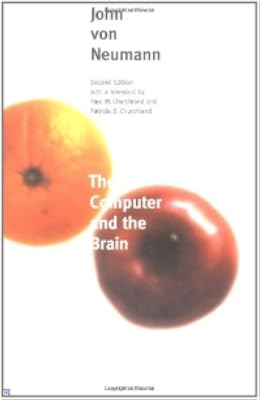
The Computer and the Brain
by John von Neumann
On This Page
Description
In this classic work, one of the greatest mathematicians of the twentieth century explores the analogies between computing machines and the living human brain. John von Neumann, whose many contributions to science, mathematics, and engineering include the basic organizational framework at the heart of today's computers, concludes that the brain operates both digitally and analogically, but also has its own peculiar statistical language.In his foreword to this new edition, Ray Kurzweil, a show more futurist famous in part for his own reflections on the relationship between technology and intelligence, places von Neumann's work in a historical context and shows how it remains relevant today. show lessTags
Recommendations









Member Reviews
The book was of interest mostly for historical reasons but the comparisons between computing and neurophysiological components (as they were known at the time) and some of the analogising between computing machines and the human neurobiological system were interesting. It's a pity von Neumann didn't finish and deliver the lectures before he died.
After 50 years, this book by the genius John von Neumann is still relevant in many aspects. I wish I had read this before I started my cognitive science education or before I have written my cog. sci. thesis. Neumann's insights into the architecture of the information processing of the brain is what many scientists today consider a nearly standard framework.
Anybody in interested in the intersection of computing science and brain research should read this short and sharp book, not only for its contents but also for Neumann's style.
Anybody in interested in the intersection of computing science and brain research should read this short and sharp book, not only for its contents but also for Neumann's style.
Impressive little book which along with Turing's work, et al., founded the field of computer science as we know it. Of most interest if you are interested in the history and foundations of modern computer science, otherwise the concepts here will be so familiar that you will know many of them already.
Brilliant insights that have informed all thinking on the subject for the past 50 years. Main argument: despite some obvious similarities in architecture (digital signals, memory) the human brain must work on a different computational model.
This is an amazing set of thoughts around computing and the human brain. It's not easy reading, but it's worth the payoff in the end. It definitely helped me refine/further develop my own opinions on the subject. If you are a computer programmer, this is essential reading.
Von Neumann's unfinished last work comparing digital computers with the human brain. Works through his estimations and comparisons of various capabilities, e.g., that the human brain has about 3.5 PB of storage. Concludes that the architecture of the brain and central nervous system is so different from that of the digital computer that it implies a completely different (programming) language of mathematics and logic is used.
Questo breve saggio di von Neumann nasce come una serie di lezioni che il grande matematico avrebbe dovuto tenere a Yale: la sua malattia gli impedì non solo di presentarle ma anche di terminarle e controllarle (Paolo Bartesaghi nella traduzione segnala un paio di punti in cui i risultati delle operazioni matematiche sono banalmente errati). Io non sono così d'accordo con i peana delle prefazioni alla seconda e terza edizione del libro sulla visione del funzionamento del cervello: al più si può affermare che se le cose stanno davvero così allora negli ultimi 60 anni non si è in realtà fatto nulla di nuovo. La prima parte del testo però è molto interessante sia dal punto storico - in quanti sanno come era fatto un computer negli show more anni '50? - che da quello teorico. La prosa di von Neumann è sintetica ma molto chiara, e dato che è vero che la struttura odierna di un computer è fondamentalmente la stessa da lui creata il suo resoconto ci permette di avere un'idea della logica che portò alla creazione di tale struttura. Inoltre, anche se nel testo le differenze tra computer e mente non sono molto enfatizzate, leggere il testo con le conoscenze odierne - e soprattutto ricordarsi che la capacità di memoria del primo è enormemente aumentata - aiuta a capire che in realtà non sappiamo affatto come davvero funzioni il nostro cervello :) show less
Jul 20, 2017 (Edited)Italian
Members
- Recently Added By
Lists

University Presses
155 works; 1 member
Author Information

28+ Works 1,233 Members
John von Neumann (1903-57) was one of the most important mathematicians of the twentieth century. His work included fundamental contributions to mathematics, physics, economics, and the development of the atomic bomb and the computer. He was a founding member of the Institute for Advanced Study in Princeton.
Some Editions
Awards and Honors
Awards
Series
Belongs to Publisher Series
Common Knowledge
- Canonical title
- The Computer and the Brain
- Original title
- The Computer and the brain
- Original publication date
- 1958
Classifications
- Genres
- Technology, Nonfiction, Science & Nature, General Nonfiction, Philosophy
- DDC/MDS
- 003.5 — Computer science, information & general works Computer science, knowledge & systems Systems Theory of communication and control
- LCC
- QA76 .V6 — Science Mathematics Mathematics Instruments and machines Calculating machines Electronic computers. Computer science Computer software
- BISAC
Statistics
- Members
- 459
- Popularity
- 66,493
- Reviews
- 8
- Rating
- (3.90)
- Languages
- 10 — Catalan, Chinese, Dutch, English, French, German, Galician, Italian, Portuguese, Spanish
- Media
- Paper, Ebook
- ISBNs
- 19
- ASINs
- 8