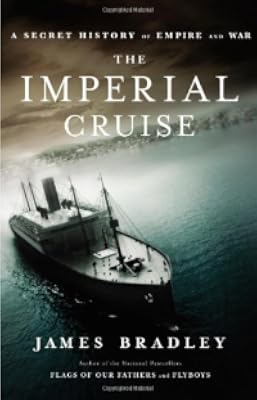
The Imperial Cruise
by James Bradley
On This Page
Description
Analyzes the multinational conflicts that set the stage for World War II, the Chinese communist revolution, and the Korean War, documenting Theodore Roosevelt's 1905 diplomatic mission in the Pacific through which the United States forged ill-fated covert agreements.Tags
Recommendations

Member Reviews
A real eye-opener for me. I had not paid attention to the history & attitudes of US society in the 1890s through 1914. Had no ideal how fully entrenched into the culture and its leadership racial discrimination was. Shocking to see language that could come out of 1930s German propaganda was being said, written by American politicians.
The book's thesis that Teddy Roosevelt's political heritage set the stage for 100 years of problems is sustained.
The book's thesis that Teddy Roosevelt's political heritage set the stage for 100 years of problems is sustained.
A towering work of revisionist history, it earns a second star only because it sent me to do so much follow-on reading on any number of topics touched. Highly recommended if one enjoys books written as exploration of alternate historical timelines.
"Empire," Orwell reminds us in his 1942 essay on Kipling, "is primarily a money-making affair. ... The map is painted red," he notes, "chiefly so the coolie can be exploited." For "coolie" substitute "Chinese," "Hawaiian," or "Filipino," and you have a pretty fair statement of one of James Bradley's main arguments in "The Imperial Cruise" -- that it was cupidity more than anything else that led to U.S. assertion of power in the Pacific. This is an important argument -- one of several such timely bits of "revisionism" in a flawed but still very worthwhile book.
Many reviewers have criticized Bradley for factual misstatements or misinterpretations, poor citations, or simply an overly polemical tone. But I think it's important to note, show more too, the ire generated simply by his willingness to throw mud on icons of our civic religion like Theodore Roosevelt and the selfless benevolence of American soldiers and Marines, or even to state the self-evident fact that the U.S. became at the time covered in this book, and remains to this day, an imperial power. (Note how many reviewers flay Bradley for "giving in to political correctness," a by-now-largely-meaningless term that signifies little more than "something Sean Hannity wouldn't like.)
Despite the flaws, though, there is quite a bit of value in what I take to be Bradley's three key points.
The first of these is the fact of the commercially-driven power politics of America's Pacific expansionism -- shaped by the racial theories of the time and promoted as part of a civilizing mission ("Initiating what would become a recurring Yankee tradition," Bradley writes, "McKinley contended that the U.S. military could invade other countries when Americans decided that their people needed help. McKinley conjured up the fantasy that when a U.S. soldier pointed a gun at a foreign Other, he was there to help" [p. 79]).
The second is that U.S. encouragement of Japanese expansionism, as the Asian nation most thoroughly in line with "the principles and methods of Western civilization" (p. 217, quoting TR), led directly to World War Two. And the third is that the Theodore Roosevelt we remember and lionize today is largely a myth of TR's own creation. Though not unusual among talented politicians -- Winston Churchill created his own myth too, as John Ramsden showed in Man of the Century: Winston Churchill and His Legend Since 1945 -- seeing through the propaganda is essential for a clear understanding of the person and his impact.
Flawed as "The Imperial Cruise" may be, by reminding us of these important facts, James Bradley has written a book that deserves to be read and recognized as a useful work of "revisionist" history. show less
Many reviewers have criticized Bradley for factual misstatements or misinterpretations, poor citations, or simply an overly polemical tone. But I think it's important to note, show more too, the ire generated simply by his willingness to throw mud on icons of our civic religion like Theodore Roosevelt and the selfless benevolence of American soldiers and Marines, or even to state the self-evident fact that the U.S. became at the time covered in this book, and remains to this day, an imperial power. (Note how many reviewers flay Bradley for "giving in to political correctness," a by-now-largely-meaningless term that signifies little more than "something Sean Hannity wouldn't like.)
Despite the flaws, though, there is quite a bit of value in what I take to be Bradley's three key points.
The first of these is the fact of the commercially-driven power politics of America's Pacific expansionism -- shaped by the racial theories of the time and promoted as part of a civilizing mission ("Initiating what would become a recurring Yankee tradition," Bradley writes, "McKinley contended that the U.S. military could invade other countries when Americans decided that their people needed help. McKinley conjured up the fantasy that when a U.S. soldier pointed a gun at a foreign Other, he was there to help" [p. 79]).
The second is that U.S. encouragement of Japanese expansionism, as the Asian nation most thoroughly in line with "the principles and methods of Western civilization" (p. 217, quoting TR), led directly to World War Two. And the third is that the Theodore Roosevelt we remember and lionize today is largely a myth of TR's own creation. Though not unusual among talented politicians -- Winston Churchill created his own myth too, as John Ramsden showed in Man of the Century: Winston Churchill and His Legend Since 1945 -- seeing through the propaganda is essential for a clear understanding of the person and his impact.
Flawed as "The Imperial Cruise" may be, by reminding us of these important facts, James Bradley has written a book that deserves to be read and recognized as a useful work of "revisionist" history. show less
 This review was written for LibraryThing Early Reviewers.
From the movie made of Flags of Our Fathers and recent reading his Flyboys: A True Story of Courage, I was drawn to read another history by James D. Bradley. This one is easily the most provocative and probably important of the trio. Bluntly stated as an "American Aryan" outlook, Bradley exposes a racist imperialism to Teddy's America and self-created image. Seeing in the Japanese a potential ally in a West-facing tide of civilization, T. R. anointed The Land of the Rising Sun as inheritors of their own version of The Monroe Doctrine -- something that grew into a monstrous evil of WW II's PTO. Meanwhile the instigated Spanish-American War led to a brutal American treatment of The Philippines, including the roots of The Moro Conflict show more (1899–1913). This armed conflict between the Moro people and the United States military during the Philippine-American War pitted the U.S. against Muslim people who lived in the Southern Philippines. Off and on, through advisors as support, this initiated basically a century of conflict with a Muslim insurgency in the area. Such education including the revelation of the era's effectively racist imperialism and Teddy's carefully cultivated image through such far-sighted manipulations as "posterity letters" placing this work along with Facing West: The Metaphysics of Indian-Hating and Empire-Building and A People's History of the United States as necessary reading for understanding the 19th Century roots of America's role in global politics.
I have a feeling Teddy's views on nativism etc. would have found him comfortable and unsurprised by Trump and understanding Teddy can do much to explain how we got here. show less
I have a feeling Teddy's views on nativism etc. would have found him comfortable and unsurprised by Trump and understanding Teddy can do much to explain how we got here. show less
This is the story of a top-secret meeting engineered by President Theodore Roosevelt that, inter alia, allowed the Japanese to expand into Korea. “With this betrayal,” Bradley writes, “Roosevelt had green-lighted Japanese imperialism on the Asian continent. Decades later, another Roosevelt would be forced to deal with the bloody ramifications of Teddy’s secret maneuvering.”
Late 19th century Harvard was the source of a great deal of theorizing about white supremacy, and Teddy Roosevelt avidly subscribed to it. He considered those areas not conquered and occupied by white English-speaking peoples "waste spaces" and believed it was the "manifest destiny" of whites to control all other races.
This attitude suffused his dealings show more with and policies toward Native Americans and foreign countries.
In the summer of 1905, Roosevelt sent Vice President William Howard Taft, seven senators, twenty-three representatives, his notorious daughter Alice, and about forty additional aids, servants, and hangers-on on a three month cruise of the Pacific on the passenger ship Manchurian. The ostensible purpose of the mission was to “show the flag” to Hawaiians, newly acquired little brown brother Filipino subjects (who were still in revolt seven years after the USA had “won” them from Spain), and various other "inferior" people like the Japanese and Chinese. “Princess” Alice monopolized the press coverage with her good looks and saucy demeanor, but “Big Bill” Taft had an important secret agenda.
The Japanese had just soundly trounced the Russian army and navy in the Russo-Japanese War. Roosevelt was about to win the Nobel Peace Prize for his efforts as mediator and peacemaker to conclude the treaty of peace between the combatants. Roosevelt’s strategic aims were to extend the American empire over the Philippines and to force an “open door” to American business interests in China.
Roosevelt, like most Americans of the time, considered the Anglo-Saxons to be superior in every important way to the “yellow” race that populated Asia, who were perceived to be incapable of self-government. Roosevelt, however, recognized that the Japanese had made great strides toward becoming almost white. He was willing to deal with them almost as equals, as long as they did not become too powerful. He saw them as useful pawns to prevent the expansion of Russian power into China.
Taft’s mission was several-fold. First, he was to inform the Filipinos that they were not ready for self-government, and would not be for at least a generation and maybe not for a hundred years. Second, he was to explore the opening of American trading rights with China. And third, he was to give the Japanese the go ahead for formulating a kind of Monroe Doctrine whereby Japan would undertake the role of policeman and dominant country in East Asia. In particular, Japan was to assert outright control of Manchuria and Korea.
The Japanese at first welcomed Taft and the other Americans, but later became angry with them when they were unwilling to wrest a large cash indemnity for Japan from the Russians in settlement of the war. Nevertheless, the Japanese took advantage of America’s oral assent to their expansionist policies by immediately occupying Korea and conquering Manchuria. The Japanese “Monroe Doctrine” morphed into the Greater East Asian Prosperity Sphere, when the Japanese invaded China, Indo-China, and Malaysia, beginning in 1933. [The atrocities committed by the Japanese by the invading forces were documented in Iris Chang’s horrifying account, The Rape of Nanking.] Bradley blames Teddy Roosevelt for encouraging Japan to embark on a policy that led directly to World War II in the Pacific.
The Imperial Cruise covers more than just the cruise and Taft’s secret mission. Bradley writes a good synopsis of the opening of Japan to western ideas and its forced opening to western trade. In addition, he covers American relations with Korea: how America first befriended the Koreans, but then sold them out to Japan in exchange for Japanese assistance in China. He also details America’s sorry history in the Philippines, where we fought for almost a decade to subdue the Filipino people, only to decide that the islands had little or no strategic value. [The casualties for Americans were relatively light; some 4,000 Americans died in battle. On the other hand, approximately, 200,000 Filipinos died in battle, with an additional 200,000 civilians dying from disease in relocation camps.] Bradley argues that American perceived racial superiority added to the ferocity of the fighting and increased the incidence of appalling acts.
Evaluation: Bradley’s book is well - albeit selectively - researched and footnoted, and consistently held my interest. His theory on the cause of World War II is simplistic to say the least, but if placed in context with other histories provides much food for thought. He limns a highly unfavorable portrait of one of America’s most beloved presidents. However, the portrait of Roosevelt is consistent with other accounts, such as the one in Evan Thomas’s book The War Lovers. Maybe we need to downsize Mount Rushmore. show less
Late 19th century Harvard was the source of a great deal of theorizing about white supremacy, and Teddy Roosevelt avidly subscribed to it. He considered those areas not conquered and occupied by white English-speaking peoples "waste spaces" and believed it was the "manifest destiny" of whites to control all other races.
This attitude suffused his dealings show more with and policies toward Native Americans and foreign countries.
In the summer of 1905, Roosevelt sent Vice President William Howard Taft, seven senators, twenty-three representatives, his notorious daughter Alice, and about forty additional aids, servants, and hangers-on on a three month cruise of the Pacific on the passenger ship Manchurian. The ostensible purpose of the mission was to “show the flag” to Hawaiians, newly acquired little brown brother Filipino subjects (who were still in revolt seven years after the USA had “won” them from Spain), and various other "inferior" people like the Japanese and Chinese. “Princess” Alice monopolized the press coverage with her good looks and saucy demeanor, but “Big Bill” Taft had an important secret agenda.
The Japanese had just soundly trounced the Russian army and navy in the Russo-Japanese War. Roosevelt was about to win the Nobel Peace Prize for his efforts as mediator and peacemaker to conclude the treaty of peace between the combatants. Roosevelt’s strategic aims were to extend the American empire over the Philippines and to force an “open door” to American business interests in China.
Roosevelt, like most Americans of the time, considered the Anglo-Saxons to be superior in every important way to the “yellow” race that populated Asia, who were perceived to be incapable of self-government. Roosevelt, however, recognized that the Japanese had made great strides toward becoming almost white. He was willing to deal with them almost as equals, as long as they did not become too powerful. He saw them as useful pawns to prevent the expansion of Russian power into China.
Taft’s mission was several-fold. First, he was to inform the Filipinos that they were not ready for self-government, and would not be for at least a generation and maybe not for a hundred years. Second, he was to explore the opening of American trading rights with China. And third, he was to give the Japanese the go ahead for formulating a kind of Monroe Doctrine whereby Japan would undertake the role of policeman and dominant country in East Asia. In particular, Japan was to assert outright control of Manchuria and Korea.
The Japanese at first welcomed Taft and the other Americans, but later became angry with them when they were unwilling to wrest a large cash indemnity for Japan from the Russians in settlement of the war. Nevertheless, the Japanese took advantage of America’s oral assent to their expansionist policies by immediately occupying Korea and conquering Manchuria. The Japanese “Monroe Doctrine” morphed into the Greater East Asian Prosperity Sphere, when the Japanese invaded China, Indo-China, and Malaysia, beginning in 1933. [The atrocities committed by the Japanese by the invading forces were documented in Iris Chang’s horrifying account, The Rape of Nanking.] Bradley blames Teddy Roosevelt for encouraging Japan to embark on a policy that led directly to World War II in the Pacific.
The Imperial Cruise covers more than just the cruise and Taft’s secret mission. Bradley writes a good synopsis of the opening of Japan to western ideas and its forced opening to western trade. In addition, he covers American relations with Korea: how America first befriended the Koreans, but then sold them out to Japan in exchange for Japanese assistance in China. He also details America’s sorry history in the Philippines, where we fought for almost a decade to subdue the Filipino people, only to decide that the islands had little or no strategic value. [The casualties for Americans were relatively light; some 4,000 Americans died in battle. On the other hand, approximately, 200,000 Filipinos died in battle, with an additional 200,000 civilians dying from disease in relocation camps.] Bradley argues that American perceived racial superiority added to the ferocity of the fighting and increased the incidence of appalling acts.
Evaluation: Bradley’s book is well - albeit selectively - researched and footnoted, and consistently held my interest. His theory on the cause of World War II is simplistic to say the least, but if placed in context with other histories provides much food for thought. He limns a highly unfavorable portrait of one of America’s most beloved presidents. However, the portrait of Roosevelt is consistent with other accounts, such as the one in Evan Thomas’s book The War Lovers. Maybe we need to downsize Mount Rushmore. show less
If you wanted to know a bit more about the dark side of U.S. imperialism and Teddy Roosevelt's role in it, read this book. During the late 19th century America demonstrated in many parts of the world that our foreign policy did not match the "melting pot" image of America. Cuba, Philippines, Korea, Russia, China, and Japan are given the "big stick" to varying degrees. Bradley speculates how Roosevelt's secret deals during the turn of the century may have led to the cataclysmic results of WWII. The book is an easy read, and Bradley is definitely disgusted with the era of US policy and shows it in his writing. This is a must read for a broader understanding of US foreign policy, then, and perhaps more importantly, now.
A provocative and in many ways a sobering book. Mr Bradley illuminates many key and sometimes forgotten foreign policy actions in the early part of the century under President Teddy Roosevelt. He makes a case for these actions being the prime movers in setting the conditions that will lead to World War II in the Pacific. The book also describes a United States more publicly tolerant of imperialistic and racist points of view then today. This was the public world view for many countries in the world at that time. I found the reading of these times both fascinating and disturbing. The analysis of events in the book shows that the results of initiatives cannot always be understood in such a complex realm as international relations. Faulty show more assumptions and unexpected events can lead to unsatisfactory states. While I don't believe the United States was completely responsible for setting up the conditions for a war with Japan, I believe their early twentieth century actions may have contributed greatly. The "not always remembered" accounts of United States mistreatments of their colonials and other Asia peoples serves to remind us that we haven't always acted with the high ideals we like to believe we always hold our county to. But a country can learn from their history and perhaps there are lessons from this work that can be applied to todays world. For anybody interested in world history from a different point of view I recommend this work. show less
This review was written for LibraryThing Early Reviewers.Members
- Recently Added By
Published Reviews
ThingScore 50
What could have been a clear, sharp revision of the Roosevelt myth is hampered by a clumsy attack... Bradley’s so incensed by Roosevelt’s foreign policies – especially with regards to Japan – that he forgets to organize his thoughts.
added by Shortride
Mr. Bradley, the author of “Flags of Our Fathers,” does not simply cite Roosevelt’s egregious talk. He presents this much-ignored aspect of Roosevelt’s thinking with sharp specificity (“I am so angry with that infernal little Cuban republic that I would like to wipe its people off the face of the earth,” Roosevelt wrote in 1906) and then goes on to make a much more damaging point, show more angrily and persuasively connecting Roosevelt’s race-based foreign policy miscalculations in Asia. His thesis in “The Imperial Cruise” is startling enough to reshape conventional wisdom about Roosevelt’s presidency. show less
added by jlelliott
Author Information

5+ Works 9,516 Members
Author James Bradley is the son of Doc Bradley, one of the flagraisers. He is a writer and speaker living in Westchester County, New York. (Publisher Provided) James Bradley was born in Wisconsin in 1954. He received a degree in East Asian history from the University of Wisconsin at Madison. He worked in the corporate communications industry in show more the United States, Japan, England and South Africa over the next twenty years. His father, John Bradley, was one of the six men who became famous for being photographed raising the American flag on Mt. Suribachi. He wrote about the six men in his first book Flags of Our Fathers, which was adapted into a movie. His other books include Flyboys and The Imperial Cruise. (Bowker Author Biography) show less
All Editions
Awards and Honors
Distinctions
Common Knowledge
- Canonical title
- The Imperial Cruise
- Original publication date
- 2009-11
- People/Characters
- Theodore Roosevelt (Jr.); Alice Roosevelt (a/k/a Princess Alice); Baron Kentaro Kaneko; General Emilio Aguinaldo; William Howard Taft; Nicholas Longworth (show all 10); Emporor Gojong; Empress Dowager Cixi; Charles LeGendre; Taro Katsura
- Important places
- Honolulu, O'ahu, Hawai'i, USA; Yokohama, Japan; Manila, The Philippines; Soel, Korea; Canton, China; Shanghai, China (show all 9); Beijing, China; Port Arthur, Liaodong, Russia (China-Manchuria); Taiwan
- Important events
- Spanish-American War; Russo-Japanese War; Chinese-Japanese War; Filipano Insurrection
- Epigraph
- "I wish to see the United States the dominant power on the shores of the Pacific Ocean." - Theodore Roosevelt, October 29, 1900
- Dedication
- For Michelle, Alison, Ava, Jack
- First words
- When my father, John Bradley, died in 1994, his hidden memory boxes illuminated his experience as one of the six men who raised the flag on Iwo Jima.
- Last words
- (Click to show. Warning: May contain spoilers.)So many still follow the sun.
Classifications
- Genres
- History, Nonfiction, General Nonfiction
- DDC/MDS
- 359.4 — Society, government, & culture Public administration & military science Naval forces and warfare Tactics and strategy
- LCC
- VA58 .B69 — Naval Science Navies: Organization, distribution, naval situation Navies: Organization, distribution, naval situation United States
- BISAC
Statistics
- Members
- 1,304
- Popularity
- 18,533
- Reviews
- 58
- Rating
- (3.40)
- Languages
- English, French
- Media
- Paper, Audiobook, Ebook
- ISBNs
- 14
- ASINs
- 13
