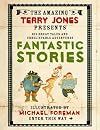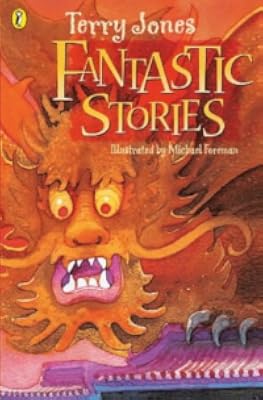
Fantastic Stories
by Terry Jones
On This Page
Description
A collection of stories, mostly original fairy tales, including "The Dragon on the Roof," "Eyes-All-Over," "The Flying King," and "Touch the Moon."Tags
Recommendations












Member Reviews
Though unable to speak German I once acquired a modern edition of Sebastian Brandt’s 1494 satire Das Narrenschiff or 'Ship of Fools', mainly because it was illustrated with distinctive woodcuts, many by Albrecht Dürer. A fruitless search for my mislaid copy was prompted by the first story in this short story collection by Terry Jones (whose sobriquet seems destined to forever remain ‘former Python’): naturally this was a tale called ‘The Ship of Fools’. Medievalist that he is, author of Who Murdered Chaucer? and Chaucer’s Knight, he won’t have lightly chosen this tale to head this collection without a reason.
At first the story appears tedious, too childish even for a children’s book: an incompetent crew led by an show more idiotic Captain, Bosun and First Mate set sail for an unknown destination, accompanied by just one wise young man, Ben. The ship goes from disaster to disaster due to contrary decisions and nonsensical actions until the sensible Ben, faced with no other choice for they won’t listen to reason, abandons them to their fates. And that’s it. What’s the point of this homily? A parody of the British children’s cartoon Captain Pugwash, itself a parody? Maybe it’s a closet criticism of political leadership at the time this book was published following a decade and more of Conservative rule? Or it is merely a whimsically comic tale with no overt message?
For me ‘The Ship of Fools’ is clearly setting out the author’s stall for the following stories (nine in total selected for this edition) with, as their overall theme, the possibility of gaining wisdom from life experiences. Can one learn the right lessons from mistakes, from making the wrong decisions? Or are we, like the supposed adults on the ship of fools, happy to make a hash of life with no thought for the consequences? Is this perhaps too weighty a message to load onto a children’s book? I don’t think so – after all, both the literary fairy tale and the traditional folktale often concluded with a moral, either explicit or implied.
‘The Dragon on the Roof’ concerns an aged Chinese dragon that has landed on the home of a merchant. Concerned to eradicate this ‘threat’ (the dragon is doing little harm, and will soon die anyway) the Emperor seeks a dragon-slayer to ensure that he becomes the most popular ruler ever of China as a result. Is this not a reference to British patriotic fervour attendant on Margaret Thatcher’s defeat of Argentina over the Falkland Islands, the Argentine Malvinas? The moral, surely, is that successful rulers distract the downtrodden population with victory in war.
More parochial tales follow. ‘The Star of the Farmyard’ details the attempts by Charlemagne the cockerel to steer Stanislav the performing farm dog towards a lucrative career, with disappointing if not disastrous results. I see a commentary here on agents ill-advisedly pushing their artists towards inappropriate audiences. Later in the collection ‘Eyes-All-Over’ is about an individual whose ability to see from different parts of his body allow him to view the immediate past, distant events, other people’s mistakes and hopes and, finally, the future that will never happen. Despite all these gifts Eyes-All-Over cares only about gold and riches, not other people. This leads him to severely exploit one particular individual who throws herself on his goodwill; too late he discovers that he should have valued human relationships above material goods. The final piece in the collection -- in the style of a Kipling Just So story – reminds the reader that pride often comes before a fall: ‘How the Badger Got its Stripes’ (and, incidentally, its thief’s mask facial markings) is also in the tradition of Aesop and all those medieval morality tales involving anthropomorphised animals.
Three pieces that come closest to literary fairy tales all have a touch of Joan Aiken about them, taking well-known tropes and subtly subverting them to create beautiful but bittersweet tellings. A variation on the Snow White motif, ‘The Improving Mirror’ relates how a looking-glass has the power to make the viewer see themselves as more beautiful than they are. The already attractive but heartless Queen Pavona – the name, though the same as an Italian town and a kind of coral, is likely to be derived from pavo, the peacock – keeps it to herself. When the distraught king her husband commands the inventor of the mirror to substitute the reflection for the real queen, unforeseen consequences result; one moral is surely Don’t inflate the vanity of those already vain enough, but there are other morals too.
As well as Kipling, Jones invokes Hans Christian Anderson. In ‘The Mermaid who Pitied a Sailor’ we hear how the mermaid Varina (a Slovak word, meaning ‘foreigner’) rescues the Cabin Boy from drowning, trying to keep him as a kind of pet. What she and her kind don’t realised is that it is their siren calls that lure sailors to their doom. Unusually for such as tale, which in Anderson’s telling, la Motte Fouqué’s Undine, folktales and medieval legends about a water sprite often end unhappily, Jones’ version does end with a heart-warming conclusion.
‘Forget-Me-Nuts’ returns to a bittersweet note. The nuts in questions allow one to ignore the trials and tribulations of everyday life, and the king consumes them by the bagful. But such a drug – for drug it surely is – brings a disconnect with the real world. The Key of Memory, an object obtained only after a quest, furnishes the only route to reality, but at a cost: it can bring happiness but also grief. Last but not least is ‘The Snow Baby’, another tale which, as well as having a touch of Raymond Briggs’ The Snowman about it, uses a motif from Snow White: the childless woman who wishes for what she appears unable to have. Set at the magical time of Christmas, the last of Jones’ tales impresses us with the thought that lasting happy memories can come from short-lived miracles: an optimistic message to retain after so many other examples of human foolishness.
This edition was produced for Nestlé, which in 2003 was still sponsoring the Smarties Prize for Children's Literature. While the original 1992 hardback included more tales (and colour, not monochrome, illustrations by Michael Foreman) this selection is exquisite and surprisingly varied, from funny to shocking and silly to serious. To some adults they may be slight but I found them profound; how its target audience finds them I'm no longer of an age to say, but somehow I don't think youngsters would be all at sea with them.
http://wp.me/s2oNj1-jones show less
At first the story appears tedious, too childish even for a children’s book: an incompetent crew led by an show more idiotic Captain, Bosun and First Mate set sail for an unknown destination, accompanied by just one wise young man, Ben. The ship goes from disaster to disaster due to contrary decisions and nonsensical actions until the sensible Ben, faced with no other choice for they won’t listen to reason, abandons them to their fates. And that’s it. What’s the point of this homily? A parody of the British children’s cartoon Captain Pugwash, itself a parody? Maybe it’s a closet criticism of political leadership at the time this book was published following a decade and more of Conservative rule? Or it is merely a whimsically comic tale with no overt message?
For me ‘The Ship of Fools’ is clearly setting out the author’s stall for the following stories (nine in total selected for this edition) with, as their overall theme, the possibility of gaining wisdom from life experiences. Can one learn the right lessons from mistakes, from making the wrong decisions? Or are we, like the supposed adults on the ship of fools, happy to make a hash of life with no thought for the consequences? Is this perhaps too weighty a message to load onto a children’s book? I don’t think so – after all, both the literary fairy tale and the traditional folktale often concluded with a moral, either explicit or implied.
‘The Dragon on the Roof’ concerns an aged Chinese dragon that has landed on the home of a merchant. Concerned to eradicate this ‘threat’ (the dragon is doing little harm, and will soon die anyway) the Emperor seeks a dragon-slayer to ensure that he becomes the most popular ruler ever of China as a result. Is this not a reference to British patriotic fervour attendant on Margaret Thatcher’s defeat of Argentina over the Falkland Islands, the Argentine Malvinas? The moral, surely, is that successful rulers distract the downtrodden population with victory in war.
More parochial tales follow. ‘The Star of the Farmyard’ details the attempts by Charlemagne the cockerel to steer Stanislav the performing farm dog towards a lucrative career, with disappointing if not disastrous results. I see a commentary here on agents ill-advisedly pushing their artists towards inappropriate audiences. Later in the collection ‘Eyes-All-Over’ is about an individual whose ability to see from different parts of his body allow him to view the immediate past, distant events, other people’s mistakes and hopes and, finally, the future that will never happen. Despite all these gifts Eyes-All-Over cares only about gold and riches, not other people. This leads him to severely exploit one particular individual who throws herself on his goodwill; too late he discovers that he should have valued human relationships above material goods. The final piece in the collection -- in the style of a Kipling Just So story – reminds the reader that pride often comes before a fall: ‘How the Badger Got its Stripes’ (and, incidentally, its thief’s mask facial markings) is also in the tradition of Aesop and all those medieval morality tales involving anthropomorphised animals.
Three pieces that come closest to literary fairy tales all have a touch of Joan Aiken about them, taking well-known tropes and subtly subverting them to create beautiful but bittersweet tellings. A variation on the Snow White motif, ‘The Improving Mirror’ relates how a looking-glass has the power to make the viewer see themselves as more beautiful than they are. The already attractive but heartless Queen Pavona – the name, though the same as an Italian town and a kind of coral, is likely to be derived from pavo, the peacock – keeps it to herself. When the distraught king her husband commands the inventor of the mirror to substitute the reflection for the real queen, unforeseen consequences result; one moral is surely Don’t inflate the vanity of those already vain enough, but there are other morals too.
As well as Kipling, Jones invokes Hans Christian Anderson. In ‘The Mermaid who Pitied a Sailor’ we hear how the mermaid Varina (a Slovak word, meaning ‘foreigner’) rescues the Cabin Boy from drowning, trying to keep him as a kind of pet. What she and her kind don’t realised is that it is their siren calls that lure sailors to their doom. Unusually for such as tale, which in Anderson’s telling, la Motte Fouqué’s Undine, folktales and medieval legends about a water sprite often end unhappily, Jones’ version does end with a heart-warming conclusion.
‘Forget-Me-Nuts’ returns to a bittersweet note. The nuts in questions allow one to ignore the trials and tribulations of everyday life, and the king consumes them by the bagful. But such a drug – for drug it surely is – brings a disconnect with the real world. The Key of Memory, an object obtained only after a quest, furnishes the only route to reality, but at a cost: it can bring happiness but also grief. Last but not least is ‘The Snow Baby’, another tale which, as well as having a touch of Raymond Briggs’ The Snowman about it, uses a motif from Snow White: the childless woman who wishes for what she appears unable to have. Set at the magical time of Christmas, the last of Jones’ tales impresses us with the thought that lasting happy memories can come from short-lived miracles: an optimistic message to retain after so many other examples of human foolishness.
This edition was produced for Nestlé, which in 2003 was still sponsoring the Smarties Prize for Children's Literature. While the original 1992 hardback included more tales (and colour, not monochrome, illustrations by Michael Foreman) this selection is exquisite and surprisingly varied, from funny to shocking and silly to serious. To some adults they may be slight but I found them profound; how its target audience finds them I'm no longer of an age to say, but somehow I don't think youngsters would be all at sea with them.
http://wp.me/s2oNj1-jones show less
Ratings
Members
- Recently Added By
Author Information

84+ Works 20,552 Members
Terry Jones was born in Colwyn Bay, Wales on February 1, 1942. He was a writer for such BBC programs as The Frost Report and Do Not Adjust Your Set, before joining with Graham Chapman, John Cleese, Eric Idle, and Michael Palin to form the Monty Python comedy troupe. Best remembered as the nude organist, Jones co-directed Monty Python and the Holy show more Grail (1975), and directed Life of Brian (1979) and Monty Python's The Meaning of Life (1983). Along with many Python-related books, screenplays, and records, he has written several non-fiction works including Chaucer's Knight: The Portrait of a Medieval Mercenary, Who Murdered Chaucer?: A Medieval Mystery, and Terry Jones's War on the War on Terror. He also wrote numerous children's books including The Saga of Erik the Viking, which won the Children's Book Award in 1984, Fantastic Stories, The Beast with a Thousand Teeth, The Curse of the Vampire Socks, and Bedtime Stories. (Bowker Author Biography) show less
All Editions
Common Knowledge
- Original publication date
- 1992
- First words
- "The Ship of Fools"
A young boy named Ben once ran away to sea. - Last words
- (Click to show. Warning: May contain spoilers.)"Nicobobinus and the Doge of Venice"
"Ah!" said Nicobobinus. "That would be telling . . . "
Classifications
- Genres
- Fiction and Literature, Children's Books
- DDC/MDS
- 823.914 — Literature & rhetoric English & Old English literatures English fiction 1900- 1901-1999 1945-1999
- LCC
- PZ8 .J555 .F — Language and Literature Fiction and juvenile belles lettres Fiction and juvenile belles lettres Juvenile belles lettres
- BISAC
Statistics
- Members
- 153
- Popularity
- 214,646
- Reviews
- 1
- Rating
- (3.36)
- Languages
- English
- Media
- Paper, Ebook
- ISBNs
- 10
- ASINs
- 4