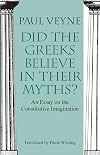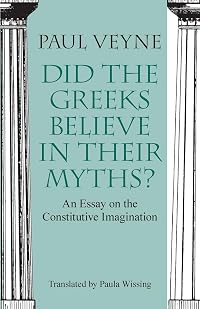
Did the Greeks Believe in Their Myths?: An Essay on the Constitutive Imagination
by Paul Veyne
On This Page
Description
"[Veyne's] present book has some kinship with his sprightly theoretical work Comment on ecrit l'histoire; and he declares that its aim was to provoke reflection on the way our conception of truth is built up and changes over the centuries. . . . The style is brilliant and exhilarating."—Jasper Griffin, Times Literary SupplementTags
Recommendations













Member Reviews
Not an easy book, not at all. Of course, that is a consequence of the subject, or rather the question posed: did the Greeks believe their own myths, did they think they were truly true? Anyone expecting a straightforward answer to this question will be disappointed. The French historian of antiquity, Paul Veyne (1930-2022), rightly points out that concepts like "belief in/of" or "truth" are problematic in themselves, because what exactly do we mean by them? This is therefore, to a certain extent, more of a philosophical book that probes the relationship between representation and reality, and thus inevitably falls within the postmodernist sphere.
Veyne primarily examines the work of the historians of antiquity, with Herodotus, Polybius, show more and Pausanias prominently featured. Through various winding paths, he arrives at the proposition that the Greeks knew that the mythical stories weren't exactly true, as we now understand "true," but they did believe in them, in the sense that they saw them as a coherent whole that made it possible to interpret reality in a way they found transparent and plausible (Veyne uses the term "allegorical"). From this perspective, "believing in/in" comes to mean something quite different than we generally understand in our culture, marked by Jewish exclusivism and Christian dogmatism.
I don't know if "allegorical" is entirely accurate. Because that's where I find a weakness in this book: Veyne refers primarily to texts and narratives when referring to myths, thereby ignoring the broader field of rituals and cults. Perhaps he would have found a shorter path to his conclusion if he had included that in his research. Because in my view rituals and cults – more than stories or texts – are ways to make sense of the surrounding, chaotic reality. They offer greater proximity and consequently more security (in the sense of peace of mind, or knowing where one belongs to) than the more cerebral aspect of narratives. And precisely that security, literally the feeling of being situated in reality, is one of the most important existential needs. Ultimately, what Veyne writes about the difference between believing in/about and being true is correct, but at the same time, he ignores a significant part of human culture. show less
Veyne primarily examines the work of the historians of antiquity, with Herodotus, Polybius, show more and Pausanias prominently featured. Through various winding paths, he arrives at the proposition that the Greeks knew that the mythical stories weren't exactly true, as we now understand "true," but they did believe in them, in the sense that they saw them as a coherent whole that made it possible to interpret reality in a way they found transparent and plausible (Veyne uses the term "allegorical"). From this perspective, "believing in/in" comes to mean something quite different than we generally understand in our culture, marked by Jewish exclusivism and Christian dogmatism.
I don't know if "allegorical" is entirely accurate. Because that's where I find a weakness in this book: Veyne refers primarily to texts and narratives when referring to myths, thereby ignoring the broader field of rituals and cults. Perhaps he would have found a shorter path to his conclusion if he had included that in his research. Because in my view rituals and cults – more than stories or texts – are ways to make sense of the surrounding, chaotic reality. They offer greater proximity and consequently more security (in the sense of peace of mind, or knowing where one belongs to) than the more cerebral aspect of narratives. And precisely that security, literally the feeling of being situated in reality, is one of the most important existential needs. Ultimately, what Veyne writes about the difference between believing in/about and being true is correct, but at the same time, he ignores a significant part of human culture. show less
A brief look at the nature of belief and the nature of historical study. This work is very valuable as a way of examining the different methods of doing history in antiquity as compared to the present, and the difference between believing in something and reporting something as true. It's an easy read, without all the obfuscation that often plagues books of this nature, although it is perhaps too redundant (in spite of being very short). It loses a half a star for the constant insistence that all truth is relative, and everything is true; scientific truths have no more claim to describe reality than any other truths. Not only is this demonstrably untrue, but he himself hits the usual brick wall that characterizes this point of view: show more when confronted with a view he can't stomach, he is willing to dismiss that view and deny it the status of truth that he grants to 'everything' (i.e., the claim by some of an ahistorical Christ; also, a handful of the balmier pseudosciences). Still, an interesting read, even though the author sort of waffles the title question. Favorite quote: "Historians are merely prophets in reverse". show less
Pas tout lu, mais beaucoup appris en peu de pages...
Feb 13, 2011French
Ratings
Members
- Recently Added By
Lists

Story/Myth Reading List
25 works; 1 member
Author Information

Series
Belongs to Publisher Series
Common Knowledge
- Canonical title*
- I greci hanno creduto ai loro miti?
- Original title
- Les Grecs ont-ils cru à leurs mythes?
- Original publication date
- 1983
- Dedication
- To Estelle Blanc...Que um conjunto real e verdadeiro é uma doença das nossas ideias. Pessoa
- First words
- There is a good reason why the ancient historians rarely offer us the opportunity to ascertain whether they make a distinction between primary and secondary sources.
- Last words
- (Click to show. Warning: May contain spoilers.)We have simply wanted also to make it clear that what is true of "them" is also true of ourselves and to bring out the implications of this primary truth.
- Publisher's editor
- Griffin, Jasper
*Some information comes from Common Knowledge in other languages. Click "Edit" for more information.
Classifications
- Genres
- Nonfiction, History, Religion & Spirituality, General Nonfiction, Philosophy, Literature Studies and Criticism
- DDC/MDS
- 292.13 — Religion Other religions Greek & Roman Mythology Religious mythology, general classes of religion, interreligious relations and attitudes, social theology Mythology and mythological foundations
- LCC
- BL782 .V4713 — Philosophy, Psychology and Religion Religions. Mythology. Rationalism Religions. Mythology. Rationalism History and principles of religions European. Occidental Classical (Etruscan, Greek, Roman)
- BISAC
Statistics
- Members
- 343
- Popularity
- 92,157
- Reviews
- 3
- Rating
- (3.63)
- Languages
- 8 — English, Estonian, French, German, Italian, Portuguese, Slovenian, Spanish
- Media
- Paper
- ISBNs
- 12
- ASINs
- 1