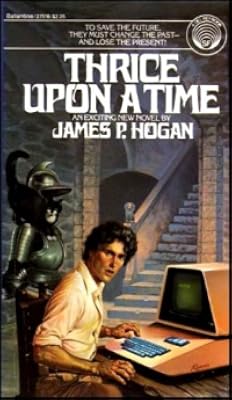
Thrice Upon a Time
by James P. Hogan
On This Page
Description
SOS FROM A FUTURE THAT WILL NEVER BE It's amazing enough when Murdoch Ross's brilliant grandfather invents a machine that can send messages to itself in the past or the future. But when signals begin to arrive without being sent, Murdoch realizes that every action he takes changes the future that would have been...and that the world he lives in has already been altered! Then a new message arrives from the future: "The world is doomed!"Tags
Recommendations


















Member Reviews
Uggh. Couldn't finish it. As others have already stated, this would have been a good short story but instead Hogan subjects us to 300 pages of pedantic lectures with very little "story" to smooth things along. Plus the overuse of descriptors (if you can describe a house or bank of equipment using one paragraph, why not use ten?!) had me skimming page after page. Those with an intellectual interest in the paradoxes associated with time travel might enjoy the arguments he sets forth but I found the whole thing meandering and dry as dust. Maybe it got better eventually? I guess I'll never know.
(Original Review, 1980-11-06)
The most well thought out model of time-travel I have ever seen in a novel was in Hogan's "Thrice Upon a Time". This book ascribes to the "reset" theory of world-lines; if you send a message into the past (no matter travels cross-time in this book but it doesn't seem to be ruled out) that says "kill me, I am about to do something very rude in the present, and I should really be stopped", then the people back then get to act on the information while you wait in the present, with your teeth clenched, for the effects of your message to ripple forward and absolve (dissolve?) you. Time travels at several rates herein. From your point of view you are waiting for the world-line to readjust (a somewhat faster show more process than normal forward running since only the new ripples have to be worked in). From the point of view of your cohorts in the past, they are living just like they normally would. What bothered me about this model is that it made actions free, with no consequences. For example, X makes a boo-boo that will ultimately destroy the world, and sends a message into the past to warn the earlier version of X not to make that mistake. It turns the whole universe into a big experiment. You don't like the results, you change it before it happened. (Imagine the amusement parks. You can become "torturer for a day" and can even tell yourself about all the fun you had before that version of you gets erased and the normal reality gets reinstated.)
I would add the following wrinkle: Rather than have realities disappear, let them stay around. What I am getting at is a bubble theory of reality. There is a time-line (call it super-time) which numbers all possible moments in the universe. Life progresses from one number to the next just as we are used to. If you go back in time from moment 55 to moment 23 and kill your grandmother, great. She's dead, and a bubble starts moving up from 23 in which you is never born. Meanwhile, up at time 55, your home reality is happily progressing, complete with a confused and guilty you in it who has pre-formed this sickening deed and has returned to find the same old grind. You don't have her inheritance. In fact, the old bag is still hopping around. (The effects don't propagate that way.) This doesn't mean that one bubble can't effect another. You can communicate with the future (or the past) by just setting your transmitter to T+22,000 (or to T-22,000). For as long as you talk, the same guy will be at the other end of the line.
One curious thing about this model is that past becomes a resource which is constantly consumed. The reason is that whenever a bubble gets started, it gradually overwrites each successive moment of super-time. Once overwritten, their old contents are gone, and your precious past has been consumed as though in a fire.
Maybe I should write to Hogan about a new book. Then again, is he on the net?
[2018 EDIT: This review was written at the time as I was running my own personal BBS server. Much of the language of this and other reviews written in 1980 reflect a very particular kind of language: what I call now in retrospect a “BBS language”.] show less
The most well thought out model of time-travel I have ever seen in a novel was in Hogan's "Thrice Upon a Time". This book ascribes to the "reset" theory of world-lines; if you send a message into the past (no matter travels cross-time in this book but it doesn't seem to be ruled out) that says "kill me, I am about to do something very rude in the present, and I should really be stopped", then the people back then get to act on the information while you wait in the present, with your teeth clenched, for the effects of your message to ripple forward and absolve (dissolve?) you. Time travels at several rates herein. From your point of view you are waiting for the world-line to readjust (a somewhat faster show more process than normal forward running since only the new ripples have to be worked in). From the point of view of your cohorts in the past, they are living just like they normally would. What bothered me about this model is that it made actions free, with no consequences. For example, X makes a boo-boo that will ultimately destroy the world, and sends a message into the past to warn the earlier version of X not to make that mistake. It turns the whole universe into a big experiment. You don't like the results, you change it before it happened. (Imagine the amusement parks. You can become "torturer for a day" and can even tell yourself about all the fun you had before that version of you gets erased and the normal reality gets reinstated.)
I would add the following wrinkle: Rather than have realities disappear, let them stay around. What I am getting at is a bubble theory of reality. There is a time-line (call it super-time) which numbers all possible moments in the universe. Life progresses from one number to the next just as we are used to. If you go back in time from moment 55 to moment 23 and kill your grandmother, great. She's dead, and a bubble starts moving up from 23 in which you is never born. Meanwhile, up at time 55, your home reality is happily progressing, complete with a confused and guilty you in it who has pre-formed this sickening deed and has returned to find the same old grind. You don't have her inheritance. In fact, the old bag is still hopping around. (The effects don't propagate that way.) This doesn't mean that one bubble can't effect another. You can communicate with the future (or the past) by just setting your transmitter to T+22,000 (or to T-22,000). For as long as you talk, the same guy will be at the other end of the line.
One curious thing about this model is that past becomes a resource which is constantly consumed. The reason is that whenever a bubble gets started, it gradually overwrites each successive moment of super-time. Once overwritten, their old contents are gone, and your precious past has been consumed as though in a fire.
Maybe I should write to Hogan about a new book. Then again, is he on the net?
[2018 EDIT: This review was written at the time as I was running my own personal BBS server. Much of the language of this and other reviews written in 1980 reflect a very particular kind of language: what I call now in retrospect a “BBS language”.] show less
I'm afraid I agree with an Amazon review I saw that this would have done much better as a short story or novella. This is a work of hard science fiction, with an emphasis on hard science and not so good on the fiction. Hogan has done better--I quite liked his characters in Realtime Interrupt, but here, although it's a great idea, I just don't find the ideas compelling enough to make up for a weak plot and characters. This isn't the usual time travel book and I do appreciate all the thought Hogan put into grounding his concept--no, wait, excuse me, I lied. I don't appreciate all the time spent grounding the concept. I was bored. Very little other than the breaking/not breaking of a jar happens for the first hundred pages. I did like the show more Scottish setting--it made for a nice change compared to all the American (or America in Space) settings you usually see in science fiction. But this just never came alive for me, no matter how clever the overall concept. show less
A great read from the early eighties, which is when I first read it. The work has aged well. Totally convincing resolution of the time-traveler paradox.
This book was good. It did take me time to get into the story because there was so much technical / programming stuff. But once I got the hang of that it was good. Usually if I cannot get into the book fast enough I give up and move on. This story kept me hooked however and is worth the read.
A reasonably good and intriguing science fiction story involving wrinkles in time that occur when a scientist figures out that every process generates a very small amount of energy that is sent back in time, and that this can be used to send messages back, possibly even altering the time of the sender. Good basic science fiction, with nice characterization.
got to p. 44 of the 310 p. edition, went to GR to find out whether I should keep struggling, decided not to.... apparently this takes 'exploration of ideas' too far and just dumps any pretense of story or characterization.... sorry
Members
- Recently Added By
Lists

Best Time Travel Novels
165 works; 125 members
Author Information

78+ Works 11,739 Members
James P. Hogan was born in London on June 27, 1941. He left school at the age of sixteen and eventually began an intensive, broad-based five-year program at the Royal Aircraft Establishment covering the practical and theoretical sides of electrical, electronic, and mechanical engineering. He worked as a design engineer for several companies before show more moving to sales. He started writing science fiction books in the 1970s and became a full-time writer in 1979. He wrote 30 fiction and non-fiction books during his lifetime including Inherit the Stars, Voyage from Yesteryear, and Kicking the Sacred Cow. He won three Seiun-sho awards, which were voted for by Japanese science fiction fans. He died suddenly on July 12, 2010 at the age of 69. (Bowker Author Biography) show less
Some Editions
Series
Belongs to Publisher Series
Colecção Argonauta (377)
Moewig Science Fiction (3661)
Common Knowledge
- Canonical title*
- Mensagem Do Futuro
- Original title
- Thrice upon a Time
- Original publication date
- 1980
- Dedication
- To all at Del Rey Books --- the other half of the team who never get mentioned on the cover.
- First words
- The digits, glowing bright red in the upper corner of the computer display screen, changed silently to count off the final seconds. - - Prologuel
- Quotations
- The Americans seemed to get things done while the rest of the world found time to think about what it all meant, and therefore to criticize.
- Last words
- (Click to show. Warning: May contain spoilers.)Naturally . . .
- Original language
- English
*Some information comes from Common Knowledge in other languages. Click "Edit" for more information.
Classifications
Statistics
- Members
- 669
- Popularity
- 43,119
- Reviews
- 10
- Rating
- (3.64)
- Languages
- English, German, Portuguese (Portugal)
- Media
- Paper, Audiobook, Ebook
- ISBNs
- 9
- ASINs
- 6