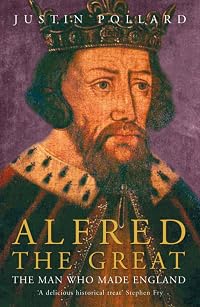
Alfred the Great: The Man Who Made England
by Justin Pollard
On This Page
Description
Alfred was England's first king. His rule spanned troubled times: his shores were under constant threat from Viking marauders and his life was imperilled by conspiracies in his own court. But he was an extrordinary character - a soldier, scholar and statesman like no other in English history - and out of adversity he forged a new type of nation.Tags
Recommendations












Member Reviews
This is a marvellously readable account of the life and reign of a king justly called the Great (though that appellation was first used only 700 years after his life). One can get an impression of the real voice and thoughts of Alfred from his commentaries on his translations into English of classic religious and secular works, which is a unique contribution we possess whether from this era, or many later ones. He truly laid down the foundations for the England of later centuries in terms of national defence, territorial unity, a clear line of royal descent, as well as modern government, literacy and education. He fully deserves his appellation.
During the Anglo-Saxon period there existed an institution called the witan-- an assembly of elders who could remove an inept or unpopular king. Think about that for a minute.
The Ninth Century in what is now England met the definition set by Hobbes. It was panicky and bad. Suddenly on the horizon, longships! Matters were now worse. Or were they, in terms of the longue duree Braudel asserts elsewhere that the marauding of the Vikings removed wealth from such intense concentration and helped distribute such, which likely inspired artisanal efforts and possibly investment. The Danish kickstart of the swerve or Renaissance is left under-reported. The Danes trading networks for the Berber coast to the House of Rurik can't be ignored.
Well, show more anyway, there were a number of kingdoms in that nascent England and Alfred was the youngest of the heirs. Attrition was common in the Anglo-Saxon era and before Bob's your uncle, he's king. He proceeds with caution and prefers negotiations with the Danes, unfortunately this drains the coffers and suddenly the witan toss him aside and the Vikings are invited in to the vacuum to stabilize. Alfred lives in the woods for a while and becomes a folk hero of sorts. There's a popular revolt and Alfred is back. Populism has been the coin of many realms. Well, all of this from a Welsh scribe named Asser, who happened to be in the employ of Good King Alfred.
Learning from the repeated Viking raids and plunder, Alfred institutes a civil defense network, he invites intellectuals to his side and begins some serious nation building, including legal codes and the promotion of literacy. He also modernized their navy and consequently the Danes left, or did they? I hear you knocking, Norman Invasion show less
The Ninth Century in what is now England met the definition set by Hobbes. It was panicky and bad. Suddenly on the horizon, longships! Matters were now worse. Or were they, in terms of the longue duree Braudel asserts elsewhere that the marauding of the Vikings removed wealth from such intense concentration and helped distribute such, which likely inspired artisanal efforts and possibly investment. The Danish kickstart of the swerve or Renaissance is left under-reported. The Danes trading networks for the Berber coast to the House of Rurik can't be ignored.
Well, show more anyway, there were a number of kingdoms in that nascent England and Alfred was the youngest of the heirs. Attrition was common in the Anglo-Saxon era and before Bob's your uncle, he's king. He proceeds with caution and prefers negotiations with the Danes, unfortunately this drains the coffers and suddenly the witan toss him aside and the Vikings are invited in to the vacuum to stabilize. Alfred lives in the woods for a while and becomes a folk hero of sorts. There's a popular revolt and Alfred is back. Populism has been the coin of many realms. Well, all of this from a Welsh scribe named Asser, who happened to be in the employ of Good King Alfred.
Learning from the repeated Viking raids and plunder, Alfred institutes a civil defense network, he invites intellectuals to his side and begins some serious nation building, including legal codes and the promotion of literacy. He also modernized their navy and consequently the Danes left, or did they? I hear you knocking, Norman Invasion show less
Pollard does an excellent job bringing a medieval figure to life, which is not an easy task. With very few contemporary sources and even fewer solidly reliable ones, Alfred's character is easily obscured by the ages that have passed since his reign. This book does a fine job of making Alfred seem more human and less like a myth or legend. A great pick for the casual historian.
Ratings
Members
- Recently Added By
Lists

al.vick-wishlist-history
70 works; 2 members
Author Information

12+ Works 1,365 Members
Common Knowledge
- Canonical title
- Alfred the Great: The Man Who Made England
- People/Characters
- Alfred the Great
Classifications
- Genres
- History, Nonfiction, General Nonfiction, Biography & Memoir
- DDC/MDS
- 942.0164092 — History & geography History of Europe England and Wales England Anglo-Saxon B.C. 55 - A.D. 1066 Alfred the Great
- LCC
- DA153 .P77 — History of Europe, Asia, Africa and Oceania Great Britain History of Great Britain England History By period Early and medieval to 1485 Celts. Romans. Saxons. Danes. Normans
- BISAC
Statistics
- Members
- 228
- Popularity
- 142,942
- Reviews
- 3
- Rating
- (4.02)
- Languages
- English
- Media
- Paper
- ISBNs
- 3