The Microscripts
by Robert Walser
On This Page
Description
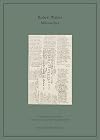
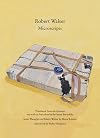
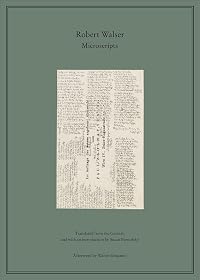
Robert Walser wrote many of his manuscripts in a highly enigmatic, shrunken-down form. These narrow strips of paper, covered with tiny ant-like pencil markings a millimeter high, came to light only after the author's death in 1956.At first considered random restless pencil markings or a secret code, the microscripts were in time discovered to be a radically miniaturized form of antique German script: a whole story was deciphered on the back of a business card. These twenty-five shortpieces show more address schnapps, rotten husbands, small town life, elegant jaunts, the radio, swine, jealousy, and marriage proposals. show lessTags
Recommendations

























Member Recommendations

Member Reviews
Assuming I do not lie, she wept with joy, although quite possibly she did so for some other reason.("Assuming I do not lie" is the best clause to start off any sentence)
Obviously, this work has hip-appeal and almost Herzog-like marketability with its back-story. In case you haven't heard it yet: Walser spent many of his waning years writing in a kind of tiny hieroglyphic code that only he understood on the back of slips, envelopes, napkins, strips of paper, and whatnot. It took them 35 years to decode (and they still haven't decoded them all), and the contents of this book is the result of those snippets translated PLUS beautiful facsimiles of the original pieces of paper each story was written on.
The actual pieces are dizzying in the show more way they twist about. It is hard enough to follow one sentence of his, much less a whole sketch, which moves quickly from topic to topic. There is a sense that he tossed these off without much thought, although this casualness is coupled with his typical ornate overblown formality of style to a very strange effect. I find these pieces generally much more complicated and dense (on the sentence-level) than his early novels like [book:The Assistant|335333], there is a sense of over-crowdedness here.
The casual manner in which I loved my beloved, who was forever distinguishing herself by her utter absence, resembled a soft-swelling, enchanting sofa.Walter Benjamin writes an afterword to this book, and it has some great insights which I will now share with you.
Exhibit 1.
For we can set our minds at rest by realizing that to write yet never correct what has been written implies both the absence of intention and the most fully considered intentionality
Exhibit 2.
Everything seems to be on the verge of disaster; a torrent of words pours from him in which the only point of every sentence is to make the reader forget the previous one.
Exhibit3.
The tears they shed are his prose. For sobbing is the melody of Walser's loquaciousness. It reveals to us where his favorite characters come from--namely, from insanity and nowhere else. They are figures who have left madness behind them, and this is why they are marked by such a consistently heartrending, inhuman superficiality.show less
3.5 Hard to rate. Strange and beautiful, these fragments are 2-3 stars without the back story, but 5+ as micro-miniature objects. Worth it for the reproductions.
Lovely. Strange.
My thoughtful criticism and review can be read here:
http://mewlhouse.hubpages.com/hub/Getting-To-Be-Of-Some-Moment
http://mewlhouse.hubpages.com/hub/Getting-To-Be-Of-Some-Moment
Ratings
Members
- Recently Added By
Published Reviews
ThingScore 100
The caffeinated writer and the sleepy writer share the aspiration to be, essentially, not themselves. Which is to say that the creative method is that of vanishing, of disappearing from the drafting table. Robert Walser made of that method—vanishing by whatever means—a kind of art all unto itself. And the paradox is that by becoming so small, so quiet, so penciled, Walser became vast, show more indelible. show less
added by Shortride
Lists

Very short stories
39 works; 2 members
Author Information

274+ Works 6,984 Members
Some Editions
Awards and Honors
Awards
Common Knowledge
- Original publication date
- 1985 (original German) (original German); 2010 (English: Bennofsky) (English: Bennofsky)
Classifications
- Genres
- Fiction and Literature, General Fiction
- DDC/MDS
- 833.912 — Literature & rhetoric German & related literatures German fiction 1900- 1900-1990 1900-1945
- LCC
- PT2647 .A64 .A2 — Language and Literature German, Dutch and Scandinavian literatures German literature Individual authors or works 1860/70-1960
- BISAC
Statistics
- Members
- 303
- Popularity
- 105,645
- Reviews
- 4
- Rating
- (4.10)
- Languages
- English, French, German
- Media
- Paper
- ISBNs
- 5
- ASINs
- 3