A Tour on the Prairies
by Washington Irving
On This Page
Description
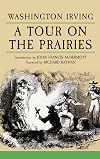
In 1832, Washington Irving, America's first literary superstar, returned to the United States after seventeen years abroad and swiftly set out to explore Pawnee country--the wild uncharted territory deep in the young nation's interior. It was a part of the country few white men had set foot in and even fewer had written about it--and certainly none as famous as Irving. Owing to a chance encounter on a steamboat with the newly appointed Indian Commissioner, and embracing an opportunity to show more silence critics who had begun to doubt his patriotism (after so much time abroad), Irving finds himself sleeping under the stars, traversing hostile plains, and venturing blindly into the unknown. He discovers a certain kind of tranquility in the open air and relishes the traditions and culture of the Pawnee. Irving kept a daily account of his excursion into what is now Oklahoma, and upon his return home, spun this fabulously entertaining and groundbreaking work. With unparalleled descriptions of the natural terrain--a land of giant flowing rivers and endless golden plains--and vivid depictions of the lives in Native Americans, A Tour on the Prairies stands as a classic portrait of what life was like out West before chronic warfare left the plains and the population decimated. Irving's book became a huge success when it was originally published and quickly silenced critics who questioned his affection for his homeland. show lessTags
Recommendations


















Member Reviews
Washington Irving used the notes from his 1832 tour on the Arkansas and Oklahoma prairie to write this account. As with any good story, he may have stretched the truth here, changed the timing of events there, but overall it dovetails with the journals of his companions. John Francis McDermott wrote the introduction and edited the book, so I am assuming he wrote the footnotes as well. He may know why he felt compelled in the footnotes to tell us what was going to happen in the next chapter or later on, but I don't.
I found this fascinating and difficult at times to read. The feeling that you were there among these men, living this experience was strong, but that is also what made it difficult. To read how they wantonly killed the show more wildlife around them, eating only a little, wasting so much and leaving the pristine wilderness they were traveling through a mess, is hard to stomach in this day and age. It made me wonder what we are wasting because we have a feeling of abundance. Resources? Time? Health? Will we ever learn?
The book is well worth the reading though. There is no doubt about it, Mr. Irving can write. show less
I found this fascinating and difficult at times to read. The feeling that you were there among these men, living this experience was strong, but that is also what made it difficult. To read how they wantonly killed the show more wildlife around them, eating only a little, wasting so much and leaving the pristine wilderness they were traveling through a mess, is hard to stomach in this day and age. It made me wonder what we are wasting because we have a feeling of abundance. Resources? Time? Health? Will we ever learn?
The book is well worth the reading though. There is no doubt about it, Mr. Irving can write. show less
This is excellent. Maybe I am interested in it because it is the first written exploration of the Oklahoma area that is so close to where I live. But I also love it because the language is not so different than what we use today, its not so tongue in cheek as Mark Twain's travelogues, and it explores the beauty of the areas with the creatures and inhabitants that occupied it at the time. I do think that this book set the tone for most of our Western cliches. Interesting to learn that they aren't just Hollywood melodrama, but based in fact.
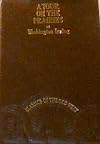
Time-life, leather bound, nice book. I think this is Washington Irvings most interesting and readable work. His jaunt on the praire, seems to typify the social and literary climates of the time. I think to put one of the greatest american writers on one of the greatest american frontiers, is bound to leave a lasting impression. Irving didn't disappoint me in the book. I've read it a couple of times.
This is a 1st edition in it's peculiar 1st state. 12mo [7.5x5in]; [i-ii, missing series general title, "Miscellanies", and imprint], [iii] title, [iv] blank, [v]-xiii, [xiv] blank, [1]- 335 pp., [336] colophon; 3/4 leather binding over dark gray cloth with gilt lettering on black label with gilt rules and device on spine, blind rules along edges of leather, dark brown end papers, all edges trimmed. Some rubbing to all edges and corners, leather worn through on corners, all edges darken with age, front and back hinges cracked but tight, stain spot on leather front cover & detailed bookplate of W. J. Holliday on front end paper. Pages xi and xii are misplaced after xiii, and in ‘Content’ under Chapter XXV the page number 220 is show more mis-numbered 22. This English edition preceded the American edition by one month, and is the true first printing.
BAL 10139; Howes I86; Sabin 35139; Wagner-Camp 56:1
[Wagner-Camp 56:1 noted "Blanck states that this edition consists of two settings: in one setting, the chapter heading XXVI is correctly given in the table of contents (p. xii) and on page 21 is mis-numbered 12; in the other setting, the chapter heading is incorrectly given as XXIV and page 21 is numbered correctly." This book is the first setting].
Washington Irving (1783-1859), acclaimed international writer of Rip Van Winkle (1819) and The Legend of Sleepy Hollow (1820), returned to the United States after 17 years in England at the age of 49, and wanted to see the American frontier. He was accompanied by Charlie Joseph Latrobe, an Englishman, and Alexander de Pourtales, a 19 year old Franco-Swiss Count. They met Judge Henry Leavitt Ellsworth on a Detroit Steamer on Lake Erie, whom President Andrew Jackson appointed to the Board of Commissioners to remove the Southern Indian Tribes west of the Mississippi River. Ellsworth invited the group to join him for a month-long tour of unexplored Indian country (present day Oklahoma). They arrived at the Ft. Gibson to meet a group of Rangers on reconnaissance south to the Red River. Irving was more of a bon vivant than a frontiersman, and this trip was an exciting time of discovery.
Bookplate - William J. Holliday (1895-1977), Indianapolis steel business magnate, spent winters in Tucson, Arizona. He was a compulsive collector with focus on western Americana, Southwest & Mexican history, western expansion & the Gold Rush. In the early 1950's, he donated 7,000 books on the Southwest to the Arizona Historical Society. In 1954, he had a late "mid-life change", remarried, sold the steel business and auctioned his remaining Library. show less
BAL 10139; Howes I86; Sabin 35139; Wagner-Camp 56:1
[Wagner-Camp 56:1 noted "Blanck states that this edition consists of two settings: in one setting, the chapter heading XXVI is correctly given in the table of contents (p. xii) and on page 21 is mis-numbered 12; in the other setting, the chapter heading is incorrectly given as XXIV and page 21 is numbered correctly." This book is the first setting].
Washington Irving (1783-1859), acclaimed international writer of Rip Van Winkle (1819) and The Legend of Sleepy Hollow (1820), returned to the United States after 17 years in England at the age of 49, and wanted to see the American frontier. He was accompanied by Charlie Joseph Latrobe, an Englishman, and Alexander de Pourtales, a 19 year old Franco-Swiss Count. They met Judge Henry Leavitt Ellsworth on a Detroit Steamer on Lake Erie, whom President Andrew Jackson appointed to the Board of Commissioners to remove the Southern Indian Tribes west of the Mississippi River. Ellsworth invited the group to join him for a month-long tour of unexplored Indian country (present day Oklahoma). They arrived at the Ft. Gibson to meet a group of Rangers on reconnaissance south to the Red River. Irving was more of a bon vivant than a frontiersman, and this trip was an exciting time of discovery.
Bookplate - William J. Holliday (1895-1977), Indianapolis steel business magnate, spent winters in Tucson, Arizona. He was a compulsive collector with focus on western Americana, Southwest & Mexican history, western expansion & the Gold Rush. In the early 1950's, he donated 7,000 books on the Southwest to the Arizona Historical Society. In 1954, he had a late "mid-life change", remarried, sold the steel business and auctioned his remaining Library. show less
Ratings
Members
- Recently Added By
Lists

Geography and Travel from The Book-Lover
291 works; 1 member
Author Information

784+ Works 27,069 Members
Washington Irving, one of the first Americans to achieve international recognition as an author, was born in New York City in 1783. His A History of New York, published in 1809 under the name of Diedrich Knickerbocker, was a satirical history of New York that spanned the years from 1609 to 1664. Under another pseudonym, Geoffrey Crayon, he wrote show more The Sketch-book, which included essays about English folk customs, essays about the American Indian, and the two American stories for which he is most renowned--"The Legend of Sleepy Hollow" and "Rip Van Winkle." Irving served as a member of the U.S. legation in Spain from 1826 to 1829 and as minister to Spain from 1842 to 1846. Following his return to the U.S. in 1846, he began work on a five-volume biography of Washington that was published from 1855-1859. Washington Irving died in 1859 in New York. show less
Series
Belongs to Publisher Series
Work Relationships
Common Knowledge
- Canonical title
- A Tour on the Prairies
- Original publication date
- 1835
- People/Characters
- Washington Irving
- Important places
- Oklahoma, USA; United States of America; Western United States
- Dedication
- For "TIA"
Elizabeth Irwin Elder
Classifications
Statistics
- Members
- 160
- Popularity
- 204,797
- Reviews
- 4
- Rating
- (4.00)
- Languages
- English, French
- Media
- Paper, Ebook
- ISBNs
- 16
- ASINs
- 8