On This Page
Tags
Recommendations







Member Reviews
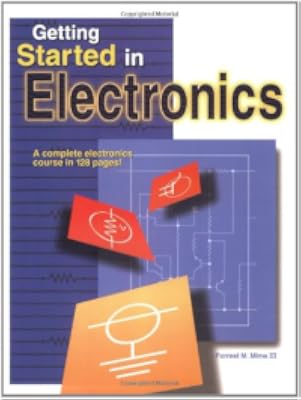
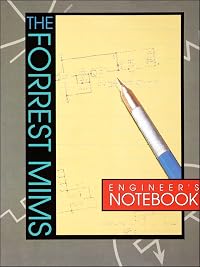
I think this book mislead me more than it taught me. I remember as a kid being frustrated by my inability to make circuits work, and I think this book's simplistic descriptions are partially to blame.
The book emphasizes electron current instead of conventional current, as if this is somehow more instructive or more correct. In fact, depending on the materials the component is made out of, current can be carried by electrons (metal), ions (batteries, electrolytic capacitors, neon lamps), holes (semiconductors), or even free protons (fuel cells). Conventional current abstracts away this distinction between charge carriers so you can focus on the big picture. Teaching everything backwards — as if only electron current matters — just show more confuses things, for no benefit.
The drawings show little electron cartoons jumping out of wires, getting "stuck" inside resistors, being blocked by the field of an FET, or stuck on one side of a thyristor with none being able to get to the other side, etc. This is not how circuits work. A resistor slows down all the current in the entire circuit, not just the electrons on one side of it. Electrons don't all move in unison with each other, they bounce around randomly, and only the net drift of billions of particles matters. It should be thought of as a fluid, not as individual particles. Maybe it would be more fair to say that the book was a little over my head as a kid. But the pictures are misleading, and those are what I focused on at the time.
There are problems with the descriptions, too. Although they make sense to someone already familiar with electronics, the book is aimed at people who aren't. "Ground", for instance, is described as "the point in a circuit at zero voltage, whether or not it's connected to ground". I struggled with these descriptions for years. Only when I got to college did I finally start to learn this stuff, rather than poke in the dark and hope that things worked. (You can pick any point in a circuit and call it ground. It's just a reference point for making voltage measurements, and there are common conventions for which point you should choose. It's as simple as that.)
I think William Beaty's Electricity Misconceptions pages are much better at explaining electricity in an intuitive, but accurate way. show less
The book emphasizes electron current instead of conventional current, as if this is somehow more instructive or more correct. In fact, depending on the materials the component is made out of, current can be carried by electrons (metal), ions (batteries, electrolytic capacitors, neon lamps), holes (semiconductors), or even free protons (fuel cells). Conventional current abstracts away this distinction between charge carriers so you can focus on the big picture. Teaching everything backwards — as if only electron current matters — just show more confuses things, for no benefit.
The drawings show little electron cartoons jumping out of wires, getting "stuck" inside resistors, being blocked by the field of an FET, or stuck on one side of a thyristor with none being able to get to the other side, etc. This is not how circuits work. A resistor slows down all the current in the entire circuit, not just the electrons on one side of it. Electrons don't all move in unison with each other, they bounce around randomly, and only the net drift of billions of particles matters. It should be thought of as a fluid, not as individual particles. Maybe it would be more fair to say that the book was a little over my head as a kid. But the pictures are misleading, and those are what I focused on at the time.
There are problems with the descriptions, too. Although they make sense to someone already familiar with electronics, the book is aimed at people who aren't. "Ground", for instance, is described as "the point in a circuit at zero voltage, whether or not it's connected to ground". I struggled with these descriptions for years. Only when I got to college did I finally start to learn this stuff, rather than poke in the dark and hope that things worked. (You can pick any point in a circuit and call it ground. It's just a reference point for making voltage measurements, and there are common conventions for which point you should choose. It's as simple as that.)
I think William Beaty's Electricity Misconceptions pages are much better at explaining electricity in an intuitive, but accurate way. show less
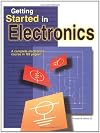
A good introduction to semiconductor electronics, suitable for late secondary / high school students or anyone keen to learn more in later life. The book explains the concepts well in its unique style (handwritten with many many diagrams) and finishes with a 100 mini-projects or ideas to illustrate the foregoing text. I first read this book over 20 years ago where it set me up well for passing school exams and projects, and was pleased to rediscover its charm these years later.
This is probably the best book to understand some basic concepts in electronics. It is written for persons without any previous experience in electronics therefore it is very easy to read.
Mims explained electronics to me.
Ratings
Members
- Recently Added By
Author Information

93 Works 1,851 Members
Series

Classifications
- Genres
- Technology, Nonfiction
- DDC/MDS
- 621.381 — Applied science & technology Engineering Applied physics Electronics & Computers Electronics, communications engineering Electronics
- LCC
- TK7825 .M49 — Technology Electrical engineering. Electronics. Nuclear engineering Electrical engineering. Electronics. Nuclear Electronics
Statistics
- Members
- 501
- Popularity
- 60,422
- Reviews
- 4
- Rating
- (4.21)
- Languages
- English
- Media
- Paper
- ISBNs
- 2
- ASINs
- 10