Spontaneous Alternation Behavior
by William N. Dember
On This Page
Description
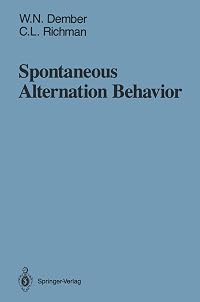
A wide variety of species, including human beings, exhibits a remarkably reliable behavior pattern, known as spontaneous alternation behavior (SAB), that has intrigued researchers for over seven decades. Though the details may vary depending on species and setting, SAB essentially entails first choosing one member of a pair of alternatives and then the other, without instructions or incen tives to do so. Spontaneous alternation is manifested even in the early trials of a show more discrimination-learning experiment, where only one of the choices is reinforced. Indeed, that was the setting in which SAB was first noted (Hunter, 1914). Rein forcement contingencies, evidently, are superimposed, not on a random sequence of choices, but on a potent, systematic behavior pattern. This book is the first to be devoted entirely to SAB and closely related phenomena, such as habituation and exploration. The literature on SAB is vast, covering a host of questions ranging from the cues that guide alternation to its phylogenetic and ontogenetic generality, its relation to learning and motivation, and its neurochemical substrates. In separate chapters we take up each of the major issues, reviewing what is known about the several facets of SAB and revealing areas of ignorance. The chapter authors were encouraged to discuss their own research where pertinent, some of it as yet unpublished, indeed some conducted specifically for this volume. show lessTags
Members
- Recently Added By
Author Information
5 Works 28 Members
Classifications
Statistics
- Members
- 2
- Popularity
- 6,013,671
- Languages
- English
- Media
- Paper, Ebook
- ISBNs
- 3