On This Page
Description
Business. Finance. Nonfiction. HTML:Do you have the millionaire mind?The runaway bestseller The Millionaire Next Door told us who America's wealthy really are. The Millionaire Mind tells how they got there, and how to become one of them. Inside, you'll discover the surprising answers to questions such as...
What success factors made them wealthy in one generation?
What part did luck and school play?
How do they find the courage to take financial risks?
How did they find their ideal show more vocations?
What are they spouses like and how did they choose them?
How do they run their households?
How do they buy and sell their homes?
What are their favorite leisure activities?
To become a millionaire, you have to think like one. The Millionaire Mind tells you how. show less
Tags
Recommendations

Member Reviews
I really enjoyed this book, although I can't really rate it as one of the best money books ever because it is simply outdated in terms of real estate prices, interest rates, etc. I'm really hoping that someone does another book similar to this and looks at a more current generation of millionaires.
That being said, what a great book. It turns out that millionaires, like many other groups of people, share certain characteristics. Do they all share the same ones? Of course not, but some of the associated values are pretty high. Here are some of my takeaways:
-Balance sheet rich is much better than income statement rich. Build wealth and assets, not just your paycheck and lifestyle.
-Getting married and staying married (as well as having show more kids) is a good thing, especially for money. Divorce can destroy people financially and often does. Also, support from a spouse is key to being successful.
-Millionaires are invested in many different areas.
-They are typically not DIYers and hire other people to do these things so they can use their time more wisely (funny, this is one of the points I find odd and disagree with...I think you can be wealthy and cut your own damn lawn).
-Most are college educated, although A LOT did not do well in college as well as not testing well. The exceptions were doctors, lawyers, etc. who needed to go to a graduate school for their degrees and hold that as being important.
-Take your time buying a home and don't necessarily buy a brand new home.
There were a lot more, especially around budgeting and being thrifty (driving old cars, shopping lists, not going on wild vacations, etc.) that were really good. It was nice to see some of the patterns of behavior that these individuals have and that becoming a millionaire is a real possibility in this country. The author also noted that certain individuals are set up for success better than others and didn't discount home environment as a factor in becoming wealthy.
Anyway, I enjoyed the read and got a lot out of the mindset of becoming and staying wealthy. I have recently appreciated my 18 year old Honda more after reading this.
Now, to get rich! show less
That being said, what a great book. It turns out that millionaires, like many other groups of people, share certain characteristics. Do they all share the same ones? Of course not, but some of the associated values are pretty high. Here are some of my takeaways:
-Balance sheet rich is much better than income statement rich. Build wealth and assets, not just your paycheck and lifestyle.
-Getting married and staying married (as well as having show more kids) is a good thing, especially for money. Divorce can destroy people financially and often does. Also, support from a spouse is key to being successful.
-Millionaires are invested in many different areas.
-They are typically not DIYers and hire other people to do these things so they can use their time more wisely (funny, this is one of the points I find odd and disagree with...I think you can be wealthy and cut your own damn lawn).
-Most are college educated, although A LOT did not do well in college as well as not testing well. The exceptions were doctors, lawyers, etc. who needed to go to a graduate school for their degrees and hold that as being important.
-Take your time buying a home and don't necessarily buy a brand new home.
There were a lot more, especially around budgeting and being thrifty (driving old cars, shopping lists, not going on wild vacations, etc.) that were really good. It was nice to see some of the patterns of behavior that these individuals have and that becoming a millionaire is a real possibility in this country. The author also noted that certain individuals are set up for success better than others and didn't discount home environment as a factor in becoming wealthy.
Anyway, I enjoyed the read and got a lot out of the mindset of becoming and staying wealthy. I have recently appreciated my 18 year old Honda more after reading this.
Now, to get rich! show less
Joe Millionaire is just like you; he puts his pants on in the morning and brushes his teeth and shaves. He might be worth millions of dollars, but you are not. Why is that? Dr. Thomas J. Stanley argues that there are thought processes and certain types of resilience built into the Millionaire Mind. They have different thought patterns and ideas that allow them to navigate the marathon of life. Maybe they were creative enough to see an opportunity that no one else did, or they occupy a niche that no one else can easily specialize in.
With this book, Dr. Stanley sent out questionnaires to homes and zip codes that were likely to house millionaires. He found some surprising things; although I suppose not all of it is surprising at all. Many show more of them value hard work and determination more than luck, which makes sense. They know of the stock market but that isn’t how they made most of their money. Some of them were high school dropouts. Some can’t write very well. A great many of them questioned authority and had an excellent support system at home.
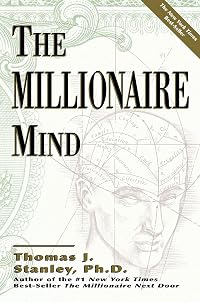
There is a lot of interesting data in this book, and it is listed over and over. The book is slightly older than I thought it was, but that isn’t really a problem since it looks for common factors to people that have a net worth of a million dollars or more. The cover sort of irks me, mainly because it reminds me of one of those old Phrenology charts but other than that it is fine. Dr. Stanley had a previous hit with The Millionaire Next Door, a book that I can’t really comment on since I haven’t read it. show less
With this book, Dr. Stanley sent out questionnaires to homes and zip codes that were likely to house millionaires. He found some surprising things; although I suppose not all of it is surprising at all. Many show more of them value hard work and determination more than luck, which makes sense. They know of the stock market but that isn’t how they made most of their money. Some of them were high school dropouts. Some can’t write very well. A great many of them questioned authority and had an excellent support system at home.
There is a lot of interesting data in this book, and it is listed over and over. The book is slightly older than I thought it was, but that isn’t really a problem since it looks for common factors to people that have a net worth of a million dollars or more. The cover sort of irks me, mainly because it reminds me of one of those old Phrenology charts but other than that it is fine. Dr. Stanley had a previous hit with The Millionaire Next Door, a book that I can’t really comment on since I haven’t read it. show less
I didn't enjoy this nearly as much as the Millionaire next door. It just didn't feel complete - and didn't have a strong overriding theme. It was more like a bunch of facts put together into a volume. Not to say it was a bad book - it just didn't flow quite the same as other books in the category.
I found this follow-up to The Millionaire Next Door to be rather less interesting and less applicable to “regular people.” For one thing, it is focused less on low-level millionaires and more on those with between five and ten million dollars; a person with an upper five-figure income and frugal habits might break a million in net worth, but would not be in that five-to-ten club. Almost all of the people he talks about are successful entrepreneurs. The section on house buying is perhaps the most applicable to non-entrepreneurs. (To summarize, millionaires buy houses in good school districts, shop for a bargain, and live in those houses for a long time. They don’t have houses built because it takes up too much time.)
A book based on data, no concepts. A simple, well-written gem that's full of insight.
I actually didn't quite finish reading it. I thought some of the concepts were very interesting, and the reader was good, but I found it very repetitive. It was also targeted more to the young (establishing your path from an early age). I decided not to finish it, though I may send print copies to my nephews just starting out - as food for thought.
Follow and apply the stats in this book and yes, even you can become a millionaire.
Well written and interesting.
Well written and interesting.
Members
- Recently Added By
Author Information

12+ Works 6,526 Members
Thomas J. Stanley was born in 1944 in the Bronx, New York City. He went to college in Connecticut, did graduate work at the University of Tennessee, and received a doctorate at the University of Georgia. He was a marketing professor at Georgia State University, a public speaker, a consultant on selling to the rich, and an author. He wrote books on show more the habits of millionaires including The Millionaire Next Door and The Millionaire Mind. He died in a car accident on February 28, 2015 at the age of 71. (Bowker Author Biography) show less
Awards and Honors
Distinctions
Series

Work Relationships
Is contained in
Common Knowledge
- Canonical title
- The Millionaire Mind
- Original publication date
- 2000
Classifications
Statistics
- Members
- 1,223
- Popularity
- 20,206
- Reviews
- 17
- Rating
- (3.71)
- Languages
- 5 — English, French, Hungarian, Lithuanian, Portuguese
- Media
- Paper, Audiobook, Ebook
- ISBNs
- 27
- UPCs
- 2
- ASINs
- 8