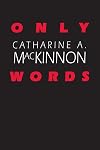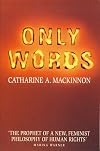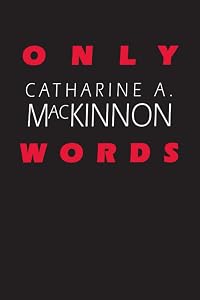
Only Words
by Catharine A. MacKinnon
On This Page
Description
When is rape not a crime? When it's pornography--or so First Amendment law seems to say: in film, a rape becomes "free speech." Pornography, Catharine MacKinnon contends, is neither speech nor free. Pornography, racial and sexual harassment, and hate speech are acts of intimidation, subordination, terrorism, and discrimination, and should be legally treated as such. Only Words is a powerful indictment of a legal system at odds with itself, its First Amendment promoting the very inequalities show more its Fourteenth Amendment is supposed to end. In the bold and compelling style that has made her one of our most provocative legal critics, MacKinnon depicts a society caught in a vicious hypocrisy. Words that offer bribes or fix prices or segregate facilities are treated by law as acts, but words and pictures that victimize and target on the basis of race and sex are not. Pornography--an act of sexual domination reproduced in the viewing--is protected by law in the name of "the free and open exchange of ideas." But the proper concern of law, MacKinnon says, is not what speech says, but what it does. What the "speech" of pornography and of racial and sexual harassment and hate propaganda does is promote and enact the power of one social group over another. Cutting with surgical deftness through cases of harassment in the workplace and on college campuses, through First Amendment cases involving Nazis, Klansmen, and pornographers, MacKinnon shows that as long as discriminatory practices are protected as free speech, equality will be only a word. show lessTags
Recommendations















Member Reviews
MacKinnon is an anti-pornography feminist, which can cause people on both ends of the political spectrum to reject her ideas without taking the time to engage with them first. This is a shame, because MacKinnon's argument here is one of the most interesting anti-pornography arguments I've read, avoiding the easy use of anecdotal pathos, in favor of a legal argument, suggesting that pornography's status as "protected expression" is a classification error, and that it belongs more properly in the category of speech acts that are treated legally as actions rather than ideas (hate speech; sexual harrassment). Elegant and deft.
this is a discourse on the first amendment (freedom of speech) and the fourteenth amendment (equal protection law) and how differently the american courts treat these laws when it comes to sexual and racial equality, and specifically pornography. awesome. except that it's a really dense read, which makes it hard and pretty inaccessible. mackinnon is an icon for feminists and anti-pornographers (that's me), but she's also a law professor, which is probably why this book reads the way it does. i wish it was more accessible and didn't require such major concentration, not to mention having a computer constantly on hand to look up court cases and get more information about so many things.
here are some important bits that you won't have to show more read too, too slowly.
"Protecting pornography means protecting sexual abuse as speech, at the same time that both pornography and its protection have deprived women of speech, especially speech against sexual abuse."
"This message [of pornography] is addressed directly to the penis, delivered through an erection, and taken out on women in the real world."
"How many women's bodies have to stack up here even to register against male profit and pleasure presented as First Amendment principle?"
"If used at work, this spread [magazine pornography] would create a hostile unequal working environment actionable under federal sex discrimination law. But there is no law against a hostile unequal living environment, so everywhere else it is protected speech."
"Speech theory does not disclose or even consider how to deal with power vanquishing powerlessness; it tends to transmute this into truth vanquishing falsehood, meaning what power wins becomes considered true. Speech, hence the lines within which much of life can be lived, belongs to those who own it, mainly big corporations." show less
here are some important bits that you won't have to show more read too, too slowly.
"Protecting pornography means protecting sexual abuse as speech, at the same time that both pornography and its protection have deprived women of speech, especially speech against sexual abuse."
"This message [of pornography] is addressed directly to the penis, delivered through an erection, and taken out on women in the real world."
"How many women's bodies have to stack up here even to register against male profit and pleasure presented as First Amendment principle?"
"If used at work, this spread [magazine pornography] would create a hostile unequal working environment actionable under federal sex discrimination law. But there is no law against a hostile unequal living environment, so everywhere else it is protected speech."
"Speech theory does not disclose or even consider how to deal with power vanquishing powerlessness; it tends to transmute this into truth vanquishing falsehood, meaning what power wins becomes considered true. Speech, hence the lines within which much of life can be lived, belongs to those who own it, mainly big corporations." show less
Some confusing language in parts kept this from being a 5—but fantastic overall.
Ratings
Members
- Recently Added By
Lists

List of Removed Books from Nimitz Library
353 works; 1 member
Author Information

23+ Works 1,437 Members
Catharine A. MacKinnon is Elizabeth A. Long Professor of Law at the University of Michigan Law School
Common Knowledge
- First words
- Imagine that for hundreds of years your most formartive traumas, your daily suffering and pain, the abuse you live through, the terror you live with, are unspeakable—not the basis of your literature.
- Last words
- (Click to show. Warning: May contain spoilers.)When this day comes, silence will be neither an act of power, as it is now for those who hide behind it, nor an experience of imposed powerlessness, as it is now for those who are submerged in it, but a context of repose into which thought can expand, an invitation that gives speech its shape, an opening to a new conversation.
- Blurbers
- Lawrence, Charles R., III; Rorty, Richard; Dees, Morris; Matsuda, Mari J.; Schauer, Frederick; Williams, Patricia J.
Classifications
- Genres
- Politics and Government, Nonfiction, Sexuality and Gender Studies, General Nonfiction, Philosophy
- DDC/MDS
- 342.73 — Society, government, & culture Law U.S. Constitution - Bill of Rights, Amendments North America Constitutional law--United States
- LCC
- KF4772 .M33 — Law Law of the United States Law of the United States (Federal) Constitutional law Individual and state Civil and political rights and liberties
- BISAC
Statistics
- Members
- 266
- Popularity
- 121,902
- Reviews
- 3
- Rating
- (3.47)
- Languages
- English, French, German
- Media
- Paper, Ebook
- ISBNs
- 7
- ASINs
- 2