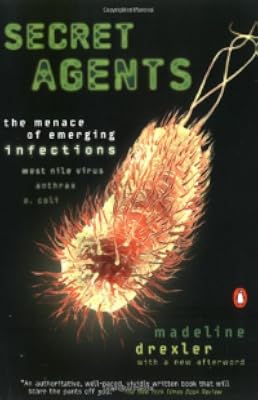
Secret Agents: The Menace of Emerging Infections
by Madeline Drexler
On This Page
Description
Secret Agents looks at today's new and emerging infections and tells the stories of scientists racing to catch up with invisible adversaries superior in both speed and guile.Tags
Recommendations
















Member Reviews
This is an engaging, easy to read foray into the fearsome world of disease-causing microbes. Many contrasting cases are covered like true crime episodes. These cases include West Nile viral encephalitis that occurred in the New York metropolitan area during the late 1990s and food borne illnesses. The latter goes from the E. Coli fast food outbreaks of several years before to non-meat cases caused by picker laborers not treated like the food handlers that they are. Also explored in the chain from farm to grocery is the over-reliance on antibiotics in our feed stock. Then, there is the over-prescription of anti-biotics for humans and the drug-resistant monster bugs this encourages. There is much about the lingering threat from diseases show more arising from the mixtures of humans and animals and wet markets in China (foreshadowing COVID-19) as well as bio-terrorism and the basic easy of movement of threats in the modern, connected globe.
One interesting tidbit was that authorities gather reports of crow die-offs as the scavenging animals are so robust that anything that can kill enough of them to draw attention should be investigated. show less
One interesting tidbit was that authorities gather reports of crow die-offs as the scavenging animals are so robust that anything that can kill enough of them to draw attention should be investigated. show less
Even though this book is over 20 years old, its message holds. Emerging infections can take us all out.
In this book Drexler reviews the state-of-the-art science on food poisoning, superbugs, pandemics, and bioterror. At the time of this writing AIDS was still a huge threat worldwide. Treatments have since changed that trajectory for the better. Anthrax was on everyone's mind right after 9/11, and it still should be.
Drexler ends with a concern about the lack of funding and interest in public health in this country and others, and calls for a change in thinking and emphasis. There are heroes in the book, public health heroes, and we should acknowledge them and learn from them. Even more importantly, we need plans. We need plans that spell show more out how to manage pandemics, food scares, bioterror attacks. show less
In this book Drexler reviews the state-of-the-art science on food poisoning, superbugs, pandemics, and bioterror. At the time of this writing AIDS was still a huge threat worldwide. Treatments have since changed that trajectory for the better. Anthrax was on everyone's mind right after 9/11, and it still should be.
Drexler ends with a concern about the lack of funding and interest in public health in this country and others, and calls for a change in thinking and emphasis. There are heroes in the book, public health heroes, and we should acknowledge them and learn from them. Even more importantly, we need plans. We need plans that spell show more out how to manage pandemics, food scares, bioterror attacks. show less
Well worth reading. Though published in 2002, the issues are still current and, in fact, probably worse now. Most of the topics I already knew about, but I learned many more fascinating details.
I am now eager to read her book "Emerging Epidemics" which was published in 2009 and should be a bit more up to date.
I am now eager to read her book "Emerging Epidemics" which was published in 2009 and should be a bit more up to date.
My full review is on Secret Agents: The Menace of Emerging Infections. This edition has a two-page afterword by the author which adds nothing substantial.
Among the best books on this topic.
Ratings
Members
- Recently Added By
Author Information

3 Works 200 Members
Awards and Honors
Classifications
- Genres
- Nonfiction, General Nonfiction, Science & Nature
- DDC/MDS
- 614.4 — Applied science & technology Medicine & health Epidemics and poisons Incidence of and public measures to prevent disease
- LCC
- RA653 .D74 — Medicine Public aspects of medicine Public aspects of medicine Public health. Hygiene. Preventive medicine Epidemics. Epidemiology. Quarantine. Disinfection
- BISAC
Statistics
- Members
- 155
- Popularity
- 212,226
- Reviews
- 5
- Rating
- (3.78)
- Languages
- English
- Media
- Paper, Ebook
- ISBNs
- 4
- ASINs
- 1