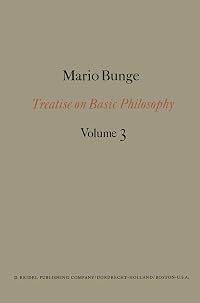
Treatise on Basic Philosophy: Ontology I: The Furniture of the World
by Mario Bunge
On This Page
Description
In this Introduction' we shall sketch the business of ontology, or metaphysics, and shall locate it on the map of learning. This has to be done because there are many ways of construing the word 'ontology' and because of the bad reputation metaphysics has suffered until recently - a well deserved one in most cases. 1. ONTOLOGICAL PROBLEMS Ontological (or metaphysical) views are answers to ontological ques tions. And ontological (or metaphysical) questions are questions with an extremely show more wide scope, such as 'Is the world material or ideal - or perhaps neutral?" 'Is there radical novelty, and if so how does it come about?', 'Is there objective chance or just an appearance of such due to human ignorance?', 'How is the mental related to the physical?', 'Is a community anything but the set of its members?', and 'Are there laws of history?'. Just as religion was born from helplessness, ideology from conflict, and technology from the need to master the environment, so metaphysics - just like theoretical science - was probably begotten by the awe and bewilderment at the boundless variety and apparent chaos of the phenomenal world, i. e. the sum total of human experience. Like the scientist, the metaphysician looked and looks for unity in diversity, for pattern in disorder, for structure in the amorphous heap of phenomena - and in some cases even for some sense, direction or finality in reality as a whole. show lessTags
Members
- Recently Added By
Author Information

138+ Works 1,076 Members
prolific author on all aspects of the philosophy of science and a pioneer in philosophy of technology, Mario Augusto Bunge was born in Buenos Aires, Argentina, in 1919 and educated at the Universidad Nacional de La Plata, receiving his Ph.D. in physics in 1952. He did research work in and taught theoretical physics in Argentina before moving to show more the United States in 1960, where he taught at several universities, including the University of Pennsylvania, Texas, Delaware, and Temple University. He moved to Montreal in 1966, where he remains and has been Frothingham Professor of Logic and Metaphysics at McGill University since 1981. Bunge insists on describing both science and technology exactly as they are. His pioneering approach to the philosophy of technology includes a clear characterization of all the components of technological systems in systems-theory terms, including their value commitments and relationships to other institutions. Outspokenly critical of what he views as pseudo-science, including psychoanalysis, Bunge is equally strong in his defenses of democracy, although he also sees it as subject to much abuse. (Bowker Author Biography) show less
Classifications
Statistics
- Members
- 16
- Popularity
- 1,521,475
- Languages
- Dutch, English
- Media
- Paper, Ebook
- ISBNs
- 3
- ASINs
- 1