On This Page
Description
"Sex education for children ages 6 to 9, from a Christian point of view"--Provided by publisher.Tags
Recommendations


Member Reviews
Many parents (myself included) often wonder when is the right age to begin discussing intimacy, sexuality and biology with your children. While there are many books written on the subject, few that I’ve read address it with such delicacy, simplicity, and beauty as Dr. Jim Burns does in his book series “Pure Foundations.” In this series, Burns seeks to “lay the foundations for healthy sexuality” with “age-appropriate resources” in order to equip parents to teach their children that their bodies and sexuality are God-given gifts. I had the opportunity to read and review the first two books in the series.
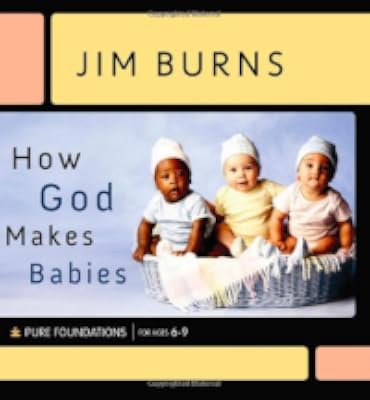
The second, “How God Makes Babies” is aimed at children ages 6 to 9. While the first book was aimed more at helping show more younger children to recognize the differences God made in each of us, this second book spends more time discussing the “private parts” of boys and girls as well as more details of how a baby is made. Children at this age are starting to be curious about their bodies as well as the bodies of their friends. But the book wisely points out that “these special parts…are called parts….When something is private, it is not meant to be shared with other people….Sharing your private parts is something to save for your husband or wife when you are grown and married. That is God’s wonderful plan.” (pp.16, 17)
The first book in the series did not go into any detail about sex; this second however, does describe it in a little detail. But even here, while perhaps the most uncomfortable part of “the talk,” the subject is handled delicately and without putting a lot of emphasis on it. “When a husband and wife make love, they fit together in a wonderful way. The husband puts his penis into the wife’s vagina. It might sound icky or uncomfortable to you, and that’s okay. Making love is a beautiful thing meant only for grown-ups who are married to each other.” (p.18)
The stages of a baby’s growth are discussed and illustrated, including a couple of drawings showing what the baby might look like inside the womb. Of great help is the size comparisons given to help children visualize how big the baby is – the size of a dot on the page, or a Cheerio, or an orange slice, etc.
There were several things I appreciated about the book. One was the beautiful, yet simple photography that illustrated each page. The photos didn’t feel overdone, but captured the simplicity and interactions of different people. Perhaps most important was the clear impression that a baby, “from the very moment the sperm and egg join together,” is very much a person, complete with heartbeat. Lastly, as the father of three children who were adopted, of especial interest to me was the inclusion that adoption was a loving option for some families. “The birth parents do a very loving and wonderful thing by allowing another family to adopt the baby. The new parents want to grow their family, and they welcome the baby into their home. The baby becomes their child.” (p.44)
I would highly recommend this second book of the Pure Foundations series to parents of younger children. show less
The second, “How God Makes Babies” is aimed at children ages 6 to 9. While the first book was aimed more at helping show more younger children to recognize the differences God made in each of us, this second book spends more time discussing the “private parts” of boys and girls as well as more details of how a baby is made. Children at this age are starting to be curious about their bodies as well as the bodies of their friends. But the book wisely points out that “these special parts…are called parts….When something is private, it is not meant to be shared with other people….Sharing your private parts is something to save for your husband or wife when you are grown and married. That is God’s wonderful plan.” (pp.16, 17)
The first book in the series did not go into any detail about sex; this second however, does describe it in a little detail. But even here, while perhaps the most uncomfortable part of “the talk,” the subject is handled delicately and without putting a lot of emphasis on it. “When a husband and wife make love, they fit together in a wonderful way. The husband puts his penis into the wife’s vagina. It might sound icky or uncomfortable to you, and that’s okay. Making love is a beautiful thing meant only for grown-ups who are married to each other.” (p.18)
The stages of a baby’s growth are discussed and illustrated, including a couple of drawings showing what the baby might look like inside the womb. Of great help is the size comparisons given to help children visualize how big the baby is – the size of a dot on the page, or a Cheerio, or an orange slice, etc.
There were several things I appreciated about the book. One was the beautiful, yet simple photography that illustrated each page. The photos didn’t feel overdone, but captured the simplicity and interactions of different people. Perhaps most important was the clear impression that a baby, “from the very moment the sperm and egg join together,” is very much a person, complete with heartbeat. Lastly, as the father of three children who were adopted, of especial interest to me was the inclusion that adoption was a loving option for some families. “The birth parents do a very loving and wonderful thing by allowing another family to adopt the baby. The new parents want to grow their family, and they welcome the baby into their home. The baby becomes their child.” (p.44)
I would highly recommend this second book of the Pure Foundations series to parents of younger children. show less
Jim Burns is dedicated to equipping parents with the tools they need to educate their children about sexuality with a firmly Christian worldview. Well known for his resources such as The Purity Code for teenagers, Burns has now turned his hand to colorful, age appropriate resources for children.
How God Makes Babies is his offering for the 6-9 age group, though some parents may choose to read only parts of this book to their children or delay reading it with their children until they are older – depending upon their life circumstances and individual children.
Opening with a special note to parents Burns states:
“Studies show that when children receive values-centered sex education at home, they are less likely to become sexually show more promiscuous and more likely to have a healthy view of their bodies and relationships.”
This is certainly one key reason why some gentle sex education should take place even in the younger age groups. There are many others as well – glorifying God through our obedience to His plan for sex, educating our children so that they are prepared to resist inappropriate sexual activity that they may otherwise fall prey to due to ignorance, and many others.
God’s plan for sex should be treated respectfully and in age appropriate ways – thankfully How God Makes Babies certainly makes this task easier for parents by being able to open a book, read, and discuss it with their children. I had read through parts of this book with my oldest daughter when she was younger (6 or 7), but I didn’t read through the entire book with her until she showed signs that she needed to understand a fuller picture of human reproduction.
Our discussions together had slowly been becoming more detailed – particularly as she began reading the Bible independently each day. Her questions from Bible readings naturally led into some gentle explanations. We have always told our children in very simple terms that mommies and daddies cuddle together in a special way that only married people do, and that is where babies come from.
When my eight-year-old told me that bulls jump on top of mommy cows and stretch out their pee-pees inside of them (courtesy of a similarly aged relative of ours – sweet girl – and I didn’t mind at all), I knew we had to get a bit more detailed in our talks together. I wanted to be the one to provide the more nitty-gritty details, not someone else. How God Makes Babies provided us with the next step to take in our discussions.
Filled with birth color photographs, How God Makes Babies always places sexuality firmly within the realm of marriage as a normal expression of marital love, for which I am very thankful. Simple anatomical drawings illustrate the differences between boys and girls while using correct anatomical terminology. Protecting your private parts from inappropriate touches is briefly covered. A straightforward, facts focused explanation of the act of marital intimacy and conception is provided along with photos of sperm and egg coming together and the newly dividing embryo. Developmental stages of a baby in-utero are illustrated and described, followed by a description of birth, and explanations of how a new baby changes a family. There are also provisions made for diverse families that may be made up of different configurations than two parents and children (homosexual families are not depicted). Adoption is also covered.
This is absolutely a fabulous book for when you are ready to share more deeply about sexuality with your children. It can be tempting to put off these conversations, but they are vitally necessary to imbue children with a proper, God-honoring view of sexuality. Remember – sex is not bad, it’s a natural part of life, don’t be afraid of sharing about its proper, God-appointed role in life with your little ones.
Reviewed at quiverfullfamily.com show less
How God Makes Babies is his offering for the 6-9 age group, though some parents may choose to read only parts of this book to their children or delay reading it with their children until they are older – depending upon their life circumstances and individual children.
Opening with a special note to parents Burns states:
“Studies show that when children receive values-centered sex education at home, they are less likely to become sexually show more promiscuous and more likely to have a healthy view of their bodies and relationships.”
This is certainly one key reason why some gentle sex education should take place even in the younger age groups. There are many others as well – glorifying God through our obedience to His plan for sex, educating our children so that they are prepared to resist inappropriate sexual activity that they may otherwise fall prey to due to ignorance, and many others.
God’s plan for sex should be treated respectfully and in age appropriate ways – thankfully How God Makes Babies certainly makes this task easier for parents by being able to open a book, read, and discuss it with their children. I had read through parts of this book with my oldest daughter when she was younger (6 or 7), but I didn’t read through the entire book with her until she showed signs that she needed to understand a fuller picture of human reproduction.
Our discussions together had slowly been becoming more detailed – particularly as she began reading the Bible independently each day. Her questions from Bible readings naturally led into some gentle explanations. We have always told our children in very simple terms that mommies and daddies cuddle together in a special way that only married people do, and that is where babies come from.
When my eight-year-old told me that bulls jump on top of mommy cows and stretch out their pee-pees inside of them (courtesy of a similarly aged relative of ours – sweet girl – and I didn’t mind at all), I knew we had to get a bit more detailed in our talks together. I wanted to be the one to provide the more nitty-gritty details, not someone else. How God Makes Babies provided us with the next step to take in our discussions.
Filled with birth color photographs, How God Makes Babies always places sexuality firmly within the realm of marriage as a normal expression of marital love, for which I am very thankful. Simple anatomical drawings illustrate the differences between boys and girls while using correct anatomical terminology. Protecting your private parts from inappropriate touches is briefly covered. A straightforward, facts focused explanation of the act of marital intimacy and conception is provided along with photos of sperm and egg coming together and the newly dividing embryo. Developmental stages of a baby in-utero are illustrated and described, followed by a description of birth, and explanations of how a new baby changes a family. There are also provisions made for diverse families that may be made up of different configurations than two parents and children (homosexual families are not depicted). Adoption is also covered.
This is absolutely a fabulous book for when you are ready to share more deeply about sexuality with your children. It can be tempting to put off these conversations, but they are vitally necessary to imbue children with a proper, God-honoring view of sexuality. Remember – sex is not bad, it’s a natural part of life, don’t be afraid of sharing about its proper, God-appointed role in life with your little ones.
Reviewed at quiverfullfamily.com show less
Ratings
Members
- Recently Added By
Author Information

118 Works 2,238 Members
Jim Burns, Ph.D., is president of HomeWord, executive director for the HomeWord Center for Youth and Family at Azusa Pacific University, and host of HomeWords radio broadcasts. Jim speaks to thousands of people around the world every year. He is a three-time Gold Medallion Award winning author and has written books for parents, students, children, show more youth ministry and church leaders. Jim has more than 1.5 million resources in print in more than 20 languages. His most recent resources include The Purity Code, Teaching Your Childern Healthy Sexuality, Accept Nothing Less, God Made Your Body, How God Makes Babies, Confident Parenting, Creating an Intimate Marriage, Closer: Devotions to Draw Couples Together, The 10 Building Blocks for a Solid Family, Uncommon Youth Ministry and the Uncommon youth group studies. Jim and his wife, Cathy, and their daughters, Christy, Rebecca and Heidi, live in Southern California. show less
Series

Classifications
- Genres
- Nonfiction, Children's Books, Picture Books
- DDC/MDS
- 649.65 — Applied science & technology Home economics & family management Child rearing; home care of people with illnesses and disabilities by family and friends Discipline, Homeschool, and Toilet Training Sex Education for Children
- LCC
- HQ53 .B874 — Social sciences The family. Marriage, Women and Sexuality The Family. Marriage. Women Sexual life Sex instruction and sexual ethics
- BISAC
Statistics
- Members
- 66
- Popularity
- 473,464
- Reviews
- 2
- Rating
- (4.50)
- Languages
- English
- Media
- Paper
- ISBNs
- 1