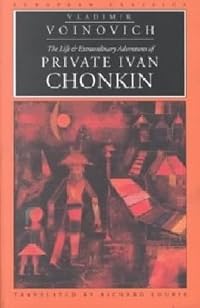
The Life and Extraordinary Adventures of Private Ivan Chonkin
by Vladimir Vojnovitsj
The Adventures of Private Ivan Chonkin (1)
On This Page
Description
A satirical novel about a Russian soldier during World War II, ridiculing numerous aspects of life in the Soviet Union.Tags
Recommendations












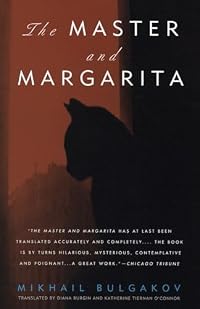

Member Recommendations

Member Reviews
I usually don't laugh at books that are supposed to be funny, especially ones that fall under the category of satire. I find a lot of allegedly funny writers try to be clever and end up being obnoxiously smarmy. There's no real humor in an author attempting to present him/herself as more intelligent than the book's characters. There is, however, plenty of humor in a guy finding out he just drank a glass of human shit.
The Life and Extraordinary Adventures of Private Ivan Chonkin is a very funny book as well as an impressive satirical depiction of the pre-WW2 USSR. Having previously read The Ivankiad, I was already aware of Vladimir Voinovich's ability to lampoon Soviet bureaucracy, but this is on another level. Voinovich has created a show more vibrant collective farm filled with citizens who, despite their exaggerated, comical personalities, struggle with many of the real problems faced by Russian peasants throughout the reign of Stalin.
Voinovich is at his funniest when writing about dreams. Ivan Chonkin and his neighbor Gladischev are ridiculous people who dream about even more ridiculous things based entirely on their inability to participate in normal human conversations. Their misunderstandings of how the world works and how the people around them think and feel lead to amazing nighttime hallucinations.
My only qualm with the book is the inconsistency of Chonkin's stupidity. He's in general a bumbling fool, but there are points where he's somehow stupid enough to ask a high-ranking Communist official about Stalin having two wives while at the same time smart enough to solve a food shortage crisis using a Soviet intelligence unit that he managed to singlehandedly capture. These wild swings in capability were a bit much to handle, and I felt intense sympathy for Nyura, a wonderful woman who just happened to pick the wrong man at the wrong time to be her partner.
Voinovich died this summer at the age of 85. While his most significant achievement may have been sneaking Vasily Grossman's Life and Fate out of the Soviet Union, it would be a shame to ignore his own literary output, much of which took the same bravery to write as Grossman's did. Voinovich was a significant voice as a Soviet dissident and one of the funniest writers in the USSR or anywhere else, so I highly recommend reading (and laughing at) all he created. show less
The Life and Extraordinary Adventures of Private Ivan Chonkin is a very funny book as well as an impressive satirical depiction of the pre-WW2 USSR. Having previously read The Ivankiad, I was already aware of Vladimir Voinovich's ability to lampoon Soviet bureaucracy, but this is on another level. Voinovich has created a show more vibrant collective farm filled with citizens who, despite their exaggerated, comical personalities, struggle with many of the real problems faced by Russian peasants throughout the reign of Stalin.
Voinovich is at his funniest when writing about dreams. Ivan Chonkin and his neighbor Gladischev are ridiculous people who dream about even more ridiculous things based entirely on their inability to participate in normal human conversations. Their misunderstandings of how the world works and how the people around them think and feel lead to amazing nighttime hallucinations.
My only qualm with the book is the inconsistency of Chonkin's stupidity. He's in general a bumbling fool, but there are points where he's somehow stupid enough to ask a high-ranking Communist official about Stalin having two wives while at the same time smart enough to solve a food shortage crisis using a Soviet intelligence unit that he managed to singlehandedly capture. These wild swings in capability were a bit much to handle, and I felt intense sympathy for Nyura, a wonderful woman who just happened to pick the wrong man at the wrong time to be her partner.
Voinovich died this summer at the age of 85. While his most significant achievement may have been sneaking Vasily Grossman's Life and Fate out of the Soviet Union, it would be a shame to ignore his own literary output, much of which took the same bravery to write as Grossman's did. Voinovich was a significant voice as a Soviet dissident and one of the funniest writers in the USSR or anywhere else, so I highly recommend reading (and laughing at) all he created. show less
Short, bowlegged, big red ears, field shirt sticking out over his belt, Private Ivan Chonkin, the hero of Vladimir Voinovich’s novel, has been likened to Jaroslav Hašek's The Good Soldier Švejk, and for good reason – like Švejk, Chonkin is an everyman forever at war with the forces - political, military, social, whatever - that use the iron fist of power in an attempt to obliterate a person’s unique individuality and humanity.
Squarely in the great tradition of satire and the absurdist fiction of Gogol, Kharms and Zabolotsky, with The Life & Extraordinary Adventures of Private Ivan Chonkin Vladimir Voinovich served up enough anti-Soviet zingers to contribute to his eventually getting kicked out of the country and stripped of his show more citizenship.
The storyline is simple: a pilot of a Soviet aircraft makes a forced landing in the farming village of Krasnoye near his Air Force base. Private Ivan Chonkin is sent to guard the military’s property.
I so much enjoyed the novel’s narrator telling readers directly how he amassed information on the subject of Chonkin and the village and added a little something of his own. And how he would have taken a tall, well built, disciplined military hero for his main character but all those crack students of military and political theory where already taken up and all he was left with was Chonkin. However, he urges us to treat his novel’s hero (Chonkin) as we would our very own child since when we have a child we get what we get and don’t throw the kid out the window.
Likewise, I relished the Mikhail Bulgakovesque dream sequences that gave Mr. Voinovich the opportunity to flex his creative imagination. Chonkin has his first dream when he’s sleeping in bed with Nyurka, his new girlfriend from the village. He watches as none other than Comrade Stalin slowly descends from the sky holding his rifle and wearing a woman’s dress. Stalin tells the sergeant in charge that Private Chonkin abandoned his post guarding the aircraft, lost his combat weapon and therefore deserves to be shot.
In our hero’s second dream, he attends a wedding reception where the groom and all the guests turn out to be not humans but pigs. Oh, no, he's been duped! Chonkin realizes he has blurted out a classified military secret to the first person (actually a pig) he ran into at the table. And one of the dire consequences of his fatal mistake? Humanork is on the menu! A tray bearing naked Comrade Stalin holding his famous pipe, all garnished with onions and green peas. Stalin grins slyly to himself behind his mustache.
The third dream is another doozy. This time the dreamer is Gladishev, one of the villagers who is a prototypical Soviet “new” man of science. In Gladishev’s dream his horse Osya informs him in plain Russian that he is no longer a horse but a human being. Gladishev says if Osya is a true Soviet human he would go to the front to fight the Germans. Osya replies that Gladishev is the dumbest person in the world since he should know a horse doesn’t have fingers to pull a trigger.
These are but snatches catching several colorful, hilarious bits. What's noteworthy is the way these dreams reinforce a major theme running throughout the novel: the prevailing Soviet system is a complete misreading of the rhythms of nature and life. Such an inept, ass-backwards system will lead men like Gladishev to do such things as fill his house with shit, even eat shit and drink water mixed with shit, based on scientific and materialistic calculations that all life is nourished by shit.
Such a misreading has its effect on all areas of Soviet life and community. For instance, at one village meeting the chairman of the local kolkhoz (collective farm) chastises members who fail to work the minimum number of workdays. Among the Comrades singled out for a tongue lashing is Zhikin, one of those who flaunts his age and illnesses. The chairman goes on: “Of course I realize that Zhikin is a disabled Civil War veteran and has not legs. But now he’s cashing in on those legs of his. . . Let him sit himself down in a furrow and crawl from bush to bush at his own speed, weeding as he goes and thereby fulfilling the minimum workday requirements.”
The chairman also is vocal when the village learns of the German offensive against their country: “The war will write everything off. The main thing’s to get to the front as fast as possible; there either you get a chest full of metals or a head full of bullets, but either way, at least you can live like an honest man.”
Such Soviet wisdom peppers every page. This is a very funny book. But as you are laughing, Comrades, you will be brought face-to-face with life on a community farm and in the military that is downright cruel and brutalizing.
One last example that really tickled my funny-bone. The narrator relays a rapid change of chairmen over at another village. The first chairman was put in jail for stealing, the second for seducing minors, and the third took to drinking and kept on drinking until he drank up everything he owned and all the kolkhoz funds. Things got so bad he hanged himself but left a one world suicide note – “Ech” with three exclamation points. The narrator tells us nobody figured out what that “Ech!!!” was supposed to mean. Actually, even as an American in 2018 I have a pretty good idea what he was getting at with his “Ech!!!” --- I CAN’T TAKE THIS ANY MORE!!!
Having read The Fur Hat and Moscow 2042 I wanted to treat myself to Vladimir Voinovich’s classic earlier work. I’m glad I did. I enjoy laughing and this novel provided ample opportunities. I can see why Ivan Chonkin is now a widely known figure in Russian popular culture.
Vladimir Voinovich, Born 1932
"Kuzma Gladishev was known as a learned man not only in Krasnoye but in the entire area. One of the many proofs of his erudition was the wooden outhouse in his garden, on which was written in large black letters, in English, WATER CLOSET." - Vladimir Voinovich, The Life & Extraordinary Adventures of Private Ivan Chonkin show less
I have to imagine that one of the things most hated by authoritarian governments is being laughed at. It's no wonder then that Voinovich found his works being refused by the Soviet government for publication in the 1960s, found himself excluded from the Soviet Writers' Union in the 1970s, and was stripped of his citizenship and exiled in the 1980s.
The Life and Extraordinary Adventures of Private Ivan Chonkin is often considered Voinovich's best work. He takes the familiar Russian character of Ivan the Fool and recasts him as Ivan Chonkin, a soldier in the Soviet Army at the advent of World War II. He is the perfect blend of bumbling naïveté with just a slight touch of guile that makes him endearing to the reader and has made him a show more modern folk figure in his own right.
Chonkin is sent to guard an airplane that has broken down and been left stranded in a farmer's field. Forgotten by the Army, he strikes up a relationship with the postmistress of the village and spends the war tending her livestock and garden. Of course, once the NKVD hear of him, it is inevitable that they should consider him a spy and—with jabs at Stalin, collectivism, the Army, Five Year Plans, and just about everything else Soviet...and with overt nods to Chekhov and Gogol—Voinovich takes on a hilarious ride through the consequences.
The 1990s brought a restoration of Voinovich's citizenship. However, while the literary world has handed him a prize here and there, I find myself wondering if the Russian government feels the same way. In 2007, he returned to familiar ground with the publishing of the third volume of Chonkin's adventures, Displaced Person, set in post-Soviet Russia.
This is a humorous anodyne for glooms or blues, particularly if you're of a certain age and your memory of Russia encompasses the Cold War era. show less
The Life and Extraordinary Adventures of Private Ivan Chonkin is often considered Voinovich's best work. He takes the familiar Russian character of Ivan the Fool and recasts him as Ivan Chonkin, a soldier in the Soviet Army at the advent of World War II. He is the perfect blend of bumbling naïveté with just a slight touch of guile that makes him endearing to the reader and has made him a show more modern folk figure in his own right.
Chonkin is sent to guard an airplane that has broken down and been left stranded in a farmer's field. Forgotten by the Army, he strikes up a relationship with the postmistress of the village and spends the war tending her livestock and garden. Of course, once the NKVD hear of him, it is inevitable that they should consider him a spy and—with jabs at Stalin, collectivism, the Army, Five Year Plans, and just about everything else Soviet...and with overt nods to Chekhov and Gogol—Voinovich takes on a hilarious ride through the consequences.
The 1990s brought a restoration of Voinovich's citizenship. However, while the literary world has handed him a prize here and there, I find myself wondering if the Russian government feels the same way. In 2007, he returned to familiar ground with the publishing of the third volume of Chonkin's adventures, Displaced Person, set in post-Soviet Russia.
This is a humorous anodyne for glooms or blues, particularly if you're of a certain age and your memory of Russia encompasses the Cold War era. show less
Private Ivan Chonkin is a soldier in the Soviet army. This novel starts in 1941, just before Germany attacked the Soviet Union. We find Private Chonkin to be an innocent and apparently weak minded individual who finds it difficult to do what is expected of him in the armed forces, and is therefore given menial tasks, is in constant trouble, and is very familiar with punishment duties.
A Soviet aircraft gets into mechanical difficulty and has to make a forced landing beside the rural village of Krasnoye, terrifying the local residents. Chonkin is equipped with a week’s supply of rations and flown over to Krasnoye where he takes up a lonely vigil guarding the crippled plane in a field beside Krasnoye.
Chonkin is forgotten by his unit and show more the novel tells the story of how he interacts with the local villagers while he sticks to his orders and guards the plane.
We are treated to droll Russian humour which includes misunderstandings, bureaucratic idiocy, internal Communist party politics, blatant bullying, digressions into trivia, organisational paranoia, and everything else one would expect from a huge, bureaucratic enterprise. This includes the chairman of the local kolkhoz, who is constantly being told by his superiors that he is under constant surveillance, believing Chonkin has been planted in the village for the sole purpose of spying on him.
I don’t usually describe so much of the content of a novel in a review, but the details above are giving nothing away. I could tell you the whole plot and how the novel ends without taking away the pleasure you will have reading it for yourself. This book was a re-read for me, something I never do, but I still enjoyed the book enormously.
Voinovich created an atmosphere and I just enjoyed living in it. He created characters that make you cringe with their actions, but he explains the logic they work to and this makes it all plausible and understandable.
Since writing this review I have learned there is a third book about Private Ivan Chonkin, and it has not yet been translated fromt he Russian. :-(
Voinovich wrote this book between 1963 and 1970. It was not appreciated by the Soviet authorities and by 1980 he was forced to emigrate from the USSR. He was subsequently rehabilitated in 1990, even receiving an award from President Putin, who, while in his KGB days, was probably on the side of the people who forced Voinovich to emigrate in the first place.
Voinovich’s work is full of droll humour and constantly pokes fun at the stupidity of situations caused by political environment and centralised power. I found Ivan Chonkin to be not just about Soviet culture and the operation of a Communist state, but to also contain stories that could easily reflect events in some large organisations that operate anywhere in the world. I know I have seen things happen that could easily have taken place in Krasnoye.
I enjoyed The Life and Extraordinary Adventures of Private Ivan Chonkin and was delighted to read it a second time. Why did I read it a second time? Because I only recently discovered there is a sequel and I wanted to remind myself of the detail before starting it; “Pretender to the Throne: The Further Adventures of Private Ivan Chonkin”. show less
A Soviet aircraft gets into mechanical difficulty and has to make a forced landing beside the rural village of Krasnoye, terrifying the local residents. Chonkin is equipped with a week’s supply of rations and flown over to Krasnoye where he takes up a lonely vigil guarding the crippled plane in a field beside Krasnoye.
Chonkin is forgotten by his unit and show more the novel tells the story of how he interacts with the local villagers while he sticks to his orders and guards the plane.
We are treated to droll Russian humour which includes misunderstandings, bureaucratic idiocy, internal Communist party politics, blatant bullying, digressions into trivia, organisational paranoia, and everything else one would expect from a huge, bureaucratic enterprise. This includes the chairman of the local kolkhoz, who is constantly being told by his superiors that he is under constant surveillance, believing Chonkin has been planted in the village for the sole purpose of spying on him.
I don’t usually describe so much of the content of a novel in a review, but the details above are giving nothing away. I could tell you the whole plot and how the novel ends without taking away the pleasure you will have reading it for yourself. This book was a re-read for me, something I never do, but I still enjoyed the book enormously.
Voinovich created an atmosphere and I just enjoyed living in it. He created characters that make you cringe with their actions, but he explains the logic they work to and this makes it all plausible and understandable.
Since writing this review I have learned there is a third book about Private Ivan Chonkin, and it has not yet been translated fromt he Russian. :-(
Voinovich wrote this book between 1963 and 1970. It was not appreciated by the Soviet authorities and by 1980 he was forced to emigrate from the USSR. He was subsequently rehabilitated in 1990, even receiving an award from President Putin, who, while in his KGB days, was probably on the side of the people who forced Voinovich to emigrate in the first place.
Voinovich’s work is full of droll humour and constantly pokes fun at the stupidity of situations caused by political environment and centralised power. I found Ivan Chonkin to be not just about Soviet culture and the operation of a Communist state, but to also contain stories that could easily reflect events in some large organisations that operate anywhere in the world. I know I have seen things happen that could easily have taken place in Krasnoye.
I enjoyed The Life and Extraordinary Adventures of Private Ivan Chonkin and was delighted to read it a second time. Why did I read it a second time? Because I only recently discovered there is a sequel and I wanted to remind myself of the detail before starting it; “Pretender to the Throne: The Further Adventures of Private Ivan Chonkin”. show less
Ivan Chonkin is an inept private in the Soviet army on the cusp of World War Two who first finds himself ordered to guard an airplane in a distant village, then finds himself forgotten by the authorities, and finally remembered and with a vengeance.
`The Life and Extraordinary Times of Private Ivan Chonkin' might be called a Soviet Catch-22 [Catch-22: A Novel (Simon & Schuster Classics)] for its seemingly absurdist send up of life in the Red Army. I say 'seemingly absurdist' because, like Catch-22, one suspects there is more than a little truth in Voinovich's portrayal of bureaucratic tomfoolery. Chonkin himself calls to mind George Macdonald Fraser's McAuslan (McAuslan in the Rough), the bumbling private in a Scottish Highland show more regiment. Others have likened it the The Good Soldier Svejk: and His Fortunes in the World War (Penguin Classics), which I have not yet read.
The background of Stalinist terror gives Voinovich's work a darker cast. Army bureaucrats endeavor at all costs to keep a low profile to avoid attracting the attention of the higher ups. Such attention is too often accompanied in their minds with imprisonment, exile, or death.
A favorite bit occurs late in the book when a regiment has surrounded the village in order to take Chonkin into custody. Chonkin has taken seven members of the secret police captive and the regiment has come to the rescue. (In the meantime, Chonkin has turned this group of seven into such efficient farm workers that word soon reaches the newspapers and even Comrade Stalin. The local chairman feels certain doom is sure to follow such success.) The captain of the secret police escapes, but falls into the hands of army, which he mistakenly thinks is the German army. Much hilarity ensues.
Although the book is somewhat an artifact of the Stalinist era and is almost certainly even better if one can read it in the original Russian (alas, I cannot), the book still rates five stars and my highest recommendation in part for the rare look it provides into life in the wartime Soviet Union and in part for its timeless portrayal of army bureaucracy, and the universal slacker, Ivan Chonkin. show less
`The Life and Extraordinary Times of Private Ivan Chonkin' might be called a Soviet Catch-22 [Catch-22: A Novel (Simon & Schuster Classics)] for its seemingly absurdist send up of life in the Red Army. I say 'seemingly absurdist' because, like Catch-22, one suspects there is more than a little truth in Voinovich's portrayal of bureaucratic tomfoolery. Chonkin himself calls to mind George Macdonald Fraser's McAuslan (McAuslan in the Rough), the bumbling private in a Scottish Highland show more regiment. Others have likened it the The Good Soldier Svejk: and His Fortunes in the World War (Penguin Classics), which I have not yet read.
The background of Stalinist terror gives Voinovich's work a darker cast. Army bureaucrats endeavor at all costs to keep a low profile to avoid attracting the attention of the higher ups. Such attention is too often accompanied in their minds with imprisonment, exile, or death.
A favorite bit occurs late in the book when a regiment has surrounded the village in order to take Chonkin into custody. Chonkin has taken seven members of the secret police captive and the regiment has come to the rescue. (In the meantime, Chonkin has turned this group of seven into such efficient farm workers that word soon reaches the newspapers and even Comrade Stalin. The local chairman feels certain doom is sure to follow such success.) The captain of the secret police escapes, but falls into the hands of army, which he mistakenly thinks is the German army. Much hilarity ensues.
Although the book is somewhat an artifact of the Stalinist era and is almost certainly even better if one can read it in the original Russian (alas, I cannot), the book still rates five stars and my highest recommendation in part for the rare look it provides into life in the wartime Soviet Union and in part for its timeless portrayal of army bureaucracy, and the universal slacker, Ivan Chonkin. show less
One doesn't need much background in Russia history or literature to enjoy this novel about broken bureaucracy. Ivan Chonkin is a likeable Everyman who engages in bumbling but satisfying comeuppances as the elite and self-important get their due, and the little guy just reward. Glad to read a lighthearted and funny novel about (and from) Soviet Russia.
This book had some good parts, I'm not going to pretend it didn't. However, I felt that, overall, it was not as powerful as I was hoping it would be and that it was written in such a style as to make it less appealing to me than if it were written otherwise. Nevertheless, a decent novel.
3 stars.
3 stars.
Members
- Recently Added By
Lists

THE WAR ROOM
813 works; 24 members
Author Information

42+ Works 1,613 Members
Vladimir Nikolayevich Voinovich was born in Stalinabad, Soviet Union on September 26, 1932. He worked as a herdsman and trained as a locksmith before serving in the Soviet Army from 1951 to 1955. He began writing poetry while in the army and in the mid-1950s started publishing stories in the magazine Novy Mir. One story, I'd Be Honest if They'd show more Let Me, about a construction supervisor whose conscience is bothered by the shoddy structures he is ordered to build, was singled out as being dangerous. His novel, The Life and Extraordinary Adventures of Private Ivan Chonkin, did not clear the Soviet censorship bar in 1969 but circulated underground and was published in Europe four years later. He was questioned repeatedly by the K.G.B. He left the country in 1980 and joined faculty of the Institute of Fine Arts in Munich. His Soviet citizenship was revoked in 1970 and he was unable to return for a decade. His other novels included Moscow 2042, The Fur Hat, Monumental Propaganda, and The Crimson Pelican. He died of a heart attack on July 27, 2018 at the age of 85. (Bowker Author Biography) show less
Some Editions
Awards and Honors
Series

Belongs to Publisher Series
Work Relationships
Is contained in
Common Knowledge
- Canonical title
- The Life and Extraordinary Adventures of Private Ivan Chonkin
- Original title
- Жизнь и необычайные приключения солдата Ивана Чонкина
- Alternate titles*
- De merkwaardige lotgevallen van soldaat Iwan Tsjonkin : een anekdotische roman
- Original publication date
- 1977 (English trans.) (English trans.); 1975 (French trans.) (French trans.); 1969
- People/Characters
- Ivan Chonkin
- First words*
- Было это или не было, теперь уж точно сказать нельзя, потому что случай, с которого началась (и тянется почти что до наших днÐ... (show all)µй) вся история, произошел в деревне Красное так давно, то и очевидцев с тех пор почти не осталось.
- Last words*
- (Click to show. Warning: May contain spoilers.)Чонкин попятился назад к машине и, никем не замеченный, покинул деревню.
- Blurbers
- Tolstoy, Nikolai
- Original language
- Russian
*Some information comes from Common Knowledge in other languages. Click "Edit" for more information.
Classifications
- Genres
- General Fiction, Fiction and Literature
- DDC/MDS
- 891.7344 — Literature & rhetoric Asian Literature East Indo-European and Celtic literatures Russian and East Slavic languages Russian fiction USSR 1917–1991 Late 20th century 1917–1991
- LCC
- PG3489.4 .I53 .Z313 — Language and Literature Slavic languages and literatures. Baltic languages. Albanian language Slavic. Baltic. Albanian Russian literature Individual authors and works 1961-2000
- BISAC
Statistics
- Members
- 567
- Popularity
- 51,892
- Reviews
- 13
- Rating
- (4.04)
- Languages
- 16 — Czech, Dutch, English, Estonian, Finnish, French, German, Hebrew, Hungarian, Norwegian (Bokmål), Portuguese, Romanian, Russian, Serbian, Spanish, Swedish
- Media
- Paper, Ebook
- ISBNs
- 44
- ASINs
- 9