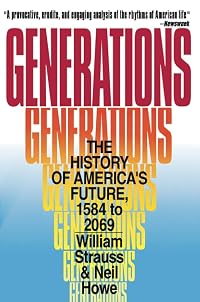
Generations: The History of America's Future, 1584 to 2069
by Neil Howe, William Strauss
On This Page
Description
Hailed by national leaders as politically diverse as former Vice President Al Gore and former House Speaker Newt Gingrich, Generations has been heralded by reviewers as a brilliant, if somewhat unsettling, reassessment of where America is heading. William Strauss and Neil Howe posit the history of America as a succession of generational biographies, beginning in 1584 and encompassing every-one through the children of today. Their bold theory is that each generation belongs to one of four show more types, and that these types repeat sequentially in a fixed pattern. The vision of Generations allows us to plot a recurring cycle in American history-a cycle of spiritual awakenings and secular crises-from the founding colonists through the present day and well into this millennium. Generations is at once a refreshing historical narrative and a thrilling intuitive leap that reorders not only our history books but also our expectations for the twenty-first century. show lessTags
Recommendations















Member Reviews
I read this book over twenty years ago and it made such a impression on me, I talk about its premise regularly and felt the need to re-read, given today's political climate. The authors William Strauss and Neil Howe do a masterful job of marshaling their data to support their theory that history can be looked at as a succession of generational biographies beginning in 1584 and encompassing everyone through the current Millennials. Each of these generations belong to one of four types that repeat sequentially within the normal human lifespan and have distinct personalities. The book was published in 1991--the year my daughter was born--and I've watched in fascination as the situations Strauss and Howe predicted for the past 26 years have show more come to pass. They also predict a major national crisis on about 2020. So no, I'm not looking forward to the next four years. Highly recommended. show less
I read this book in the early '90s and it pretty much changed the way I looked at U.S. history and society. I even built a website using their ideas (timepage.org). Even though I am totally unwilling to say whether I believe the logic that Strauss and Howe put forth in the book, I will say that their ideas have permanently altered my perception of how history happens. It isn't just me either. When I first read the book the only generational idea I had been exposed to was the baby boomer buzz but, since then, many of the authors ideas and much of their nomenclature has crept into the popular vernacular. Over time I have come to believe that the power of this idea (Strauss and Howe's Generational theory) lies in its ability to place the show more seemingly inexplicable and unpredictable events in U.S. history into some sort of regular order. Whether this apparent logical order is a direct result of the generational dynamics they describe, some other social phenomena or nothing at all, it barely matters. It all seems to so logical. World War II? Of course, what else could have happened? One thing to keep in mind is that the generational characteristics that are assigned to the various generation types needn't apply to yourself or other individuals. You don't want to take it personal. Everyone in the generation doesn't have to demonstrate all, or any, of the characteristics. The cohort is what matters. It is what you do as a group that makes you part of a generation instead of a bunch of random individuals. Strauss and Howe wrote a later book called "The Fourth Turning" that applies generational theory to our present situation in time. In that book they "updated" some of the terminology and pushed the theory out there a little more. There is a website of the same name that is filled with some real converts to the generational model if you want to pursue these ideas further. show less
There are several aspects of this book to review. Writing style: a bit dry. This is forgivable: the authors are laying out a hypothesis that covers almost 500 years of American history, and they want to make sure you've got all their evidence. I figure the book could've been tightened up, but I guess it's better they erred on the side of too much explanation rather than not enough.
The generational theory: plausible and fascinating. The authors summarize the history of 14 generations of Americans, showing how each generation fits into a cycle of four types and how these types interact. At the same time, they detail how American history alternates between spiritual awakenings and crises that usually hit at predictable intervals. It takes show more a while to get through this part of the book, but it's interesting to see the patterns develop.
The predictions: some hits, some misses. By now, 17 years after first publication, there's been time to see if the authors' theories would hold up. They've been doing better at cultural trends rather than events. I don't place the "alienating event" they thought would hit in the 1990s, but they did a fine job of describing the culture of helicopter parents years before that became a catchphrase. Still, it's hard to watch the economy crash, hear about environmental problems settling in, catch the news on the latest terrorist attack, and not think of their predicted Crisis of 2020, more or less on schedule.
The book will take time to get through (and you could skim parts of it), but there are worse ways to spend your free time. show less
The generational theory: plausible and fascinating. The authors summarize the history of 14 generations of Americans, showing how each generation fits into a cycle of four types and how these types interact. At the same time, they detail how American history alternates between spiritual awakenings and crises that usually hit at predictable intervals. It takes show more a while to get through this part of the book, but it's interesting to see the patterns develop.
The predictions: some hits, some misses. By now, 17 years after first publication, there's been time to see if the authors' theories would hold up. They've been doing better at cultural trends rather than events. I don't place the "alienating event" they thought would hit in the 1990s, but they did a fine job of describing the culture of helicopter parents years before that became a catchphrase. Still, it's hard to watch the economy crash, hear about environmental problems settling in, catch the news on the latest terrorist attack, and not think of their predicted Crisis of 2020, more or less on schedule.
The book will take time to get through (and you could skim parts of it), but there are worse ways to spend your free time. show less
I fund Part II, where the authors describe and analyze the nature, style and tendencies of every American generation from the first Puritans through the early 1990s, to be highly thought-provoking. The rest of the book is tedious in the extreme.
A lot lost without PDF figures and illustrations. The first line of the book refers to figures and illustrations in ebook. Without those the thesis IS less compelling. Sort of a self fulfilling prophecy. Many Audible titles have downloadable PDFs. Off the authors had really wanted to be convincing they would have included those rather than referring to out of print physical books. A bit greedy on their part.
Also it suffers some from having been published more than 30 years ago. Some of their forecasts have come true.
Now I need to read the fourth turning.
Also it suffers some from having been published more than 30 years ago. Some of their forecasts have come true.
Now I need to read the fourth turning.
Reread in 2017 to see if the future is panning out as predicted. Many predictions seem right on although I don't see Millennials as civic minded but rather narcissistic.
Maybe they just haven't been galvanized by purpose yet.
Maybe they just haven't been galvanized by purpose yet.
Amazingly pretty accurate 18 years later.
Members
- Recently Added By
Lists

culture
320 works; 1 member
Author Information

15 Works 2,990 Members
Neil Howe is the author of Generations, 13th Gen, and The Fourth Turning. He lives in McLean, Virginia. (Bowker Author Biography)

11 Works 2,797 Members
William Strauss is the author of Generations, 13th Gen, and The Fourth Turning. He lives in McLean, Virginia. (Bowker Author Biography)
Work Relationships
Common Knowledge
- Original publication date
- 1991
- Dedication
- To our grandparents and grandchildren, whose lives will touch parts of four centuries.
Classifications
Statistics
- Members
- 729
- Popularity
- 38,832
- Reviews
- 10
- Rating
- (4.03)
- Languages
- English, Spanish
- Media
- Paper, Audiobook, Ebook
- ISBNs
- 4
- ASINs
- 7