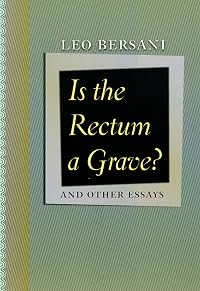
Is the Rectum a Grave?: and Other Essays
by Leo Bersani
On This Page
Description
Over the course of a distinguished career, critic Leo Bersani has tackled a range of issues in his writing, and this collection gathers together some of his finest work. Beginning with one of the foundations of queer theory-his famous meditation on how sex leads to a shattering of the self, "Is the Rectum a Grave?"-this volume charts the inspired connections Bersani has made between sexuality, psychoanalysis, and aesthetics. Over the course of these essays, Bersani grapples with thinkers show more ranging from Plato to Descartes to Georg Simmel. Foucault and Freud recur as key show lessTags
Recommendations












































Member Reviews
Bersani's Is the Rectum a Grave? is largely a project to put Focault's injunction to look for new ways of relating to each other, psychoanalytical thought, and aesthetics in conversation with each other. Because it is a collection of essays, lectures, and interviews, it gets a tad repetitive at times, but this repetition is also helpful in that it approaches the same questions from a variety of ways. Ultimately, Bersani's writing addresses "our most urgent project now: redefining modes of relationally and community, the very notion of sociality" (172).
"Is the Rectum a Grave?" is foundation for queer theory, and is largely a response to representation of HIV/AIDS in popular discourses. Bersani argues that popular media doesn't teach a show more lot about HIV/AIDS, but can teach us a lot about heterosexual anxieties about HIV/AIDS, homosexuals, and families. This media is geared toward heterosexuals, and helps to make "the family mean in a certain way" (9). Bersani also outlines how discourses about AIDS equate promiscuity with infection (18) and portrays gays as killers (17). He logically argues that the claims of MacKinnon and Dworkin are right in a way: pornography can be realism and denigrating toward women. The ultimate logic of their argument, however, is "the criminalization of sex itself until it has been reinvented" (20), and he actually sees MacKinnon and Dworkin as sharing assumptions with Foucault, Weeks, and others: that sex needs to be redefined. His problem with Dworkin and MacKinnon is their pastoralization of sex: they ignore "the inestimable value of sex as—at least in certain of its ineradicable aspects—anticommunal, antiegalitarian, antinurturing, antiloving" (22). Bersani argues for the value of powerlessness in sex: the "radical disintegration and humiliation of the self" (24). We need to reinvent the body, and Bersani argues that gay men (and everyone) should not be modeling sex off of patriarchal, heterosexual pastoral sex: the value of sexuality itself is to demean the seriousness of efforts to redeem it" (29). He concludes that "The self is a practical convenience; promoted to these status of an ethical ideal, it is a section for violence" (30).
Other ideas/quotes:
"An important function of art might be redefined as anticommunitarian, against (to the extent that this is possible) institutional assimilations of particular works" (34).
Value of homes: "Our implicit and involuntary message might be that we aren't sure of how we want to be social, and that we therefore invite straights to redefine with us the notions of community and sociality" (38).
On shame: "we will never participate in the invention of what Foucault called 'new relational models' if we merely assert the dignity of a self we have been told to be ashamed of" (69).
Teaching: "it's a sustained time and space where you do nothing but see who a group of people are going to connect" (200).
"Pedagogy and friendship are modes of extensibility less glamorous than public sex (a current queer favorite) but perhaps more worthy of exploration. . . . To redefine friendship would be a political move" (201). show less
"Is the Rectum a Grave?" is foundation for queer theory, and is largely a response to representation of HIV/AIDS in popular discourses. Bersani argues that popular media doesn't teach a show more lot about HIV/AIDS, but can teach us a lot about heterosexual anxieties about HIV/AIDS, homosexuals, and families. This media is geared toward heterosexuals, and helps to make "the family mean in a certain way" (9). Bersani also outlines how discourses about AIDS equate promiscuity with infection (18) and portrays gays as killers (17). He logically argues that the claims of MacKinnon and Dworkin are right in a way: pornography can be realism and denigrating toward women. The ultimate logic of their argument, however, is "the criminalization of sex itself until it has been reinvented" (20), and he actually sees MacKinnon and Dworkin as sharing assumptions with Foucault, Weeks, and others: that sex needs to be redefined. His problem with Dworkin and MacKinnon is their pastoralization of sex: they ignore "the inestimable value of sex as—at least in certain of its ineradicable aspects—anticommunal, antiegalitarian, antinurturing, antiloving" (22). Bersani argues for the value of powerlessness in sex: the "radical disintegration and humiliation of the self" (24). We need to reinvent the body, and Bersani argues that gay men (and everyone) should not be modeling sex off of patriarchal, heterosexual pastoral sex: the value of sexuality itself is to demean the seriousness of efforts to redeem it" (29). He concludes that "The self is a practical convenience; promoted to these status of an ethical ideal, it is a section for violence" (30).
Other ideas/quotes:
"An important function of art might be redefined as anticommunitarian, against (to the extent that this is possible) institutional assimilations of particular works" (34).
Value of homes: "Our implicit and involuntary message might be that we aren't sure of how we want to be social, and that we therefore invite straights to redefine with us the notions of community and sociality" (38).
On shame: "we will never participate in the invention of what Foucault called 'new relational models' if we merely assert the dignity of a self we have been told to be ashamed of" (69).
Teaching: "it's a sustained time and space where you do nothing but see who a group of people are going to connect" (200).
"Pedagogy and friendship are modes of extensibility less glamorous than public sex (a current queer favorite) but perhaps more worthy of exploration. . . . To redefine friendship would be a political move" (201). show less
I intitially got this book for the title essay, but I'm really glad I read it all, because in some ways, it expands and makes legible what I found so frustrating about the first essay. (I will say, I've been ranking queer theorists--as much as Bersani resists that label--by how they make me feel; so far, it's Edelman makes me feel both stupid and angry, but Bersani makes me feel stupid but not angry.) I really think the rest of the book fleshes out what Bersani tries to say in "Is the Rectum a Grave?" which is good because to me, that essay feels massively unfinished. I will also say that it might really help your understanding of the book if you have a firmer grasp than I do on psychoanalytic theory (which is to say, any grasp at all.) show more I will probably be revisiting this again (I've already read the title essay three times, trying to understand it,) and am looking for people to talk with about it! show less
Ratings
Members
- Recently Added By
Lists

Want to Read
12 works; 1 member
Author Information

32+ Works 898 Members
Leo Bersani is professor emeritus of French at University of California, Berkeley, and the author of numerous books, most recently Thoughts and Things, also published by the University of Chicago Press.
Classifications
- Genres
- Nonfiction, Sexuality and Gender Studies, LGBTQ+, Literature Studies and Criticism, Philosophy, General Nonfiction
- DDC/MDS
- 155.3 — Philosophy & psychology Psychology Differential and developmental psychology Sexuality and Gender
- LCC
- BF175.5 .S48 .B47 — Philosophy, Psychology and Religion Psychology Psychology Psychoanalysis
- BISAC
Statistics
- Members
- 90
- Popularity
- 356,374
- Reviews
- 2
- Rating
- (2.94)
- Languages
- English, French
- Media
- Paper, Ebook
- ISBNs
- 4