On This Page
Description
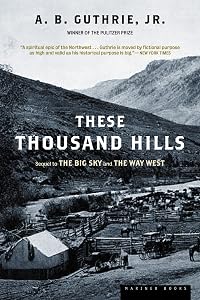
In These Thousand Hills, the third installment of A. B. Guthrie, Jr.'s Big Sky series, we follow Lat Evans (grandson of Lije Evans from the second book in the series, The Way West) as he negotiates the untamed, raucous world of cattle ranchers in the 1880s. Evans begins as a gentle cowboy, seeking a more prosperous life than his meager upbringing promised. His rise to fortune is a tempestuous one, complete with moral dilemmas and shady characters who would lead him astray. Evans finds show more prosperity with winnings from a horse race and a loan from a prostitute. But when he realizes his political ambitions may be waylaid by his checkered past, he truly learns the price of compromise.. show less
Tags
Recommendations


















Member Reviews
A. B. Guthrie's Big Sky novels have always been slow-paced, but These Thousand Hills, the third in the Western sequence (or fourth, if you place Fair Land, Fair Land chronologically after The Way West), is so slow as to lose all momentum, and it stalls on the uphill climb.
It is the first book in the series not to follow the mountain men Boone Caudill or Dick Summers, and the replacement character – the rancher Lat Evans – takes a good while to become interesting. The first half of the story is a mush – it never becomes turgid, just uneventful – and we don't know why we, the reader, should be paying attention. Later, Lat's character angst is shown to be how he wants his life to be "open and solid and respectable" (pg. 244), but show more this pursuit of social and moral respectability is much less exciting than the slow but wild roaming of Caudill and Summers in the previous books.
There's much less of the descriptive landscape writing that could take your breath away in the other books, and while These Thousand Hills gets more interesting in its final third, it's such an unnecessarily long burn for such a small spark. Guthrie tries to morph his antagonist's angst into a sort of classical, code-driven man-of-the-West ("Carmichael watched him, thinking how lonely the right was, or what men took for right" (pg. 323)), but the novel lacks the drama to really bring that out. The only conclusion to reach, for all that the book is well-written, is that These Thousand Hills doesn't reward the reader's perseverance to anything like the extent the other books in the sequence did. It survives in reputation only by its composure and the general goodwill extended by fans towards Westerns. It reverses its stall and continues its uphill climb, but your muscles groan as you follow and the blood fails to stir. show less
It is the first book in the series not to follow the mountain men Boone Caudill or Dick Summers, and the replacement character – the rancher Lat Evans – takes a good while to become interesting. The first half of the story is a mush – it never becomes turgid, just uneventful – and we don't know why we, the reader, should be paying attention. Later, Lat's character angst is shown to be how he wants his life to be "open and solid and respectable" (pg. 244), but show more this pursuit of social and moral respectability is much less exciting than the slow but wild roaming of Caudill and Summers in the previous books.
There's much less of the descriptive landscape writing that could take your breath away in the other books, and while These Thousand Hills gets more interesting in its final third, it's such an unnecessarily long burn for such a small spark. Guthrie tries to morph his antagonist's angst into a sort of classical, code-driven man-of-the-West ("Carmichael watched him, thinking how lonely the right was, or what men took for right" (pg. 323)), but the novel lacks the drama to really bring that out. The only conclusion to reach, for all that the book is well-written, is that These Thousand Hills doesn't reward the reader's perseverance to anything like the extent the other books in the sequence did. It survives in reputation only by its composure and the general goodwill extended by fans towards Westerns. It reverses its stall and continues its uphill climb, but your muscles groan as you follow and the blood fails to stir. show less
Guthrie like Zane Grey, Max Brand, L’amour, and others reflect the eras in which they wrote. That is to say, maybe the tone, language, and sensibilities are a little dated. Having conceded such, it is the only point which may pull a reader out of a superb story.
An old timer told me Guthrie was the best western writer. Prior to reading The Way West, I would have argued for Kelton or certainly McMurtry. Guthrie weaves exposition into the story so effortlessly we turn the page, never appreciating we’ve absorbed a history course.
An old timer told me Guthrie was the best western writer. Prior to reading The Way West, I would have argued for Kelton or certainly McMurtry. Guthrie weaves exposition into the story so effortlessly we turn the page, never appreciating we’ve absorbed a history course.
[b:These Thousand Hills|202034|These Thousand Hills|A.B. Guthrie Jr.|https://i.gr-assets.com/images/S/compressed.photo.goodreads.com/books/1400129419l/202034._SY75_.jpg|915053] is the fourth of A. B. Guthrie’s Big Sky series that I have read. Much to my disappointment this is an okay, but not stellar, book. It is much in the vein of the cowboy movies we watched as children, Shane and 3:10 to Yuma, the struggle of a good man in a violent world, and it incorporates almost all the standard plot lines of that time.
Lat Evans is the son of Brownie and Mercy Evans, two characters we met in [b:The Way West|202033|The Way West (The Big Sky, #2)|A.B. Guthrie show more Jr.|https://i.gr-assets.com/images/S/compressed.photo.goodreads.com/books/1435723309l/202033._SY75_.jpg|915042]. He is basically a good man, but he has more than his share of hang-ups, and I would call some of his decisions at the least questionable. After a very slow start, the novel did pick up, but in the end, I didn’t care enough for any of the characters to shed a tear over their fates.
Guthrie’s great strength is his ability to write a scene that comes to life under his pen. He engages all the senses, so that I can see the breath of cold air, hear the coyotes, envision the stretches of white falling mile upon mile. As here:
In the distant darkness a squaw wailed for her dead, and dogs chimed in, joined by coyotes on the hills. They sent a shiver up the spine, of chill and lonesomeness and dread and hope of things to come.
Or as here:
It had been cold before but not close to this. This was as cold as cold ever could be. Even the campfire at night was only a whisper of warmth, a promise of heat somewhere in the world, maybe far off in Texas; but here in itself was the whole world, lapped white from skyline to skyline, with no end to be seen and none to be hoped for.
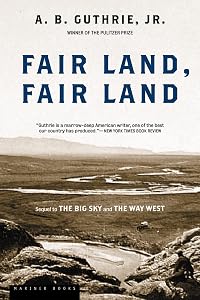
I highly recommend the first three books of this series. [b:The Way West|202033|The Way West (The Big Sky, #2)|A.B. Guthrie Jr.|https://i.gr-assets.com/images/S/compressed.photo.goodreads.com/books/1435723309l/202033._SY75_.jpg|915042] won a Pulitzer, and well deserved it. But, when you have finished [b:Fair Land, Fair Land|202032|Fair Land, Fair Land (The Big Sky, #3)|A.B. Guthrie Jr.|https://i.gr-assets.com/images/S/compressed.photo.goodreads.com/books/1388257675l/202032._SY75_.jpg|195470], you are done with the story. This book was not a continuation, it was another story altogether, not as fine a tale, and not as well told. show less
Lat Evans is the son of Brownie and Mercy Evans, two characters we met in [b:The Way West|202033|The Way West (The Big Sky, #2)|A.B. Guthrie show more Jr.|https://i.gr-assets.com/images/S/compressed.photo.goodreads.com/books/1435723309l/202033._SY75_.jpg|915042]. He is basically a good man, but he has more than his share of hang-ups, and I would call some of his decisions at the least questionable. After a very slow start, the novel did pick up, but in the end, I didn’t care enough for any of the characters to shed a tear over their fates.
Guthrie’s great strength is his ability to write a scene that comes to life under his pen. He engages all the senses, so that I can see the breath of cold air, hear the coyotes, envision the stretches of white falling mile upon mile. As here:
In the distant darkness a squaw wailed for her dead, and dogs chimed in, joined by coyotes on the hills. They sent a shiver up the spine, of chill and lonesomeness and dread and hope of things to come.
Or as here:
It had been cold before but not close to this. This was as cold as cold ever could be. Even the campfire at night was only a whisper of warmth, a promise of heat somewhere in the world, maybe far off in Texas; but here in itself was the whole world, lapped white from skyline to skyline, with no end to be seen and none to be hoped for.
I highly recommend the first three books of this series. [b:The Way West|202033|The Way West (The Big Sky, #2)|A.B. Guthrie Jr.|https://i.gr-assets.com/images/S/compressed.photo.goodreads.com/books/1435723309l/202033._SY75_.jpg|915042] won a Pulitzer, and well deserved it. But, when you have finished [b:Fair Land, Fair Land|202032|Fair Land, Fair Land (The Big Sky, #3)|A.B. Guthrie Jr.|https://i.gr-assets.com/images/S/compressed.photo.goodreads.com/books/1388257675l/202032._SY75_.jpg|195470], you are done with the story. This book was not a continuation, it was another story altogether, not as fine a tale, and not as well told. show less
It took a while for the story to fully develop, but when it did, it was quite good. Guthrie has created another character with such depth he has to be real, Lat Stevens.
Ratings
Members
- Recently Added By
Lists

National Book Award Finalists - Fiction
377 works; 12 members
Author Information

42+ Works 3,168 Members
A. B. Guthrie, Jr., is one of America's most celebrated writers of western literature. He received the 1950 Pulitzer Prize in fiction for "The Way West". Guthrie died in 1991. (Bowker Author Biography)
Awards and Honors
Awards
Distinctions
Series

Common Knowledge
- Original publication date
- 1956
- First words
- These three old men would sit and smoke and let a word fall and pause to hear the echoes of it as if they owned all time to speak their little pieces in.
- Last words
- (Click to show. Warning: May contain spoilers.)Then he went in.
Classifications
- Genres
- Fiction and Literature, General Fiction, Historical Fiction
- DDC/MDS
- 813.52 — Literature & rhetoric American literature in English American fiction in English 1900-1999 1900-1945
- LCC
- PS3513 .U855 .T45 — Language and Literature American literature American literature Individual authors 1900-1960
- BISAC
Statistics
- Members
- 182
- Popularity
- 180,289
- Reviews
- 4
- Rating
- (3.93)
- Languages
- English, French, Italian, Portuguese
- Media
- Paper, Audiobook
- ISBNs
- 16
- UPCs
- 1
- ASINs
- 12