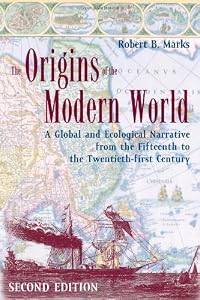
The Origins of the Modern World: A Global and Environmental Narrative from the Fifteenth to the Twenty-First Century (World Social Change)
by Robert B. Marks
On This Page
Description
This clearly written and engrossing book presents a global narrative of the origins of the modern world from 1400 to the present. Unlike most studies, which assume that the "rise of the West" is the story of the coming of the modern world, this history, drawing upon new scholarship on Asia, Africa, and the New World and upon the maturing field of environmental history, constructs a story in which those parts of the world play major roles, including their impacts on the environment. Robert B. show more Marks defines the modern world as one marked by industry, the nation state, interstate warfare, a large and growing gap between the wealthiest and poorest parts of the world, increasing inequality within the wealthiest industrialized countries, and an escape from the environmental constraints of the "biological old regime." He explains its origins by emphasizing contingencies (such as the conquest of the New World); the broad comparability of the most advanced regions in China, India, and Europe; the reasons why England was able to escape from common ecological constraints facing all of those regions by the end of the eighteenth century; a conjuncture of human and natural forces that solidified a gap between the industrialized and non-industrialized parts of the world; the mounting environmental crisis that defines the modern world; and the ways in which the forces of globalization stress the economic and political underpinnings of the modern world. Now in a new edition that brings the saga of the modern world to the present in an environmental context, the book considers how and why the United States emerged as a world power in the twentieth century and became the sole superpower by the twenty-first century, and why the changed relationship of humans to the environmental likely will be the hallmark of the modern era--the Anthropocene. Once again arguing that the US rise to global hegemon was contingent, not inevitable, Marks also points to the resurgence of Asia and the vastly changed relationship of humans to the environment that may in the long run overshadow any political and economic milestones of the past hundred years. show lessTags
Recommendations







Member Recommendations
Member Reviews
Snabbläst historik över kapitalismens uppkomst som driver tesen att det inte var en historisk nödvändighet att just Europa blev den dominerande aktören i världen under 1800-talet. Marks pekar på att Kina och Indien länge hade mycket större ekonomisk aktivitet än vad Europa hade, att Kina ville ha silver och därmed möjliggjorde handel, att Kina kunde ha valt att utveckla handeln i Indiska oceanen istället för att avveckla sin flotta, att England råkade ha stora koltillgångar och så vidare. Från början av 1800-talet menar han dock att utvecklingen hade drivits så långt att Europa kunde börja kolonisera områden och diktera villkoren för handeln på ett sätt som uppenbarligen gynnade kolonialmakten i fråga (England show more upprättade importtullar för de mycket billigare indiska textilierna under 1700-talet för att gynna sin egen industri, när britterna sedan lyckades producera billigare textilier blev de varma anhängare av "frihandel" under 1800-talet).
Boken driver en viss tes, men är ändå så allmängiltig att den kan läsas som en kort introduktion till världens ekonomiska utveckling 1400-1900. show less
Boken driver en viss tes, men är ändå så allmängiltig att den kan läsas som en kort introduktion till världens ekonomiska utveckling 1400-1900. show less
This brief book looks at the origins of the modern world through two lenses. The first is through "the old biological regime", which is the limits placed on population and economic growth in traditional agrarian societies. Marks looks at that regime from 1400-1800 and comes to the conclusion that Indian and China were the dominant forces because their agriculture was most advanced, as evidenced by their population. The second lens is fighting against a "Euro-centric" narrative of the modern world. By this, Marks means the story that India and China were backward while Europe was progressive, making the dominance of Europe inevitable. Marks argues against this by showing that a) India and China were the engines of the world economy up to show more 1800 and perhaps as late as 1850, b) Europe was "fortunate enough" (his favorite phrase) to have a series of advantages and accidental contingencies that allowed it to industrialize first. After industrializing, it proceeded to dominate the world and set up an international system that favored it while keeping the rest of the world impoverished, essentially creating the "Third World".
Overall, Marks makes a good case. There is little doubt that China in particular was much stronger economically in 1800, with a very sophisticated economy. There is also little doubt that Europe benefited from some nice contingencies, such as accessible coal and raw materials from colonies in the New World. He makes some reference to the economic systems that developed, particularly in Britain and the Netherlands, that allowed the government to extract greater revenue for use in war and to the competition between European states that drove that sort of innovation. All in all, his narrative is convincing.
The problems come from his insistence on fighting the Euro-centric viewpoint. He argues that there was nothing "better" or more deserving about Europe's system, nor was there anything inevitable about Europe's rise. I haven't heard any serious scholar make those claims in decades, so he is either creating a straw man to knock down or he is arguing against pop "historians". It's frustrating because it is a nice synthesis of the subject, but he makes no attempt to be balanced (which he admits early on).
He also doesn't touch on intellectual property rights, which were a significant part of industrialization in Britain. It's hard to compare Britain and China without mentioning that. I can't think of a good reason for that, except that it wouldn't fit into his argument.
Overall, this was well worth reading. It is concise (perhaps too much so) and easy to read. I would consider using it in my modern World Civilizations class except that his argument against Euro-centricism is completely lacking objectivity. If he toned it down a bit, the book would still show that Asia was the dominant region in the early modern world and that Europe had some very good luck to allow industrialization to happen. But I want my students to learn to make a balanced and nuanced argument and this is a bad example. So I'll use the ideas, including the "Old Biological Regime", and I'll mention Marks as the source, but I won't ask them to read it. show less
Overall, Marks makes a good case. There is little doubt that China in particular was much stronger economically in 1800, with a very sophisticated economy. There is also little doubt that Europe benefited from some nice contingencies, such as accessible coal and raw materials from colonies in the New World. He makes some reference to the economic systems that developed, particularly in Britain and the Netherlands, that allowed the government to extract greater revenue for use in war and to the competition between European states that drove that sort of innovation. All in all, his narrative is convincing.
The problems come from his insistence on fighting the Euro-centric viewpoint. He argues that there was nothing "better" or more deserving about Europe's system, nor was there anything inevitable about Europe's rise. I haven't heard any serious scholar make those claims in decades, so he is either creating a straw man to knock down or he is arguing against pop "historians". It's frustrating because it is a nice synthesis of the subject, but he makes no attempt to be balanced (which he admits early on).
He also doesn't touch on intellectual property rights, which were a significant part of industrialization in Britain. It's hard to compare Britain and China without mentioning that. I can't think of a good reason for that, except that it wouldn't fit into his argument.
Overall, this was well worth reading. It is concise (perhaps too much so) and easy to read. I would consider using it in my modern World Civilizations class except that his argument against Euro-centricism is completely lacking objectivity. If he toned it down a bit, the book would still show that Asia was the dominant region in the early modern world and that Europe had some very good luck to allow industrialization to happen. But I want my students to learn to make a balanced and nuanced argument and this is a bad example. So I'll use the ideas, including the "Old Biological Regime", and I'll mention Marks as the source, but I won't ask them to read it. show less
Ratings
Members
- Recently Added By
Author Information
5 Works 428 Members
Robert B. Marks is professor of history and environmental studies at Whittier College.
Classifications
- Genres
- History, Nonfiction, General Nonfiction, Science & Nature
- DDC/MDS
- 940.2 — History & geography History of Europe History of Europe Europe: Renaissance, Reformation, Enlightenment, Napolean
- LCC
- D203 .M37 — History of Europe, Asia, Africa and Oceania History (General) Medieval history Later medieval. 11th-15th centuries
- BISAC
Statistics
- Members
- 385
- Popularity
- 80,399
- Reviews
- 2
- Rating
- (3.67)
- Languages
- 6 — Chinese, English, German, Norwegian (Bokmål), Spanish, Swedish
- Media
- Paper, Audiobook, Ebook
- ISBNs
- 24
- ASINs
- 2