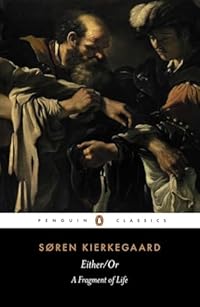
Either/Or: A Fragment of Life
by Søren Kierkegaard
On This Page
Description
In Either/Or, using the voices of two characters - the aesthetic young man of part one, called simply 'A', and the ethical Judge Vilhelm of the second section - Kierkegaard reflects upon the search for a meaningful existence, contemplating subjects as diverse as Mozart, drama, boredom, and, in the famous Seducer's Diary, the cynical seduction and ultimate rejection of a young, beautiful woman. A masterpiece of duality, Either/Or is a brilliant exploration of the conflict between the show more aesthetic and the ethical - both meditating ironically and seductively upon Epicurean pleasures, and eloquently expounding the noble virtues of a morally upstanding life. show lessTags
Recommendations







Member Reviews
Il tema di questo classico del pensiero esistenzialistico, uscito nel 1843, è la scelta di fondo che la persona concreta deve compiere riguardo alla propria esperienza, alla propria direzione di vita. La scelta non è tra bene e male, ma tra la visione etica ed estetica della vita. Scelta molto concreta che riguarda il nostro modo di organizzare esperienze e sensazioni, al nostro modo di amare e di dar senso al nostro amore. La scelta etica è la scelta della continuità, del significato, della presenza riconoscibile del bene e del male. La scelta estetica costringe alla discontinuità, ad una vita senza significato perchè incapace di organizzarsi in valori assoluti. Il salto di qualità, dal quale deriva la necessità eroica dello show more scegliere, sarà la disperazione: una disperazione attiva, che nasce dalla constatata assoluta esigenza di valori eterni nei quali la effimera presenza dell'uomo acquista un senso definitivo. L'esteta difende la sua estrema precarietà sottraendosi, prima che alla scelta, a questa illuminante disperazione. La filosofia conosce pochi libri più felici di questo, scritto con estro dialettico e affascinante fervore morale, impetuoso e severo, ma anche affettuoso e cordiale. show less
Either/Or is a two part/two book set; this book is part I, that is, the Either of Either/Or. For those unfamiliar with this work by the Danish philosopher, Either presents what Kierkegaard terms the aesthetic view of life. And since the aesthetic view of life embraces multiplicity and variation, this book isn’t a straightforward philosophical essay; rather, Kierkegaard’s aesthetic individual (herein called ‘A’) writes 8 different papers, each one from a different aesthetic angle.
For example, the first paper is a series of short journal entries, dozens of them, written in a highly polished literary language, covering the wide emotional range of A’s philosophical self-examination. In one entry we read, “I say of my sorrow what show more the Englishman says of his house: My sorrow is my castle.”, and in another entry we read, “I have never been joyful, and yet it has always seemed as if joy were my constant companion, as if the buoyant jinn of joy danced around me." If this sounds contradictory . . .well, such is the aesthetic life.
The aesthetic life finds delectable fruit in music. In the nearly 100 page paper “The Immediate Erotic Stages” the author analyzes Mozart’s Don Giovanni. Anybody interested in Mozart and/or music will find this paper highly engaging and insightful. Toward the end, we read, “What It means to say – that Don Giovanni’s essential nature is music – is clearly apparent here. He dissolves, as it were, in music for us; he unfurls in a world of sound. . . . Such is his life, effervescing like champagne. And just as the beads in this wine, as it simmers with an internal heat, sonorous with its own melody, rise and continue to rise, just so the lust for enjoyment resonates in the elemental boiling that is his life.” This passage is typical of what one finds in Kierkegaard’s writing – colorful, poetic, highly engaging and thought-provoking.
One of the most lively papers is entitled ‘Rotation of Crops’ where the author invites us to consider ways to avoid boredom. For example: if you are obliged to listen to the words of a person you find boring, then simply shift your focus, rather than listening to him speak, watch the perspiration on his forehead or nose. Again, another example: if you are bored of living in your current city or country, simply move to another city or country. The trick is learning how to vary your activities and surroundings, to rotate your pleasures the way a farmer rotates his crops.
In the spirit of rotating pleasures to experience novel sensations, the author encourages his own country of Denmark to do something dramatic: “Borrow fifteen million, use it not to pay off our debts but for public entertainment. Let us celebrate the millennium with fun and games. . . . Everything would be free: the theater would be free, prostitutes would be free, rides to Deer Park would be free, funerals would be free, one’s own funeral eulogy would be free. I say “free” for if money is always available, everything is free in a way.” A bit of ironic tongue-in-cheek but, then again, why not, if life is to be lived on the level of an aesthete.
Jean Richepin, the decadent fin-de-siècle French author, wrote a story about a man who took the aesthetic life to the extreme, becoming ‘the dandy of the unpredictable’. This man possessed all the qualities needed to become a great poet, musician and painter, but rejected such things since he saw these accomplishments as too vulgar and altogether beneath him. So, what did this dandy of the unpredictable do? He murdered his mistress, embalmed her, and continued to be her lover. Then, living up to his creed of unpredictability, he confessed his crime and spent the last hours of his life in jail inventing a novel dance-step and creating a original oyster sauce. Kierkegaard’s aesthetic A would understand and appreciate his actions, for, after all, he avoided boring himself and certainly didn’t bore others.
So, the aesthetic life is to live on the surface of things, where one has a need to continually keep changing activities since one has become inured to the simple joys of life. Does all this sound vaguely familiar? Recall how back in the 1970s Alexander Solzhenitsyn said the Western world, in his estimation, would never serve as a model for a free society since it was enslaved to commercialism, intolerable music and TV stupor. In other words, according to Solzhenitsyn, we are an entire society of aesthetes.
Kierkegaard viewed his task to be the Socrates of Copenhagen, to wake us up from our comfortable stupor, to look inward and examine our lives as individuals capable of spiritual depth. This book by Kierkegaard is not only imaginative, vibrant literature but also deeply profound philosophy. show less
Either/Or is a two part/two book set; this book is part I, that is, the Either of Either/Or. For those unfamiliar with this work by the Danish philosopher, Either presents what Kierkegaard terms the aesthetic view of life. And since the aesthetic view of life embraces multiplicity and variation, this book isn’t a straightforward philosophical essay; rather, Kierkegaard’s aesthetic individual (herein called ‘A’) writes 8 different papers, each one from a different aesthetic angle.
For example, the first paper is a series of short journal entries, dozens of them, written in a highly polished literary language, covering the wide emotional range of A’s philosophical self-examination. In one entry we read, “I say of my sorrow what show more the Englishman says of his house: My sorrow is my castle.”, and in another entry we read, “I have never been joyful, and yet it has always seemed as if joy were my constant companion, as if the buoyant jinn of joy danced around me." If this sounds contradictory . . .well, such is the aesthetic life.
The aesthetic life finds delectable fruit in music. In the nearly 100 page paper “The Immediate Erotic Stages” the author analyzes Mozart’s Don Giovanni. Anybody interested in Mozart and/or music will find this paper highly engaging and insightful. Toward the end, we read, “What It means to say – that Don Giovanni’s essential nature is music – is clearly apparent here. He dissolves, as it were, in music for us; he unfurls in a world of sound. . . . Such is his life, effervescing like champagne. And just as the beads in this wine, as it simmers with an internal heat, sonorous with its own melody, rise and continue to rise, just so the lust for enjoyment resonates in the elemental boiling that is his life.” This passage is typical of what one finds in Kierkegaard’s writing – colorful, poetic, highly engaging and thought-provoking.
One of the most lively papers is entitled ‘Rotation of Crops’ where the author invites us to consider ways to avoid boredom. For example: if you are obliged to listen to the words of a person you find boring, then simply shift your focus, rather than listening to him speak, watch the perspiration on his forehead or nose. Again, another example: if you are bored of living in your current city or country, simply move to another city or country. The trick is learning how to vary your activities and surroundings, to rotate your pleasures the way a farmer rotates his crops.
In the spirit of rotating pleasures to experience novel sensations, the author encourages his own country of Denmark to do something dramatic: “Borrow fifteen million, use it not to pay off our debts but for public entertainment. Let us celebrate the millennium with fun and games. . . . Everything would be free: the theater would be free, prostitutes would be free, rides to Deer Park would be free, funerals would be free, one’s own funeral eulogy would be free. I say “free” for if money is always available, everything is free in a way.” A bit of ironic tongue-in-cheek but, then again, why not, if life is to be lived on the level of an aesthete.
Jean Richepin, the decadent fin-de-siècle French author, wrote a story about a man who took the aesthetic life to the extreme, becoming ‘the dandy of the unpredictable’. This man possessed all the qualities needed to become a great poet, musician and painter, but rejected such things since he saw these accomplishments as too vulgar and altogether beneath him. So, what did this dandy of the unpredictable do? He murdered his mistress, embalmed her, and continued to be her lover. Then, living up to his creed of unpredictability, he confessed his crime and spent the last hours of his life in jail inventing a novel dance-step and creating a original oyster sauce. Kierkegaard’s aesthetic A would understand and appreciate his actions, for, after all, he avoided boring himself and certainly didn’t bore others.
So, the aesthetic life is to live on the surface of things, where one has a need to continually keep changing activities since one has become inured to the simple joys of life. Does all this sound vaguely familiar? Recall how back in the 1970s Alexander Solzhenitsyn said the Western world, in his estimation, would never serve as a model for a free society since it was enslaved to commercialism, intolerable music and TV stupor. In other words, according to Solzhenitsyn, we are an entire society of aesthetes.
Kierkegaard viewed his task to be the Socrates of Copenhagen, to wake us up from our comfortable stupor, to look inward and examine our lives as individuals capable of spiritual depth. This book by Kierkegaard is not only imaginative, vibrant literature but also deeply profound philosophy. show less
This is a classic of philosophy. Kierkegaard said not to read just one section of this book. But, that's what i did..lol.. The concept behind the whole book i've got though, so its okay. His idea is that there are two different ways of living your life, ascetically or morally according to the laws of whatever..religion, etc., and aesthetically or in the pursuit of beauty and pleasure for your own artistic reasons. Kierkegaard never really tells which one is best and that is for the reader to decide..maybe..perhaps he is saying that some blend of the two is ideal, and that to pursue either approach exlusively is wrong. That's what i believe. Regardless, I read this for the aesthetic parts, and his Seducers diary especially is a show more fascinating work on its own. I love the thoughts and characterization of Johannes, they are as you might expect, beautiful. show less
Essentially an argument that one should make a choice between the aesthetic way of life and the ethical way of life. Although as one reads deeply into the book he finds that the choice is not a simple one and the difficulties in discerning how to make the choice are manifold. This is not a book for the general or light reader, but one rather that rewards deep reading and thought about how one really should make choices in the direction of one's life.
The first part about the aesthetic is much more readable than the second part about the ethical. It is hard to understand how the same man wrote these two excerpts!
“I have always loved, on a moonlit night, to lie out in a boat on one of our lovely lakes. I take in the sails and the oars, remove the rudder, stretch out full-length, and gaze up into the vault of heaven. When the boat rocks on the breast of the waves, when the clouds scud before the strong wind so that the moon vanishes for a moment and then reappears, I find rest in this unrest. The motion of the waves lulls me, their lapping against the boat is a monstrous cradle-song.”
“Doubt, therefore, lies in difference, despair in the absolute. It requires talent to doubt, it show more requires no talent at all to despair; but talent as such is difference and what needs talent to make it effectual can never be the absolute, for it is only for the absolute that the absolute can be absolute as such.”
Perhaps the philosophy loses meaning in the translation. Perhaps I should reread the introductory explanations, or get a copy of the Cliff Notes. But I am too exhausted from slogging through to the end, to start over. I’ll just accept that I did my duty to give it a try, and remember some of the beautiful lines from the beginning. show less
“I have always loved, on a moonlit night, to lie out in a boat on one of our lovely lakes. I take in the sails and the oars, remove the rudder, stretch out full-length, and gaze up into the vault of heaven. When the boat rocks on the breast of the waves, when the clouds scud before the strong wind so that the moon vanishes for a moment and then reappears, I find rest in this unrest. The motion of the waves lulls me, their lapping against the boat is a monstrous cradle-song.”
“Doubt, therefore, lies in difference, despair in the absolute. It requires talent to doubt, it show more requires no talent at all to despair; but talent as such is difference and what needs talent to make it effectual can never be the absolute, for it is only for the absolute that the absolute can be absolute as such.”
Perhaps the philosophy loses meaning in the translation. Perhaps I should reread the introductory explanations, or get a copy of the Cliff Notes. But I am too exhausted from slogging through to the end, to start over. I’ll just accept that I did my duty to give it a try, and remember some of the beautiful lines from the beginning. show less
I found this work quite engaging for a work of philosophy in a foreign language. There is a lot of characterization, the the premise, that either impulse, as shown by the imagined life of an "arty" artist, is king, or we live an life bound by rigorous adherence to a set of principles. the latter pattern is illustrated by a conversation with an imagined judge. The book was I hope well translated in the edition whose cover I have attached.
Members
- Recently Added By
Lists

Existentialism
90 works; 11 members

Fakes, Forgeries, and Fictitious Authors
112 works; 4 members

Philosophy, Politics and Economics
61 works; 1 member

Philip Ward's Lifetime Reading Plan
592 works; 22 members
Author Information

625+ Works 33,011 Members
Born in Copenhagen, Denmark, Søren Kierkegaard was the son of a wealthy middle-class merchant. He lived all his life on his inheritance, using it to finance his literary career. He studied theology at the University of Copenhagen, completing a master's thesis in 1841 on the topic of irony in Socrates. At about this time, he became engaged to a show more woman he loved, but he broke the engagement when he decided that God had destined him not to marry. The years 1841 to 1846 were a period of intense literary activity for Kierkegaard, in which he produced his "authorship," a series of writings of varying forms published under a series of fantastic pseudonyms. Parallel to these, he wrote a series of shorter Edifying Discourses, quasi-sermons published under his own name. As he later interpreted it in the posthumously published Point of View for My Work as an Author, the authorship was a systematic attempt to raise the question of what it means to be a Christian. Kierkegaard was persuaded that in his time people took the meaning of the Christian life for granted, allowing all kinds of worldly and pagan ways of thinking and living to pass for Christian. He applied this analysis especially to the speculative philosophy of German idealism. After 1846, Kierkegaard continued to write, publishing most works under his own name. Within Denmark he was isolated and often despised, a man whose writings had little impact in his own day or for a long time afterward. They were translated into German early in the twentieth century and have had an enormous influence since then, on both Christian theology and the existentialist tradition in philosophy. (Bowker Author Biography) show less
Some Editions
Awards and Honors
Series
Belongs to Publisher Series
Work Relationships
Is contained in
Contains
Inspired
Common Knowledge
- Canonical title
- Either/Or: A Fragment of Life
- Original title
- Enten-Eller
- Alternate titles*
- Entweder – Oder. Ein Lebensfragment
- Original publication date
- 1843; 1943 (French, Guignot-Prior) (French, Guignot-Prior)
- First words*
- Amico mio! Quello che ti ho già detto tante volte, te lo ripeto, anzi te lo grido: o questo o quello, aut-aut! L'importanza dell'argomento giustifica l'uso delle parole.
- Original language
- Danish
- Canonical DDC/MDS
- 198.9
- Canonical LCC
- PT8142.E57 E5
*Some information comes from Common Knowledge in other languages. Click "Edit" for more information.
Classifications
- Genres
- Philosophy, Nonfiction, Religion & Spirituality
- DDC/MDS
- 198.9 — Philosophy and Psychology Modern western philosophy Philosophy of Scandinavia and Finland Denmark
- LCC
- PT8142 .E57 .E5 — Language and Literature German, Dutch and Scandinavian literatures Danish literature Individual authors or works 19th century
- BISAC
Statistics
- Members
- 2,283
- Popularity
- 8,691
- Reviews
- 17
- Rating
- (3.91)
- Languages
- 16 — Czech, Danish, Dutch, English, Finnish, French, German, Hungarian, Italian, Polish, Portuguese, Serbian, Slovak, Spanish, Swedish, Turkish
- Media
- Paper, Ebook
- ISBNs
- 40
- ASINs
- 20