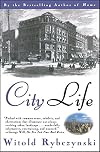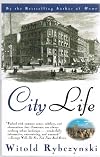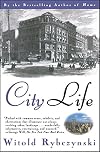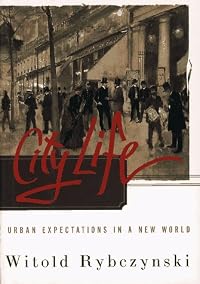
City Life: Urban Expectations In A New World
by Witold Rybczynski
On This Page
Description
In City Life, Witold Rybczynski looks at what we want from cities, how they have evolved, and what accounts for their unique identities. In this vivid description of everything from the early colonial settlements to the advent of the skyscraper to the changes wrought by the automobile, the telephone, the airplane, and telecommuting, Rybczynski reveals how our urban spaces have been shaped by the landscapes and lifestyles of the New World.Tags
Recommendations




















Member Reviews
There are lots of interesting insights about cities, especially their planning and architecture in this small book.. It's easy reading and well researched. It's even enjoyable. But I kept seeing shortcomings. There's lots of verbal descriptions, but not a single photo or drawing. Perhaps the author doesn't believe a picture's worth a thousand words. Other omissions are even more important. The word segregation never appears. There's a brief discussion of Afro-American migration and definitely a description why urban renewal and housing projects were gigantic failures. But not a word about redlining, restricted covenants, the prohibitions in FHA mortgages and the GI bill. Not a word about Robert Moses. And other over sights, Atlanta and show more Portland barely mentioned. I wanted more.
Eventually the title seemed too simplistic. Perhaps it should have been City Life from an Architect's Point of View. At the end of the book the author's biases became very clear. He praises the small town which he defines as having a population of about 10,000. Really? I think of a small town as having a population of 50,000 to 100,000. Yes this is worth reading. Just expect to feel hungry at the end. show less
Eventually the title seemed too simplistic. Perhaps it should have been City Life from an Architect's Point of View. At the end of the book the author's biases became very clear. He praises the small town which he defines as having a population of about 10,000. Really? I think of a small town as having a population of 50,000 to 100,000. Yes this is worth reading. Just expect to feel hungry at the end. show less
Over a dozen years ago Rybczynski's book City Life made me care about urban planning. He introduced me to the concept that cities, like living things, evolve. American cities are the way they are for a reason; we adapt where we live to how we live. And because we live differently from Europeans, Africans and Asians - our cities are different from theirs.
Just like there are layers of complexity to the natural world , the same is true of the man- made.
Rybczynski describes the American city in its many incarnations - New York, Chicago, D.C., Boston, etc. He points out the connections that aren't always obvious to the rest of us. For example, when Alexis de Tocqueville came to America in 1831 all was not as he expected.
' He had read James show more Fenimore Cooper's novels set in the wilderness, and he anticipated that a nation that included pioneering settlers as well as urban patricians would display cultural extremes even more striking than those between the rustic French provinces and the sophisticated capitale. A travel essay he published describes how a visit to the frontier (present day Michigan) confounded his expectations. "When you leave the main roads your force your way down barely trodden paths. Finally, you see a field cleared, a cabin made from half-shaped tree trunks admitting light though only one narrow window only. You think that you have at last reached the home of the American peasant. Mistake. You make your way into this cabin that seems the asylum of all wretchedness but the owner of the place is dressed in the same clothes as yours and he speaks the language of towns. On his rough table are books and newspapers; he himself is anxious to know what is happening in Europe and asks you to tell him w hat has most struck you in his country." Toqueville continued: "One might think one was meeting a rich landowner who had come to spend just a few nights in a hunting lodge." '
This national "urbanity" was due largely to the fact that the majority of early Americans dispersed into the wilderness (later into the suburbs) from cities/urban centers. The reverse was true in Europe - the more established peasant class often making their way into the big cities from the countryside. So, a defining aspect of the American character and culture is directly linked to how the country was geographically settled....
For a longer review, please go to BookSexy.wordpress.com show less
Just like there are layers of complexity to the natural world , the same is true of the man- made.
Rybczynski describes the American city in its many incarnations - New York, Chicago, D.C., Boston, etc. He points out the connections that aren't always obvious to the rest of us. For example, when Alexis de Tocqueville came to America in 1831 all was not as he expected.
' He had read James show more Fenimore Cooper's novels set in the wilderness, and he anticipated that a nation that included pioneering settlers as well as urban patricians would display cultural extremes even more striking than those between the rustic French provinces and the sophisticated capitale. A travel essay he published describes how a visit to the frontier (present day Michigan) confounded his expectations. "When you leave the main roads your force your way down barely trodden paths. Finally, you see a field cleared, a cabin made from half-shaped tree trunks admitting light though only one narrow window only. You think that you have at last reached the home of the American peasant. Mistake. You make your way into this cabin that seems the asylum of all wretchedness but the owner of the place is dressed in the same clothes as yours and he speaks the language of towns. On his rough table are books and newspapers; he himself is anxious to know what is happening in Europe and asks you to tell him w hat has most struck you in his country." Toqueville continued: "One might think one was meeting a rich landowner who had come to spend just a few nights in a hunting lodge." '
This national "urbanity" was due largely to the fact that the majority of early Americans dispersed into the wilderness (later into the suburbs) from cities/urban centers. The reverse was true in Europe - the more established peasant class often making their way into the big cities from the countryside. So, a defining aspect of the American character and culture is directly linked to how the country was geographically settled....
For a longer review, please go to BookSexy.wordpress.com show less
witold writes about urban planning with an ease and grace that defies most writers of much simpler subjects. i picked up this gem on an overstocked table in denver and when i got home found out it was a signed copy! yay me. in addition, it's a very well-written book that nicely compares the american urban evolutionary path to the european -- but not in an overly judgemental way.
Reading Rybczynski is like spelling his name. Fascinating and frustrating at the same time. His rambling style, excursions and personal anecdotes are interesting but ultimately distracting from the topic at hand. Most vexing are the omissions in his narrative. Does he not know or does he not care?
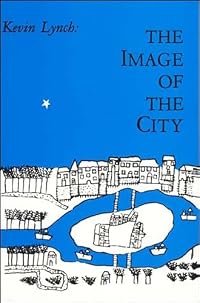
The book at hand deals with the development of the American city. His key question is: Why aren't North American cities like European ones? Frustratingly, he does not answer the question, presenting a history of urban development of the US in nine chapters: Kevin Lynch's types of cities (ch. 2); Spanish, French and English roots, grid and space (ch. 3); US individualism and aversion to public space (ch. 4); urban parks (ch. 5); railroad show more stations and public infrastructure (ch. 6); skyscrapers (Ch. 7); suburbs and public housing (ch. 8) and malls (ch. 9). The tenth chapter sees him moving from the Canadian border to Philly's suburbs.
The reader is left to distill the answer to Rybczynski's question himself among the morsels and underdeveloped themes. Most elements that feature prominently in his chapters are present in Europe (and the ignored rest of world) too, so they can not be the answer. As Rybczynski writes himself covered shopping malls existed in Milano and Paris before the US started building them (although the Americans upped the scale). Barcelona has a grid. The love of private space is not uncommon in England and elsewhere ... My explaining factors are geography, energy and government. The availability of unbroken, empty land and cheap energy were enablers. The major cause why US cities look so different from European ones is weak government which could not prevent the worst (broken ghettos and insufficient public infrastructure) and the best (skyscrapers) of US cities.
Overall, a rather weak book by Rybczynski. show less
The book at hand deals with the development of the American city. His key question is: Why aren't North American cities like European ones? Frustratingly, he does not answer the question, presenting a history of urban development of the US in nine chapters: Kevin Lynch's types of cities (ch. 2); Spanish, French and English roots, grid and space (ch. 3); US individualism and aversion to public space (ch. 4); urban parks (ch. 5); railroad show more stations and public infrastructure (ch. 6); skyscrapers (Ch. 7); suburbs and public housing (ch. 8) and malls (ch. 9). The tenth chapter sees him moving from the Canadian border to Philly's suburbs.
The reader is left to distill the answer to Rybczynski's question himself among the morsels and underdeveloped themes. Most elements that feature prominently in his chapters are present in Europe (and the ignored rest of world) too, so they can not be the answer. As Rybczynski writes himself covered shopping malls existed in Milano and Paris before the US started building them (although the Americans upped the scale). Barcelona has a grid. The love of private space is not uncommon in England and elsewhere ... My explaining factors are geography, energy and government. The availability of unbroken, empty land and cheap energy were enablers. The major cause why US cities look so different from European ones is weak government which could not prevent the worst (broken ghettos and insufficient public infrastructure) and the best (skyscrapers) of US cities.
Overall, a rather weak book by Rybczynski. show less
informative, somewhat dry, look at the forces and trends which have historically influenced the evolution of American cities and suburbs
Cultural history about the development of cities in the U.S., with specific reference to several, from Boston to Williamsburg. As ever, Rybczynski's prose is a delight.
Ratings
Members
- Recently Added By
Author Information

31+ Works 6,191 Members
Witold Rybczynski is an architect and emeritus professor of urbanism at the University of Pennsylvania.
Common Knowledge
Classifications
- Genres
- Sociology, Nonfiction, Art & Design, History, General Nonfiction
- DDC/MDS
- 711.4 — Arts & recreation Area planning & landscape architecture Area planning (Civic art) Local community planning (City planning)
- LCC
- NA9105 .R93 — Fine Arts 2599.5-2599.9 Architectural criticism Architecture Aesthetics of cities. City planning and beautifying
- BISAC
Statistics
- Members
- 646
- Popularity
- 44,629
- Reviews
- 6
- Rating
- (3.61)
- Languages
- English
- Media
- Paper, Ebook
- ISBNs
- 7
- ASINs
- 7