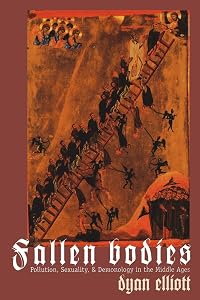
Fallen Bodies: Pollution, Sexuality, and Demonology in the Middle Ages
by Dyan Elliott
On This Page
Description
Medieval clerics believed that original sin had rendered their "fallen bodies" vulnerable to corrupting impulses ?particularly those of a sexual nature. They feared that their corporeal frailty left them susceptible to demonic forces bent on penetrating and polluting their bodies and souls.Drawing on a variety of canonical and other sources, Fallen Bodies examines a wide-ranging set of issues generated by fears of pollution, sexuality, and demonology. To maintain their purity, celibate show more clerics combated the stain of nocturnal emissions; married clerics expelled their wives onto the streets and out of the historical record; an exemplum depicting a married couple having sex in church was told and retold; and the specter of the demonic lover further stigmatized women's sexuality. Over time, the clergy's conceptions of womanhood became radically polarized: the Virgin Mary was accorded ever greater honor, while real, corporeal women were progressively denigrated. When church doctrine definitively denied the physicality of demons, the female body remained as the prime material presence of sin.Dyan Elliott contends that the Western clergy's efforts to contain sexual instincts ?and often the very thought and image of woman ?precipitated uncanny returns of the repressed. She shows how this dynamic ultimately resulted in the progressive conflation of the female and the demonic, setting the stage for the future persecution of witches. show lessTags
Recommendations




Member Reviews
In Fallen Bodies, Dyan Elliott looks at issues of ritual purity, demonic presence, sexuality and gender in light of the Gregorian reform movement and thirteenth-century scholasticism. She argues that clerical fears about ritual purity/pollution were at the heart of many of their misogynist views, and that ultimately those fears gave rise to the witch crazes of the late medieval/early modern period. Elliot sifts through a wealth of information to produce a synthesis impressive in its breadth, and scholars will find the lengthy endnotes well worth mining. As a whole, the book interesting, and mostly well-written, but Mr Bingley would tell Elliott she has at times a tendency to study too much for words of four syllables, and the reliance show more on Freud as a framework for psychoanalysing medieval people just struck me as weird. Elliott writes, in defense of her methodology, that an attempt by historians to avoid all anachronisms of concepts/terminology when writing about medieval people is misguided as "it ultimately leads to flattening out the medieval psychic landscape by confining its description to the vocabulary in which medieval thinkers were accustomed to describe themselves" (7), but while that may arguably be true, that still doesn't explain to me why she thought Freud's theories were the best lens to use. show less
Ratings
Members
- Recently Added By
Lists

Mythical Monsters of the World
199 works; 79 members
Author Information
5+ Works 176 Members
Series
Belongs to Publisher Series
Common Knowledge
- Canonical title
- Fallen Bodies: Pollution, Sexuality, and Demonology in the Middle Ages
Classifications
- Genres
- Nonfiction, Religion & Spirituality, History, General Nonfiction, Sexuality and Gender Studies
- DDC/MDS
- 261.8 — Religion Christian organization, social work & worship Social theology and interreligious relations and attitudes Christianity and socioeconomic problems
- LCC
- BT708 .E43 — Philosophy, Psychology and Religion Doctrinal Theology Doctrinal Theology Creation
- BISAC
Statistics
- Members
- 64
- Popularity
- 487,442
- Reviews
- 1
- Rating
- (3.88)
- Languages
- English
- Media
- Paper, Ebook
- ISBNs
- 4
- ASINs
- 1