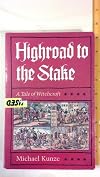
Highroad to the Stake: A Tale of Witchcraft
by Michael Kunze
On This Page
Description
Details the 15th century persecution of a vagrant German family.Tags
Recommendations



















Member Reviews
Highroad to the Stake is unlike anything I could’ve expected. It thoroughly examines life in 17th c. Germany by focusing on the story of the Pappenheimers, from their life as a vagrant, struggling beggars to their execution for witchcraft.
In the summer of 1599, a thief named Geindl is hanged for reasons including the murder of 7 pregnant women. On the scaffold, Geindl declares that brothers Michel and Gumpprecht Pappenheimer had assisted him. The sheriff’s men then seek out and arrest them, Paulus, their father, Anna, their mother, and Hansel their 10-yr old brother. Kunze sympathizes with the family and takes us into their daily life before the nightmare. They were beggars, Paulus eventually took up a part-time profession of show more cleaning out cesspools. Paulus himself had attended a witch burning in 1590, never knowing he’d be next. With heads low, they did their best to avoid disreputable persons. Nevertheless they were carted off to Munich and put to extreme torture to confess. This included strappdo, and squassation.
Kunze examines each forced confession in turn. Without physical evidence, and going against the common law of corpus delicti, prosecutor Johann Wangereck departs from customary procedures and the Pappenheimers become scapegoats for a catalogue of unsolved crimes. From murder to arson to witchcraft. Two family friends, Ulrich Schaltzbauer and Georg Schmalzl are also implicated. Their execution is not something that I will be detailing, suffice it to say it was highly unusual and especially horrific.
If you can push through the graphic scenes, this is an excellent resource and study for a unique witchcraft trial. We get to know the members of the judicial court, Duke Maximilian I, and fellow beggars as Kunze moves back and forth seamlessly between politics, pauper life, religious turmoil, and superstitious practices. show less
In the summer of 1599, a thief named Geindl is hanged for reasons including the murder of 7 pregnant women. On the scaffold, Geindl declares that brothers Michel and Gumpprecht Pappenheimer had assisted him. The sheriff’s men then seek out and arrest them, Paulus, their father, Anna, their mother, and Hansel their 10-yr old brother. Kunze sympathizes with the family and takes us into their daily life before the nightmare. They were beggars, Paulus eventually took up a part-time profession of show more cleaning out cesspools. Paulus himself had attended a witch burning in 1590, never knowing he’d be next. With heads low, they did their best to avoid disreputable persons. Nevertheless they were carted off to Munich and put to extreme torture to confess. This included strappdo, and squassation.
Kunze examines each forced confession in turn. Without physical evidence, and going against the common law of corpus delicti, prosecutor Johann Wangereck departs from customary procedures and the Pappenheimers become scapegoats for a catalogue of unsolved crimes. From murder to arson to witchcraft. Two family friends, Ulrich Schaltzbauer and Georg Schmalzl are also implicated. Their execution is not something that I will be detailing, suffice it to say it was highly unusual and especially horrific.
If you can push through the graphic scenes, this is an excellent resource and study for a unique witchcraft trial. We get to know the members of the judicial court, Duke Maximilian I, and fellow beggars as Kunze moves back and forth seamlessly between politics, pauper life, religious turmoil, and superstitious practices. show less
I had not thought that the author could milk over 400 pages of smallish print from a single criminal case four centuries old, but he did it. The sad lives and horrific deaths of the Pappenheimer family are recounted here with a jeweler's eye for detail, and without too many digressions or speculations. The book goes a long way towards explaining the way people thought at the time and why they REALLY BELIEVED in the vagrant family's guilt and the justice of the trial, verdict and execution.
But I dont recommend reading this horrifying, harrowing account.
Ratings
Members
- Recently Added By
Author Information
14 Works 105 Members
Common Knowledge
- Canonical title*
- Strasse ins Feuer : vom Leben und Sterben in der Zeit des Hexenwahns
- People/Characters
- Hansel Pamb-Gamperl; Paulus "Pappenheimer" Pamb-Gamperl; Anndl Pamb-Gamperl; Michel Pamb-Gamperl; Gumpprecht Pamb-Gamperl; Geindl (show all 22); Alexander von Haslang zu Haslangsreut; Johann Baptist Fickler; Karl Kulmer; Ernst von Roming; Sebastian Georg; Dr. Johann Simon Wangereck; Dr. Jakob Hainmuller; Duke Maximilian I, Elector of Bavaria; Sebastian Steinwandner; Ulrich Scholz; Augustin Baumann; Georg Schmalzl; Agnes Muggenthaler; Zuliedl; Jack the Glazier; Anna Muggenthaler
- Important places
- Munich, Upper Bavaria, Germany; Wörth am Main, Miltenberg, Regierungsbezirk of Lower Franconia, Bavaria, Germany; Ansbach, Middle Franconia, Bavaria, Germany; Straubing, Straubing-Bogen, Lower Bavaria, Germany; Tettenwang, Altmannstein, Eichstätt, Upper Bavaria, Germany; Ellingen, Weißenburg-Gunzenhausen, Bavaria, Germany (show all 8); Ingolstadt, Munich Metropolitan Region, Bavaria, Germany; Hexenagger, Altmannstein, Eichstätt, Upper Bavaria, Germany
- Epigraph
- In ages overshadowed by catastrophe, men look for someone to blame, and anything that deviates from the norm is blameworthy. - Will-Erich Peuckert
- First words
- One afternoon toward the end of April 1600, a open cart drawn by a pair of horses rumbled along the uneven, swampy cart track that once passed for the highway linking Nuremberg and Munich.
- Last words
- (Click to show. Warning: May contain spoilers.)The knacker stood guard and raked over the site of the fires until the ashes turned white, and only a dark cloud, drifting eastward with the wind across the blue sky of a summer afternoon, told of what had happened.
- Blurbers
- Lohmeyer, Wolfgang; Frank, Niklas
- Original language
- German
*Some information comes from Common Knowledge in other languages. Click "Edit" for more information.
Classifications
Statistics
- Members
- 88
- Popularity
- 362,734
- Reviews
- 3
- Rating
- (4.33)
- Languages
- English, German, Portuguese
- Media
- Paper
- ISBNs
- 4
- ASINs
- 2