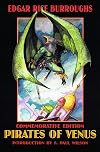
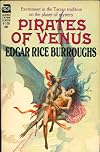
On This Page
Description
The novel contains elements of political satire aimed at communism. The novel's villains, the Thorists, start a revolution in the nation of Vepaja for their own good only, cheating the uneducated masses and killing or driving away those doctors and other highly educated that form the foundation of the society. Throughout the book the Thorists remain distant and unreal, and those few that the hero Carson Napier meets are often stupid or incompetent.Tags
Recommendations





Member Recommendations
jseger9000 The Sky People is an homage to Burrough's Carson of Venus series.
Member Reviews
It is hard not to compare Carson Napier with Edgar Rice Burroughs's other interplanetary adventurer, John Carter of Mars, though the two have very little in common. While Carter and Barsoom represent an American audience looking back on the conquering of the frontier, Napier and Amtor very much represent the social concerns of the 1930s. The John Carter books feature a self-assured hero and a pervading sense of nostalgia for a world near its end. Pirates of Venus lacks a cohesive plot and, though Carson Napier is a more realistic protagonist than John Carter, he feels less interesting and exciting for this. The world of Amtor is jumbled and so is the story of Pirates of Venus.
Here again, Burroughs creates a unique world. His Venus is show more Amtor, not the Cosoom of the John Carter series. The inhabitants are geographically separated with little linking them physically or culturally. And they are completely unaware of their planet's spherical shape! The series requires the same suspension of disbelief as Burroughs earlier John Carter books since the modern reader will know that Venus could never have supported life except possibly very shortly after its formation and that its day, rather than the 26 hours, 56 minutes, and 4 seconds of earth time that Burroughs ascribes to it, is actually 116 days and 18 hours in earth time. The ray-based weaponry and ever-present swords will remind readers of the weapons of Barsoom, though the description of its function uses a more up-to-date understanding of radiation. Finally, Burroughs spends an inordinate amount of time interrupting what plot there is to explain the language of Amtor, whereas in the John Carter books he briefly described any necessary terms so the reader could picture the subject or left it up to context to define the terms.
Carson Napier, rather than a poor knock-off of John Carter, is Burroughs's attempt at an autobiographical character. Readers and Burroughs himself would like to be John Carter or Tarzan, but most are actually more like Napier. For the fan of Burroughs, Pirates of Venus is interesting, but it is unlikely to appeal to the casual reader, especially as it ends like a serial film without a proper resolution. show less
Here again, Burroughs creates a unique world. His Venus is show more Amtor, not the Cosoom of the John Carter series. The inhabitants are geographically separated with little linking them physically or culturally. And they are completely unaware of their planet's spherical shape! The series requires the same suspension of disbelief as Burroughs earlier John Carter books since the modern reader will know that Venus could never have supported life except possibly very shortly after its formation and that its day, rather than the 26 hours, 56 minutes, and 4 seconds of earth time that Burroughs ascribes to it, is actually 116 days and 18 hours in earth time. The ray-based weaponry and ever-present swords will remind readers of the weapons of Barsoom, though the description of its function uses a more up-to-date understanding of radiation. Finally, Burroughs spends an inordinate amount of time interrupting what plot there is to explain the language of Amtor, whereas in the John Carter books he briefly described any necessary terms so the reader could picture the subject or left it up to context to define the terms.
Carson Napier, rather than a poor knock-off of John Carter, is Burroughs's attempt at an autobiographical character. Readers and Burroughs himself would like to be John Carter or Tarzan, but most are actually more like Napier. For the fan of Burroughs, Pirates of Venus is interesting, but it is unlikely to appeal to the casual reader, especially as it ends like a serial film without a proper resolution. show less
The first of Edgar Rice Burroughs' five-book Carson of Venus series (well, 4⅓ books, given that the last installment, the posthumously-published Wizard of Venus, is only 50 pps. long), Pirates of Venus is a sad come-down from the zest and vigor of the first few books in ERB's John Carter and Tarzan series.
Pirates of Venus is essentially a yarn told in a distracted, not fully-present way about a lesser permutation of ERB's supermen -- this one named Carson Napier, and quite the self-satisfied lunkhead is he -- who designs a rocket to take him to Mars (John Carter and his progeny are quite unknown in this continuity, so it's "Mars," and not "Barsoom"; OTOH, specific reference is made to the adventures of Tarzan in Pellucidar, the show more hollow-earth land where dinosaurs yet dwell, as depicted in the 1929 Tarzan At the Earth's Core, in the first few paragraphs of PoV), forgets to factor Earth's Moon into his calculations, and as a consequence winds up on Venus, or Amtor, as the natives -- who have but a single language throughout the entire planet -- call it. Carson soon falls in with a group of comely, robust and vigorous humans who wear precious little in the way of clothing, fixes upon an inamorata, and fights various fauna who seem more suited to H.G. Wells' The Food of the Gods -- or a Bert I. Gordon low budget SFX'er -- than the type of full-blooded sword & planet adventure that ERB himself helped pioneer. Carson also fights other, less comely -- and, therefore, villainous -- humans of the faction called Thorists. (Despite the fact that the name hearkens to Norse mythology, the Thorists are stand-ins for Earth's Soviets.) Pirates concludes with a cliff-hanger; but A Princess of Mars it ain't.
By the time Pirates of Venus was published -- 1934 -- Burroughs was apparently on auto-pilot: his fortune, largely built on Tarzan, was well and truly made; Tarzana, a district of Los Angeles in the San Fernando Valley, had already been named in Lord Greystoke's honor (indeed, ERB has a bit of drollery in the opening chapter, when he has his avatar aver, "I detest business and everything connected with it" [p. 13 of Ace Books ed., F-179]: pretty funny given that he was something of a real estate mogul); and his writing here is undistinguished enough to prompt anyone previously unacquainted with it to wonder just what all the fuss was about. The book is almost halfway over before anything of real interest or consequence occurs; I found myself at times recalling fondly Lin Carter's pastiche of ERB and A. Merritt, the five-book Green Star series.
In short, Pirates of Venus is probably of interest only to ERB fans; it makes a pretty tepid introduction to his work. Honestly, I'd only rate this book two stars, except I gave it a quarter-star because it picked up a bit in the last couple of chapters (although I still wanted to dope-slap Carson for being so utterly clueless), and another quarter-star because of the hints of ERB's politics and philosophy peeking through the flimsy scrim of the adventure. If things don't improve by the second book (Lost on Venus, 1935), I'll probably either re-read the first few John Carter books, pick up where I left off with Tarzan, or move on to one of his other series. Maybe The Mucker.... show less
Pirates of Venus is essentially a yarn told in a distracted, not fully-present way about a lesser permutation of ERB's supermen -- this one named Carson Napier, and quite the self-satisfied lunkhead is he -- who designs a rocket to take him to Mars (John Carter and his progeny are quite unknown in this continuity, so it's "Mars," and not "Barsoom"; OTOH, specific reference is made to the adventures of Tarzan in Pellucidar, the show more hollow-earth land where dinosaurs yet dwell, as depicted in the 1929 Tarzan At the Earth's Core, in the first few paragraphs of PoV), forgets to factor Earth's Moon into his calculations, and as a consequence winds up on Venus, or Amtor, as the natives -- who have but a single language throughout the entire planet -- call it. Carson soon falls in with a group of comely, robust and vigorous humans who wear precious little in the way of clothing, fixes upon an inamorata, and fights various fauna who seem more suited to H.G. Wells' The Food of the Gods -- or a Bert I. Gordon low budget SFX'er -- than the type of full-blooded sword & planet adventure that ERB himself helped pioneer. Carson also fights other, less comely -- and, therefore, villainous -- humans of the faction called Thorists. (Despite the fact that the name hearkens to Norse mythology, the Thorists are stand-ins for Earth's Soviets.) Pirates concludes with a cliff-hanger; but A Princess of Mars it ain't.
By the time Pirates of Venus was published -- 1934 -- Burroughs was apparently on auto-pilot: his fortune, largely built on Tarzan, was well and truly made; Tarzana, a district of Los Angeles in the San Fernando Valley, had already been named in Lord Greystoke's honor (indeed, ERB has a bit of drollery in the opening chapter, when he has his avatar aver, "I detest business and everything connected with it" [p. 13 of Ace Books ed., F-179]: pretty funny given that he was something of a real estate mogul); and his writing here is undistinguished enough to prompt anyone previously unacquainted with it to wonder just what all the fuss was about. The book is almost halfway over before anything of real interest or consequence occurs; I found myself at times recalling fondly Lin Carter's pastiche of ERB and A. Merritt, the five-book Green Star series.
In short, Pirates of Venus is probably of interest only to ERB fans; it makes a pretty tepid introduction to his work. Honestly, I'd only rate this book two stars, except I gave it a quarter-star because it picked up a bit in the last couple of chapters (although I still wanted to dope-slap Carson for being so utterly clueless), and another quarter-star because of the hints of ERB's politics and philosophy peeking through the flimsy scrim of the adventure. If things don't improve by the second book (Lost on Venus, 1935), I'll probably either re-read the first few John Carter books, pick up where I left off with Tarzan, or move on to one of his other series. Maybe The Mucker.... show less
Despite the various trodden and untrue tropes, not so old at time of writing, I was surprised by the level of the prose in this book. The bits of wry humour sparingly sprinkled improve the quality of the read still more. Even the female lead, though familiar to readers of fainting-women-burly-men fiction, has more chutzpah (and fighting skill) than you might expect for the 1930s.
I recently acquired the entire Venus series from a local bookseller, This first one is beautiful and I can't wait to read the rest. I love the subtle anti communist bent and the prose is unmatched.
I liked these, but I liked the John Carter series better. The dangerous jungle planet of Venus is an interesting location. This was based on what was speculated at the time about Venus, we now know a lot different.
I decided to bite the bullet and read through Edgar Rice Burroughs “Venus” series in 2012. Pirate is the first book and recounts how a man named Carson travel from earth to Venus, and gets stranded there. He is able to communicate his adventure back to earth via telephathy. Chief among those adventures is, batteling giant spider-like ape creatures, falling in love with Duare the forbidden daughter of the King, being kidnapped and taken as a slave, then finally leading a mutainy and becoming a pirate.
I'm relatively new to the work of ERB, but it seems to me he just keeps writing the same story over and over. This was not as much fun as [b:The Moon Maid|2690100|The Moon Maid|Edgar Rice Burroughs|https://d.gr-assets.com/books/1240177406s/2690100.jpg|432893], was a real struggle to finish, and ends on a cliffhanger.
Members
- Recently Added By
Lists

Books Read in 2015
3,299 works; 129 members
Author Information

769+ Works 65,438 Members
Edgar Rice Burroughs was born on September 1, 1875, in Chicago. His father, George Tyler was a distiller and a battery manufacturer. Early in life Burroughs attempted to support his family in a variety of occupations, including railroad policeman, business partner, and miner. None of these proved successful. However, Burroughs had always enjoyed show more reading adventure fiction and decided to try his hand at writing. His first attempt, written under the pseudonym Normal Bean, sold very quickly and Burroughs' career took off. Although critics and educators have not always been supportive of Burroughs' writing, the characters in his stories have entertained readers for many years. Tarzan was the most popular, earning Burroughs enough money to start his own publishing house and a motion picture company. Another character, John Carter, is the hero of Burroughs' Mars adventure series. The continuing popularity of these characters has led some critics to reconsider the value of Burroughs' writing and to acknowledge significant themes in his stories. Burroughs died on March 19, 1950. (Bowker Author Biography) show less
Some Editions
Awards and Honors
Series

Belongs to Publisher Series
Work Relationships
Common Knowledge
- Canonical title
- Pirates of Venus
- Original title
- Pirates of Venus
- Original publication date
- 1934
- People/Characters
- Carson Napier; Duare; Abner Perry; Kamlot; Danus; Jason Gridley
- Important places
- Venus; Amtor
- First words
- "If a female figure in a white shroud enters your bedchamber at midnight on the thirteenth day of this month, answer this letter; otherwise, do not."
- Quotations
- Even no excuse is a good excuse to the man who wishes to see the object of his infatuation; but now I prided myself that I had a real reason for seeing her and one that she herself must appreciate, since it was prompted by so... (show all)licitude for her welfare.
- Last words
- (Click to show. Warning: May contain spoilers.)Thus I went into captivity in the land of Noobol, an adventure that is no part of this story; but I went with the knowledge that the woman I loved, loved me, and I was happy.
- Original language
- English
- Canonical DDC/MDS
- 813.087626
Classifications
- Genres
- Fiction and Literature, Science Fiction
- DDC/MDS
- 813.087626 — Literature & rhetoric American literature in English American fiction in English By type Genre fiction Adventure fiction Speculative fiction Science fiction Planetary romance
- LCC
- PS3503 .U687 .P57 — Language and Literature American literature American literature Individual authors 1900-1960
- BISAC
Statistics
- Members
- 792
- Popularity
- 35,297
- Reviews
- 10
- Rating
- (3.38)
- Languages
- 5 — Danish, Dutch, English, German, Spanish
- Media
- Paper, Audiobook, Ebook
- ISBNs
- 26
- ASINs
- 53