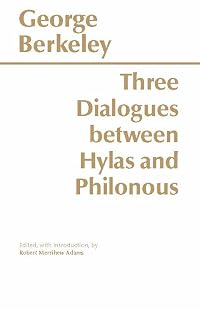
Three Dialogues Between Hylas and Philonous
by George Berkeley
On This Page
Description
Irish-born philosopher George Berkeley developed a radical theory of human knowledge that he called "immaterialism." Put simply, it was Berkeley's belief that most objects that the human mind perceives as real do not actually exist. Following the back-and-forth conversational style of Socrates, Berkeley sets forth his innovative ideas in dialogue form in this text..
Tags
Recommendations






Member Reviews
Três diálogos muito bem escritos, em um embate divertido entre um imaterialista (idealista), defendendo a bizarra posição do autor (ser é ser percebido, tudo que existe, existe dentro de mentes), contra um curioso e incomodado materialista recalcitrante. Philonous emprega todas as variações da pentelhação "tudo é correlacionado", "tudo é para nós", "não há como pensar algo fora do pensamento, porque ao fazê-lo, estamos pensando o fora para nós, dentro do pensamento", enquanto mostra que um empirismo radical leva a negar a matéria, a existência exterior à mente, e afirmar Deus, a mente que a tudo percebe. (o que para os padrões atuais, soa, é claro, como "negar o pensamento científico")
Skip it and read Hume, who says the same stuff more quickly, takes it further, and doesn't go god-mad. Or if you must have a taste, only suffer the first dialogue - it's downhill from there.
This doesn't feel like a dialogue: Berkeley has given his man Phil all the words and prepared thoughts he needs, and left his opponent only breath enough to ask the right questions, and say variations of "Oh gee Phil, I guess you're right! I must admit I have no thoughts really on that!". The first dialogue does present the strong argument for Idealism, and some very nice reasonable advice of trying to stay skeptical, not taking inferences too far, and not introducing superflous ideas where things can be given simpler explanations. He then forgets show more all that and brings his god into it; he believes all reality is only in our minds (could be!), and that things continue to exist when there are no people about, because everything is in the mind of god. show less
This doesn't feel like a dialogue: Berkeley has given his man Phil all the words and prepared thoughts he needs, and left his opponent only breath enough to ask the right questions, and say variations of "Oh gee Phil, I guess you're right! I must admit I have no thoughts really on that!". The first dialogue does present the strong argument for Idealism, and some very nice reasonable advice of trying to stay skeptical, not taking inferences too far, and not introducing superflous ideas where things can be given simpler explanations. He then forgets show more all that and brings his god into it; he believes all reality is only in our minds (could be!), and that things continue to exist when there are no people about, because everything is in the mind of god. show less
This was a pretty interesting treatise on skepticism (and the only philosophy book I've ever read with a "twist"). Worth reading, even if you're not a philosopher, because it's very simple and relatively terminology-free. Lots of fun, very erroneous arguments also.
Berkeley's Three Dialogues were written to present the author's philosophy in an easy to digest format, as his previous work containing these views did not have as big an impact as he had expected.
The gist of his philosophy is that matter does not exist, and the the universe consists solely of ideas and minds. Included within the categories of ideas are thoughts and sensations, which to exist must be present in the mind. The reality of external objects is not denied, only their existence is transferred from being material to being ideas in God's mind, which exist independently of us just like matter does. He argues that the objects that we perceive really exist, and are not illusions, but are dependent for their existence on God.
The show more dialogues are written in a similar way to Plato's Socratic dialogues, with one person trying to convince someone else of his opinions by using arguments such as thought experiments.
The first dialogue aims to prove that all we receive in way of information from the outside world is sensations, and that sensations are only ideas, and that ideas can exist only in minds. This last part I contend: ideas can surely exist outside minds (in a manner such as the Platonic forms), and this is evident in the mathematics, where truths are universal and eternal, and not dependent on empirical information. These truths would exist in a universe whether there was a God or humans or minds or not. Going on his premise that ideas can only exist in minds, and that they are external and have a real existence, Berkeley claims that all ideas are created by God, which he can then put into our minds. Several of the arguments against matter involve the premise that matter is extended, which he believes is necessary to a materialist world view. Yet, the atom could be viewed as a point (ie not extended), or as energy, with extension being an emergent property, which he does not consider. Another faulty premise in this chapter is that we perceive objects directly, that what we see is exactly what is there. The eye and the parts of the brain that process visual information interpret it to make sense of it, and extrapolate upon and embellish the data the eye receives before it is presented to consciousness. Berkeley does not realise this, and uses the apparent contradictions in what we see as evidence for the impossibility of matter, while in truth the brain can be responsible for making these illusions.
The second dialogue discusses the possibility of God using matter as an intermediate through which ideas are relayed, between being created by him and reaching us. This is argued against with the theory that God would not need to use matter as an instrument if he was omnipotent, and that matter could itself never be known to us except through sensations anyway, and so outside of sensations (which can only exist in the mind) there can be no evidence for it.
The third dialogue considers objections to this system of Idealism, and provides counters to them.
At the seat of it, this dialogue revolves around the mind body problem, which the author's philosophy would remove if it were right. We still do no know how and if mind emerges out of matter, how and if we have free will, and what the exact nature of matter is. If we deny the existence of matter, it solves these apparent problems, which Berkeley obviously thought about.
There are no logical arguments to prove that the essentials of Berkeley's philosophy are wrong, but he fails to do what he sets out to do, to prove that his philosophy is right, that matter does not exist.
There are multiple ways of interpreting what we see around us, one is Berkeley's way, another is the “materialist” way, where matter only exists, and mind and ideas are reduceable to matter. Another interpretation of reality, which I would favour, is that matter is real (Scientific realism), and that ideas are also real (Platonic realism), and of a separate category. Mind appears to be an emergent property of matter (though not reducible to it, as it comes about from an interaction of matter and the laws of the universe, which are themselves immaterial, and possibly mathematical, thus analogous to ideas), and that science and philosophy will discover how this all works more precisely in the future, which is not to say precisely at all. show less
The gist of his philosophy is that matter does not exist, and the the universe consists solely of ideas and minds. Included within the categories of ideas are thoughts and sensations, which to exist must be present in the mind. The reality of external objects is not denied, only their existence is transferred from being material to being ideas in God's mind, which exist independently of us just like matter does. He argues that the objects that we perceive really exist, and are not illusions, but are dependent for their existence on God.
The show more dialogues are written in a similar way to Plato's Socratic dialogues, with one person trying to convince someone else of his opinions by using arguments such as thought experiments.
The first dialogue aims to prove that all we receive in way of information from the outside world is sensations, and that sensations are only ideas, and that ideas can exist only in minds. This last part I contend: ideas can surely exist outside minds (in a manner such as the Platonic forms), and this is evident in the mathematics, where truths are universal and eternal, and not dependent on empirical information. These truths would exist in a universe whether there was a God or humans or minds or not. Going on his premise that ideas can only exist in minds, and that they are external and have a real existence, Berkeley claims that all ideas are created by God, which he can then put into our minds. Several of the arguments against matter involve the premise that matter is extended, which he believes is necessary to a materialist world view. Yet, the atom could be viewed as a point (ie not extended), or as energy, with extension being an emergent property, which he does not consider. Another faulty premise in this chapter is that we perceive objects directly, that what we see is exactly what is there. The eye and the parts of the brain that process visual information interpret it to make sense of it, and extrapolate upon and embellish the data the eye receives before it is presented to consciousness. Berkeley does not realise this, and uses the apparent contradictions in what we see as evidence for the impossibility of matter, while in truth the brain can be responsible for making these illusions.
The second dialogue discusses the possibility of God using matter as an intermediate through which ideas are relayed, between being created by him and reaching us. This is argued against with the theory that God would not need to use matter as an instrument if he was omnipotent, and that matter could itself never be known to us except through sensations anyway, and so outside of sensations (which can only exist in the mind) there can be no evidence for it.
The third dialogue considers objections to this system of Idealism, and provides counters to them.
At the seat of it, this dialogue revolves around the mind body problem, which the author's philosophy would remove if it were right. We still do no know how and if mind emerges out of matter, how and if we have free will, and what the exact nature of matter is. If we deny the existence of matter, it solves these apparent problems, which Berkeley obviously thought about.
There are no logical arguments to prove that the essentials of Berkeley's philosophy are wrong, but he fails to do what he sets out to do, to prove that his philosophy is right, that matter does not exist.
There are multiple ways of interpreting what we see around us, one is Berkeley's way, another is the “materialist” way, where matter only exists, and mind and ideas are reduceable to matter. Another interpretation of reality, which I would favour, is that matter is real (Scientific realism), and that ideas are also real (Platonic realism), and of a separate category. Mind appears to be an emergent property of matter (though not reducible to it, as it comes about from an interaction of matter and the laws of the universe, which are themselves immaterial, and possibly mathematical, thus analogous to ideas), and that science and philosophy will discover how this all works more precisely in the future, which is not to say precisely at all. show less
Read this for a college Phil course. Radical idealism definitely ain't my thing. I rebelled against it pretty strongly even then, when I didn't know enough to know why. My ultimate reaction to Berkeley and most other stuff in this philosophical vein is "Yeah... So?" I'm just too much of a throughgoing pragmatist to play along long enough to get much out of it.
I remember following Berkeley's logic, more or less, and being not quite ready to agree with him.
Ratings
Members
- Recently Added By
Author Information

127+ Works 3,559 Members
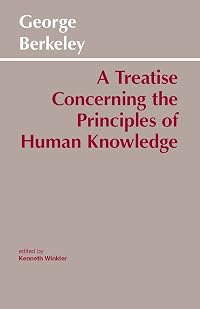
Born and reared in Ireland, George Berkeley studied at Trinity College, Dublin, and then taught as a fellow there, eventually becoming Dean of Derry (1724) and Bishop of Cloyne (1734) in the Irish branch of the Anglican church. His primary philosophical interests included metaphysics and epistemology, the psychology of perception, philosophy of show more science, and natural theology. But he is best known for his defense of metaphysical idealism and denial of the existence of matter. Berkeley's best-known writings were produced relatively early in his life, between the ages of 24 and 28: They included Essay Towards a New Theory of Vision (1709), Treatise Concerning the Principles of Human Knowledge (1710), and Three Dialogues (1713). In 1728 Berkeley made a voyage to the United States in an unsuccessful attempt to found a college in Bermuda. He lived for two years at Newport, Rhode Island, and had a significant influence on American education, chiefly through his association with and donation of books to Yale University and his correspondence with Samuel Johnson, the first president of what is now Columbia University. (Bowker Author Biography) show less
Some Editions
Series
Belongs to Publisher Series
Work Relationships
Is contained in
The Empiricists : Locke, An Essay Concerning Human Understanding (Abridged) ; Berkeley, Principles of Human Knowledge, and 3 Dialogues ; Hume, An Enquiry Concerning Human Understanding, and Dialogues Concerning Natural Religion by Richard Taylor (indirect)
English Philosophers of the Seventeenth and Eighteenth Centuries: Locke; Berkeley; Hume by Charles William Eliot
Common Knowledge
- Original publication date
- 1713
- First words
- PHILONOUS. Good morrow, Hylas: I did not expect to find you abroad so early.
- Quotations
- "Few men think, yet all will have opinions"
- Last words
- (Click to show. Warning: May contain spoilers.)Just so, the same Principles which, at first view, lead to Scepticism, pursued to a certain point, bring men back to Common Sense.
Classifications
Statistics
- Members
- 966
- Popularity
- 27,317
- Reviews
- 6
- Rating
- (3.62)
- Languages
- 11 — Catalan, Dutch, English, French, German, Hungarian, Italian, Japanese, Polish, Serbian, Spanish
- Media
- Paper, Audiobook, Ebook
- ISBNs
- 75
- ASINs
- 28