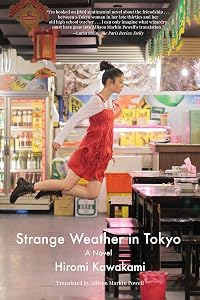
Strange Weather in Tokyo
by Hiromi Kawakami
On This Page
Description
Shortlisted for the 2013 Man Asian Literary Prize, Strange Weather in Tokyo is a story of loneliness and love that defies age.Tsukiko, thirty–eight, works in an office and lives alone. One night, she happens to meet one of her former high school teachers, "Sensei," in a local bar. Tsukiko had only ever called him "Sensei" ("Teacher"). He is thirty years her senior, retired, and presumably a widower. Their relationship develops from a perfunctory acknowledgment of each other as they eat show more and drink alone at the bar, to a hesitant intimacy which tilts awkwardly and poignantly into love.
As Tsukiko and Sensei grow to know and love one another, time's passing is marked by Kawakami's gentle hints at the changing seasons: from warm sake to chilled beer, from the buds on the trees to the blooming of the cherry blossoms. Strange Weather in Tokyo is a moving, funny, and immersive tale of modern Japan and old–fashioned romance. show less
Tags
Recommendations


































Member Recommendations

Member Reviews
A story about solitude, described sensually via yudofu, bottles of warm sake, and the moon. Over plates of fish, small cheeses, and mushrooms is a hunger for connection. Rituals of everyday life have a poetic earthiness, allowing (encouraging?) us to be more mindful of different shades of colours within our own mundane existence.
In loneliness I have drifted this long way, alone.
My torn and shabby robe could not keep out the cold.
And tonight the sky was so clear
it made my heart ache all the more.
- Seihaku Irako
In loneliness I have drifted this long way, alone.
My torn and shabby robe could not keep out the cold.
And tonight the sky was so clear
it made my heart ache all the more.
- Seihaku Irako
Tsukiko, a Tokyo office-worker in her late thirties, is drawn into conversation by the elderly man drinking sake next to her in a neighbourhood bar - it turns out that he's her former high-school Japanese literature teacher. The two of them don't seem to have much in common - they're thirty years apart in age, and Tsukiko was never a good student and still has a deaf ear for classical poetry. She addresses her old teacher as "Sensei" not so much out of respect but rather because she can't remember his name at first. But they somehow drift into being companionable drinking acquaintances, then friends, then (after many quarrels about unimportant things) discover that they really need each other's company.
This is a very engaging, show more delicate-but-funny (occasionally even surrealistic) May-to-December romance and a commentary on modern urban loneliness, but I think Kawakami is also enjoying herself pulling the reader's leg a bit - while Tsukiko is to all appearances a classic western chick-lit character, the detail of the story is obsessively Japanese to the point of self-parody - the over-specified food, the discussions about the correct way to pour sake, the activities Tsokiko and Sensei share (mushroom-hunting, a calligraphy exhibition, a vegetable market, a hot-springs inn, a pachinko parlour, a passionate night of octopus-related haiku-composition...). And then there's the odd figure of Sensei's presumably-dead wife, as subversively odd as Sensei is conservatively old-fashioned. There's definitely a bit more going on here than an unlikely love-affair! show less
This is a very engaging, show more delicate-but-funny (occasionally even surrealistic) May-to-December romance and a commentary on modern urban loneliness, but I think Kawakami is also enjoying herself pulling the reader's leg a bit - while Tsukiko is to all appearances a classic western chick-lit character, the detail of the story is obsessively Japanese to the point of self-parody - the over-specified food, the discussions about the correct way to pour sake, the activities Tsokiko and Sensei share (mushroom-hunting, a calligraphy exhibition, a vegetable market, a hot-springs inn, a pachinko parlour, a passionate night of octopus-related haiku-composition...). And then there's the odd figure of Sensei's presumably-dead wife, as subversively odd as Sensei is conservatively old-fashioned. There's definitely a bit more going on here than an unlikely love-affair! show less
We don't hear from Sensei directly but we can imagine the turmoil he went through before accepting Tsukiko. There are clues. He described himself as shilly-shallying and he was concerned that their relationship might be short-lived because of his age. In the end, age and time didn't matter. She feels his absence keenly but it is clear from Tsukiko's account that there were no regrets. That is what life should be. Live intensely and not worry about what may come.
Tsukiko Omachi likes to frequent a saké bar after work. She likes to sit and drink and eat the food prepared there and pass the time. She is a solitary drinker. But her solitude is disturbed one evening when she notices the elderly man sitting a few seats further down the bar. She recognizes him as Mr Harutsuna Matsumoto, but her whole life she has always thought of him and called him “Sensei”. He was her Japanese literature teacher in school. Now he is long retired, another solitary drinker who likes to quietly partake of saké and bar food. Over the course of the next two years, Tsukiko and Sensei will move closer, both literally in starting to sit beside one another but also in the development of tender feelings. This is a show more winter/summer romance that is as fresh and fragile as any new love. That it can only last a limited time is a mere detail since all lovers are finite though love is not.
Sensei is extremely formal, rigid, and concerned with propriety. Yet he quickly develops affection for his former pupil (despite chastising her for being such a poor student). Tsukiko is perhaps more difficult to fathom. She is in her late thirties at the outset, single but self-sufficient. She works in an office is all we know but we never learn what kind of work she does. She does not appear to have had too many romantic entanglements over the years. But even she acknowledges that she suffers from a kind of arrested development. Indeed, she increasingly sounds more like a schoolgirl than a mature woman. Is this a curious aspect of her particular character, or is it a kind of infantilization which serves to underwrite (and justify?) the protective tone that Sensei takes on? It is difficult to tell. Certainly Tsukiko seems excessively young — far younger than her actual age. And that exaggerates the difference between her and Sensei. (Indeed, the fact that she insists on thinking of and referring to him as “Sensei” enforces the disparity between their relative positions in the relationship.) Yet the overall story continually strives for a poignancy that could not be achieved if any crass exploitation of their differences were at hand. In the end, this is a quietly observed love story (accompanied by a prodigious amount of alcohol). It is, as others have described it, enchanting. Gently recommended. show less
Sensei is extremely formal, rigid, and concerned with propriety. Yet he quickly develops affection for his former pupil (despite chastising her for being such a poor student). Tsukiko is perhaps more difficult to fathom. She is in her late thirties at the outset, single but self-sufficient. She works in an office is all we know but we never learn what kind of work she does. She does not appear to have had too many romantic entanglements over the years. But even she acknowledges that she suffers from a kind of arrested development. Indeed, she increasingly sounds more like a schoolgirl than a mature woman. Is this a curious aspect of her particular character, or is it a kind of infantilization which serves to underwrite (and justify?) the protective tone that Sensei takes on? It is difficult to tell. Certainly Tsukiko seems excessively young — far younger than her actual age. And that exaggerates the difference between her and Sensei. (Indeed, the fact that she insists on thinking of and referring to him as “Sensei” enforces the disparity between their relative positions in the relationship.) Yet the overall story continually strives for a poignancy that could not be achieved if any crass exploitation of their differences were at hand. In the end, this is a quietly observed love story (accompanied by a prodigious amount of alcohol). It is, as others have described it, enchanting. Gently recommended. show less
Tsukiko is a 38-year-old woman who has an office job and is content living alone without a significant other in her life. One night in a bar she runs into her former high school Japanese language teacher, whom she calls Sensei. From that point on they run into each other regularly at the same bar or walking in the street, and they begin conversing. Their relationship develops from barely acknowledging each other to being casual acquaintances to forging a tentative friendship and finally, reluctantly, to love.
This is a lovely book that grows the sweetly developing relationship between Tsukiko and Sensei very, very slowly -- appropriately fitting for their individual personalities. Sensei is thirty years older than Tsukiko; both are show more living their own lives in very clear and set ways, and neither is looking for a reacquaintance, much less a romance. They sometimes go for months without running into each other, and both are fine with just doing things together -- like going to the market -- when they happen to see each other.
This book gave me all the warm fuzzies and took me back to my recent trip to Japan, what with all its detailed descriptions of various foods and an unnamed island, which I imagine might have been a smaller version of Miyajima. The book made me smile with the simplest descriptions of things like Sensei's hat sitting crookedly atop his head as he moved through the throngs at the market. I felt happiness and sadness; I felt joy and melancholy; I felt the contentment of solitude and the emptiness of loneliness. "Strange Weather in Tokyo" was all of this, a beautiful book that I read in one sitting. show less
This is a lovely book that grows the sweetly developing relationship between Tsukiko and Sensei very, very slowly -- appropriately fitting for their individual personalities. Sensei is thirty years older than Tsukiko; both are show more living their own lives in very clear and set ways, and neither is looking for a reacquaintance, much less a romance. They sometimes go for months without running into each other, and both are fine with just doing things together -- like going to the market -- when they happen to see each other.
This book gave me all the warm fuzzies and took me back to my recent trip to Japan, what with all its detailed descriptions of various foods and an unnamed island, which I imagine might have been a smaller version of Miyajima. The book made me smile with the simplest descriptions of things like Sensei's hat sitting crookedly atop his head as he moved through the throngs at the market. I felt happiness and sadness; I felt joy and melancholy; I felt the contentment of solitude and the emptiness of loneliness. "Strange Weather in Tokyo" was all of this, a beautiful book that I read in one sitting. show less
Beautifully written, beautifully understated. The elegance of everyday things. Quirky characters. An occasional chuckle. This was a pleasure.
‘’In the autumn there are dead leaves all over the place and in winter the bare branches are bleak and dreary.’’
A woman and a man meet at their favourite bar. She was one of his students many years ago. Intimacy and understanding can come suddenly and unexplainably. The vibes of a gigantic metropolis hide the solitude of two people who have found themselves adrift in the sounds and melodies of Tokyo. As their relationship develops in a union that may seem strange, its depth and poignancy make Tsukiko question her choices, And, possibly, the power of Kawakami’s story may ‘force’ us to do the same… As the seasons change, our life chooses its own way and sometimes, all we can do is follow. Take a leap of faith and show more follow...
‘’It seemed that the only living things in Tokyo were big like us. But of course, if I really paid attention, there were plenty of other living things surrounding me in the city as well. It was never just the two of us, Sensei and me. Even when we were at the bar, I tended to only take notice of Sensei. But Satoru was always there, along with the usual crowd of familiar faces. And I never really acknowledged that any of them were alive in any way. I never gave any thought to the fact that they were leading the same kind of complicated life as I was.’’
Under the cherry blossoms, as moonlight paints the world in silver and blue, as the summer sun gives its way to the winter cold, as summer turns to autumn, as time leaves its traces, conversations and confessions are shared over sake. Japanese cuisine and poetry lend their flavour and sound to the course of two people who have loved and lost, who have chosen solitude because life is easier and safer this way. But as the tender melancholy of the approaching evening starts creeping through the silent walls, the conversations with your heart become more and more often, more and more demanding. Needless to say, I connected with Tsukiko at an almost alarming level. I saw myself in many of her choices and convictions and started seeing things in a different light in a rather peculiar stage of my life. But it is Kawakami’s writing that sings into our soul, turning daily moments into poetry, into sources of real beauty.
When you fall in love, you are bound to feel that you and your beloved are the only people in the city, in the world even. I promise you, this book will never make you feel alone.
*The companion story, Parade, is exquisite. It pays tribute to Japanese folklore and the presence of the tengu while giving voice to the victims of school bullying and discrimination. Kawakami’s Afterword is moving, ethereal, unique. Lyrical, sensitive translation by Allison Markin Powell. *
‘’Light filters while across the river
through the willows.
From Ono on the other bank.
From Ono on the other bank
a flute makes its faint way through the mist,
touching the traveller’s heart.’’
Seihaku Irako
My reviews can also be found on https://theopinionatedreaderblog.wordpress.com/ show less
A woman and a man meet at their favourite bar. She was one of his students many years ago. Intimacy and understanding can come suddenly and unexplainably. The vibes of a gigantic metropolis hide the solitude of two people who have found themselves adrift in the sounds and melodies of Tokyo. As their relationship develops in a union that may seem strange, its depth and poignancy make Tsukiko question her choices, And, possibly, the power of Kawakami’s story may ‘force’ us to do the same… As the seasons change, our life chooses its own way and sometimes, all we can do is follow. Take a leap of faith and show more follow...
‘’It seemed that the only living things in Tokyo were big like us. But of course, if I really paid attention, there were plenty of other living things surrounding me in the city as well. It was never just the two of us, Sensei and me. Even when we were at the bar, I tended to only take notice of Sensei. But Satoru was always there, along with the usual crowd of familiar faces. And I never really acknowledged that any of them were alive in any way. I never gave any thought to the fact that they were leading the same kind of complicated life as I was.’’
Under the cherry blossoms, as moonlight paints the world in silver and blue, as the summer sun gives its way to the winter cold, as summer turns to autumn, as time leaves its traces, conversations and confessions are shared over sake. Japanese cuisine and poetry lend their flavour and sound to the course of two people who have loved and lost, who have chosen solitude because life is easier and safer this way. But as the tender melancholy of the approaching evening starts creeping through the silent walls, the conversations with your heart become more and more often, more and more demanding. Needless to say, I connected with Tsukiko at an almost alarming level. I saw myself in many of her choices and convictions and started seeing things in a different light in a rather peculiar stage of my life. But it is Kawakami’s writing that sings into our soul, turning daily moments into poetry, into sources of real beauty.
When you fall in love, you are bound to feel that you and your beloved are the only people in the city, in the world even. I promise you, this book will never make you feel alone.
*The companion story, Parade, is exquisite. It pays tribute to Japanese folklore and the presence of the tengu while giving voice to the victims of school bullying and discrimination. Kawakami’s Afterword is moving, ethereal, unique. Lyrical, sensitive translation by Allison Markin Powell. *
‘’Light filters while across the river
through the willows.
From Ono on the other bank.
From Ono on the other bank
a flute makes its faint way through the mist,
touching the traveller’s heart.’’
Seihaku Irako
My reviews can also be found on https://theopinionatedreaderblog.wordpress.com/ show less
Members
- Recently Added By
Published Reviews
ThingScore 83
Lists

Japanese Literature
230 works; 40 members

the old and the restless
62 works; 14 members

Want to Read... Asian Authors
11 works; 1 member
Author Information

Some Editions
Awards and Honors
Series
Belongs to Publisher Series
Work Relationships
Has the adaptation
Common Knowledge
- Canonical title*
- Der Himmel ist blau, die Erde ist weiß
- Original title
- センセイの鞄; Sensei no kaban
- Alternate titles
- The Briefcase
- Original publication date
- 2001 (original Japanese) (original Japanese); 2012 (English: Powell) (English: Powell)
- People/Characters
- Ōmachi Tsukiko; Matsumoto Harutsuna (“Sensei”); Satoru; Tōru; Kojima Takashi
- Important places
- Tokyo, Japan; Tochigi, Japan
- First words
- His full name was Mr. Harutsuna Matsumoto, but I called him "Sensei."
- Last words*
- (Click to show. Warning: May contain spoilers.)Es ist nichts darin, nur Leere, nur eine große allumfassende Leere breitet sich darin aus.
- Original language
- Japanese
- Disambiguation notice
- This work is the original 1-volume novella by Hiromi Kawakami (川上 弘美), not the 2-volume graphic novel illustrated by Jirō Taniguchi (谷口ジロー).
This work was first published in English under another title: The Briefcase.
*Some information comes from Common Knowledge in other languages. Click "Edit" for more information.
Classifications
- Genres
- General Fiction, Fiction and Literature
- DDC/MDS
- 895.636 — Literature & rhetoric Literatures of other languages Literatures of East and Southeast Asia Japanese Japanese fiction 2000–
- LCC
- PL855 .A859 .S4613 — Language and Literature Languages and literatures of Eastern Asia, Africa, Oceania Languages of Eastern Asia, Africa, Oceania Japanese language and literature Japanese literature Individual authors and works
- BISAC
Statistics
- Members
- 1,679
- Popularity
- 13,283
- Reviews
- 67
- Rating
- (3.74)
- Languages
- 20 — Catalan, Czech, Danish, Dutch, English, Finnish, French, German, Galician, Hebrew, Hungarian, Italian, Japanese, Norwegian (Bokmål), Polish, Portuguese, Romanian, Slovenian, Spanish, Swedish
- Media
- Paper, Audiobook, Ebook
- ISBNs
- 62
- ASINs
- 15