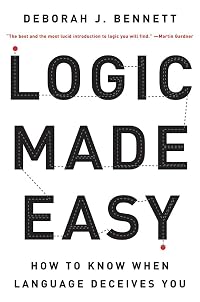
Logic Made Easy: How to Know When Language Deceives You
by Deborah J. Bennett
On This Page
Description
A collection of anecdotal histories defines the relationship between language and logic, sharing visual examples and puzzles that can be used by readers to raise test scores and recognize the illogical in everyday things.Tags
Recommendations






Member Reviews
The title here is misleading. This a book on the history of logic and on the psychological experiments testing people's use of logic. The point of the book is not to teach you how to do formal logic or how to apply logic, or even really how logic applies to the psychology of normal situations (although that last one does come up as a byproduct of describing psychology experiments). As such, this book lives in an odd middling space. On one hand it is meant as an introductory primer to logical thought, but it gets sidetracked by unnecessary history lessons and anecdotal asides. In addition, it skips on technical facets that would have helped to illuminate the concepts. Were the book more thorough it covering all of the relevant background show more information, that would have been fascinating in its own right, though it would have been a much slower read and less of an introductory popular science type book. If it had been trimmed to the bones, losing mainly the historical parts, it would be a more riveting read and truer to the subtitle. show less
An interesting and accessible introduction to logic. Deborah J. Bennett described syllogisms so that I finally understood them, and the whole book was a good reminder to think more critically and pay attention to all the information available. I also enjoyed the sample logic problems throughout the book, and even answered a few of them correctly after much cudgeling of my brain.
Deborah Bennett explains logic (both mathematical and word) through an easy-to-read style. She explains everything in detail and cites all her sources. After reading Logic Made Easy, I feel better about using logic and knowing when it's being used against me. One of my goals was to learn this to become a better communicator and this book helped.
Not as rigorous as many other logic texts, but somewhat entertaining nonetheless. This book could serve a high level refresher in basic, western logic or as a palatable introduction if followed by deeper books after.
Pretty good for general readers. Tends to idolize Aristotle, mostly confines formal notation to one latish chapter, and stops short of delving into the predicate calculus.
A title difficult to live up to.
Ratings
Members
- Recently Added By
Author Information

2 Works 518 Members
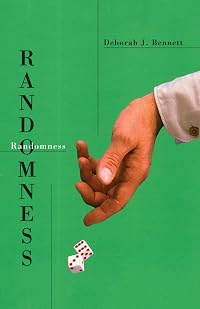
Deborah J. Bennett is the author of Randomness and teaches mathematics at New Jersey City University in Jersey City, New Jersey
Classifications
Statistics
- Members
- 341
- Popularity
- 92,697
- Reviews
- 6
- Rating
- (3.50)
- Languages
- English
- Media
- Paper, Ebook
- ISBNs
- 4
- ASINs
- 2