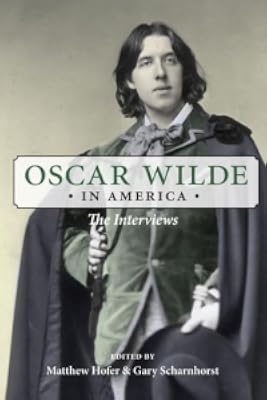
Oscar Wilde in America: The Interviews
by Oscar Wilde 
17 Members (3.75)
On This Page
Description
"This comprehensive and authoritative collection of Oscar Wilde's American interviews affords readers a fresh look at the making of a literary legend. Better known in 1882 as a cultural icon than a serious writer (at twenty-six years old, he had by then published just one volume of poems), Wilde was brought to North America for a major lecture tour on Aestheticism and the decorative arts that was organized to publicize a touring opera, Gilbert and Sullivan's Patience, which lampooned him and show more satirized the Aesthetic "movement" he had been imported to represent." "In this year-long series of broadly distributed and eagerly read newspaper interviews, Wilde excelled as a master of self-promotion. He visited major cities from New York to San Francisco but also small railroad towns along the way, granting interviews to newspapers wherever asked. With characteristic aplomb, he adopted the role as the ambassador of Aestheticism, and reporters noted that he was dressed for the part. He wooed and flattered his hosts everywhere, pronouncing Miss Alsatia Allen of Montgomery, Alabama, the most beautiful young lady he had seen in the United States, adding, "This is a remark, my dear fellow, I supposed I have made of some lady in every city I have visited in this country. It could be appropriately made. American women are very beautiful."". "Confronted at every turn by an insatiable audience of sometimes hostile interviewers, the young poet tried out a number of phrases, ideas, and strategies that ultimately made him famous as a novelist and playwright. Seeing America and Americans for the first time, Wilde's perception often proved as sharp as his wit; the echoes of both resound in much of his later writings. His interviewers also succeeded in getting him to talk about many other topics, from his opinions of British and American writers (he thought Poe was America's greatest poet) to his views of Mormonism. This volume cites all ninety-one of Wilde's interviews and contains transcripts of forty-eight of them, and it also includes his lecture on his travels in America."--BOOK JACKET. show lessTags
Member Reviews
Members
- Recently Added By
Author Information

1,764+ Works 120,954 Members
Flamboyant man-about-town, Oscar Wilde had a reputation that preceded him, especially in his early career. He was born to a middle-class Irish family (his father was a surgeon) and was trained as a scholarship boy at Trinity College, Dublin. He subsequently won a scholarship to Magdalen College, Oxford, where he was heavily influenced by John show more Ruskin and Walter Pater, whose aestheticism was taken to its radical extreme in Wilde's work. By 1879 he was already known as a wit and a dandy; soon after, in fact, he was satirized in Gilbert and Sullivan's Patience. Largely on the strength of his public persona, Wilde undertook a lecture tour to the United States in 1882, where he saw his play Vera open---unsuccessfully---in New York. His first published volume, Poems, which met with some degree of approbation, appeared at this time. In 1884 he married Constance Lloyd, the daughter of an Irish lawyer, and within two years they had two sons. During this period he wrote, among others, The Picture of Dorian Gray (1891), his only novel, which scandalized many readers and was widely denounced as immoral. Wilde simultaneously dismissed and encouraged such criticism with his statement in the preface, "There is no such thing as a moral or an immoral book. Books are well written or badly written. That is all." In 1891 Wilde published A House of Pomegranates, a collection of fantasy tales, and in 1892 gained commercial and critical success with his play, Lady Windermere's Fan He followed this comedy with A Woman of No Importance (1893), An Ideal Husband (1895), and his most famous play, The Importance of Being Earnest (1895). During this period he also wrote Salome, in French, but was unable to obtain a license for it in England. Performed in Paris in 1896, the play was translated and published in England in 1894 by Lord Alfred Douglas and was illustrated by Aubrey Beardsley. Lord Alfred was the son of the Marquess of Queensbury, who objected to his son's spending so much time with Wilde because of Wilde's flamboyant behavior and homosexual relationships. In 1895, after being publicly insulted by the marquess, Wilde brought an unsuccessful slander suit against the peer. The result of his inability to prove slander was his own trial on charges of sodomy, of which he was found guilty and sentenced to two years of hard labor. During his time in prison, he wrote a scathing rebuke to Lord Alfred, published in 1905 as De Profundis. In it he argues that his conduct was a result of his standing "in symbolic relations to the art and culture" of his time. After his release, Wilde left England for Paris, where he wrote what may be his most famous poem, The Ballad of Reading Gaol (1898), drawn from his prison experiences. Among his other notable writing is The Soul of Man under Socialism (1891), which argues for individualism and freedom of artistic expression. There has been a revived interest in Wilde's work; among the best recent volumes are Richard Ellmann's, Oscar Wilde and Regenia Gagnier's Idylls of the Marketplace , two works that vary widely in their critical assumptions and approach to Wilde but that offer rich insights into his complex character. (Bowker Author Biography) show less
Oscar Wilde has a Legacy Library. Legacy libraries are the personal libraries of famous readers, entered by LibraryThing members from the Legacy Libraries group.
Classifications
- Genres
- Fiction and Literature, Literature Studies and Criticism
- DDC/MDS
- 828.809 — Literature & rhetoric English & Old English literatures English miscellaneous writings 1837-1899 Individual authors
- LCC
- PR5823 .O655 — Language and Literature English English Literature 19th century , 1770/1800-1890/1900
- BISAC
Statistics
- Members
- 17
- Popularity
- 1,449,121
- Rating
- (3.75)
- Languages
- English
- Media
- Paper, Ebook
- ISBNs
- 3
- ASINs
- 1