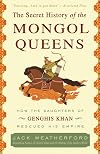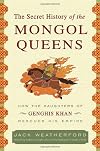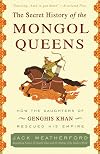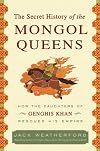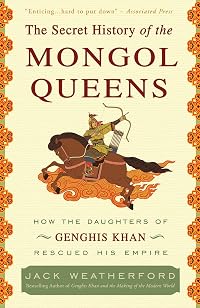
The Secret History of the Mongol Queens: How the Daughters of Genghis Khan Rescued His Empire
by Jack Weatherford
On This Page
Description
A history of the ruling women of the Mongol Empire, this work reveals their struggle to preserve a nation that shaped the world.Tags
Recommendations









Member Reviews
This was a wonderful read. An epic and scholarly work brings to life the role and legacy of the Mongol Queens, heirs to Genghis Khan. The writing and story telling is engaging and wonderful without pompous vernacular. I knew nothing about the Mongols. GK and Queens endlessly aspired to unity and peace amongst the steppe clans often with fierce opposition and circumstances. Threads of their stories traveled across the Silk Route and into Western Europe to the intrigue of Marco Pollo, Christopher Columbus, Chaucer, Goethe, and Puccini. I am ready to step out onto the steppes of Mongolia pitch a ger, drink fermented mare's milk and ride horses with unbridled abandon.
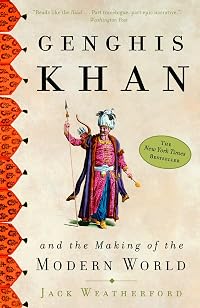
I loved Jack Weatherford’s Genghis Khan and the Making of the Modern World, & I now love this book, too. I thought this would be a rehash of that book, but no. He tells a mesmerizing story of Genghis’s daughters’ successful rule across Asia, then the deterioration of the empire across centuries, & how Queen Manduhai recovered its glory. The author loves his subject & makes it fascinating reading.
After reading Jack Weatherford’s "Genghis Khan and the Making of the Modern World" I went and pre-ordered this book – and I wasn’t disappointed.
The author tells a gripping story of lost history and the role the female heirs of Genghis Khan played in his Empire. While the Great Kahn was out conquering the world, his wives and daughters managed his empire, created bureaucracies, public projects and kept trade relationships alive. In a stroke of genius, Genghis Kahn married his daughters to men who ruled strategic points along the famous Silk Road which not only lent him eyes and ears in those important locations, but also established his presence even though he wasn’t physically there.
These daughters weren’t the timid kind; they show more were strong, independent women who inherited their father’s political cunningness and warrior spirit. However, after Genghis Khan’s death these strong women, daughters, sisters and sisters-in-law began a power struggle which lasted for centuries and eventually almost destroyed the Empire their father has built.
The book tells an astonishing tale of a once world wide Empire being torn apart by inept rulers, sibling rivalry and incompetent leaders (something I’m sure most of us can relate to) pitting mothers against sons and brothers against sisters.
The book ends with the astonishing tale of Queen Mandhuhai the Wise who reunited the Mongols while fighting the Chinese Ming dynasty and the Muslim warlords. Her successful campaigns, which she waged even when pregnant, promoted China to erect the Great Wall and preserved peace for her children and the nation.
Jack Weatherford writes in a style which transcends dry facts and dates, he brings the stories to life while drawing lines between events and people. The author realizes the names are difficult for the English speaking natives and reminds the reader every now and then who a character is when he/she reappears several pages later, which is fantastic. The information is presented in a manner which is not only linear, but also follows a certain path – which makes this book easy to comprehend and a joy to read. show less
The author tells a gripping story of lost history and the role the female heirs of Genghis Khan played in his Empire. While the Great Kahn was out conquering the world, his wives and daughters managed his empire, created bureaucracies, public projects and kept trade relationships alive. In a stroke of genius, Genghis Kahn married his daughters to men who ruled strategic points along the famous Silk Road which not only lent him eyes and ears in those important locations, but also established his presence even though he wasn’t physically there.
These daughters weren’t the timid kind; they show more were strong, independent women who inherited their father’s political cunningness and warrior spirit. However, after Genghis Khan’s death these strong women, daughters, sisters and sisters-in-law began a power struggle which lasted for centuries and eventually almost destroyed the Empire their father has built.
The book tells an astonishing tale of a once world wide Empire being torn apart by inept rulers, sibling rivalry and incompetent leaders (something I’m sure most of us can relate to) pitting mothers against sons and brothers against sisters.
The book ends with the astonishing tale of Queen Mandhuhai the Wise who reunited the Mongols while fighting the Chinese Ming dynasty and the Muslim warlords. Her successful campaigns, which she waged even when pregnant, promoted China to erect the Great Wall and preserved peace for her children and the nation.
Jack Weatherford writes in a style which transcends dry facts and dates, he brings the stories to life while drawing lines between events and people. The author realizes the names are difficult for the English speaking natives and reminds the reader every now and then who a character is when he/she reappears several pages later, which is fantastic. The information is presented in a manner which is not only linear, but also follows a certain path – which makes this book easy to comprehend and a joy to read. show less
Weatherford is one of the foremost living scholars on the Mongols and he doesn't disappoint--the book assumes a basic knowledge of Genghis Khan and his descendants but this time the focus is on his daughters, daughter-in-laws, and finally, Queen Manduhai, probably the most powerful woman in Mongolian history (not counting Genghis' mother, Hoelun). Genghis' daughters became the administrators and Queens of neighboring kingdoms while their husbands, Genghis' sons-in-law, were packed off to fight in their father-in-law's wars. Alaqai inherited in this way the Onggud, Al-Altun the Uighur, Checheyigen, the Oirat, and Tolai, the Karluk tribes, each helping build their father's empire. (As most readers will know, he divided his kingdom amongst show more his four sons-Jochi receiving Russia, Chaghatai Central Asia, Ogodei Western Mongolia, and Tolui, Eastern Mongolia.)
I will assume most readers will read this book to fill in missing bits of the history of the Mongols, but will be pleasantly surprised by the many bits of arcane information about Mongol life included--sexual and political life, the raising of children, selection of mates, warrior skills of the women, burial practices and other religious ceremonies. The Epilogue ("Secrets of History") is a real page turner as Weatherford links Geoffrey Chaucer's unfinished Squire's Tale in his Canterbury Tales with Genghis Khan and Puccini's opera Turandot. The same chapter reminds us that the Moghul Emperor Shah Jahan, who built the beautiful Taj Mahal in memory of his wife Mumtaz Mahal, was a descendent of the Borijin clan through the line of Chaghatai. "As though guided by an ancient Mongol memory, he placed the entrance to the Taj Mahal facing south like every Mongol ger), toward the sun." (p. 272)
As for Manduhai, she is remembered today in Mongolian song and dance, although the story of her life and deeds have been literally torn from official Mongolian histories. "Only grudgingly and piecemeal did the story of the daughters of Genghis Khan and of Queen Manduhai the Wise arise from the dust around me…." (p. 276) A shame that more research hasn't been done on the women of the frontier regions as we know from study of the Liao and Xixia peoples and others that the women of these tribes and clans often held the reins just as tightly as the men (both on and off horseback).
This is a fascinating book that would have merited more stars had it been more tightly edited to avoid repetition and unnecessarily (in my view) long, descriptive passages of what key figures 'may have been thinking'. This nudged the work towards factition when the subject deserves more academic attention, especially by someone as capable as Jack Weatherford, who has deservedly received the highest award for service to the Mongol nation. show less
I will assume most readers will read this book to fill in missing bits of the history of the Mongols, but will be pleasantly surprised by the many bits of arcane information about Mongol life included--sexual and political life, the raising of children, selection of mates, warrior skills of the women, burial practices and other religious ceremonies. The Epilogue ("Secrets of History") is a real page turner as Weatherford links Geoffrey Chaucer's unfinished Squire's Tale in his Canterbury Tales with Genghis Khan and Puccini's opera Turandot. The same chapter reminds us that the Moghul Emperor Shah Jahan, who built the beautiful Taj Mahal in memory of his wife Mumtaz Mahal, was a descendent of the Borijin clan through the line of Chaghatai. "As though guided by an ancient Mongol memory, he placed the entrance to the Taj Mahal facing south like every Mongol ger), toward the sun." (p. 272)
As for Manduhai, she is remembered today in Mongolian song and dance, although the story of her life and deeds have been literally torn from official Mongolian histories. "Only grudgingly and piecemeal did the story of the daughters of Genghis Khan and of Queen Manduhai the Wise arise from the dust around me…." (p. 276) A shame that more research hasn't been done on the women of the frontier regions as we know from study of the Liao and Xixia peoples and others that the women of these tribes and clans often held the reins just as tightly as the men (both on and off horseback).
This is a fascinating book that would have merited more stars had it been more tightly edited to avoid repetition and unnecessarily (in my view) long, descriptive passages of what key figures 'may have been thinking'. This nudged the work towards factition when the subject deserves more academic attention, especially by someone as capable as Jack Weatherford, who has deservedly received the highest award for service to the Mongol nation. show less
6648001The Secret History of the Mongol Queens: How the Daughters of Genghis Khan Rescued His Empire by Jack Weatherford. ★★★★★
A section from the ancient text The Secret History of the Mongols was cut away by censors, leaving only these words of Genghis Khan: “Let us reward our female offspring.” In The Secret History of the Mongol Queens, Jack Weatherford chronicles the stories of Genghis Khan's daughters and the queens who came after them. The stories of many of these women have been largely forgotten in the mainstream historical narrative, but they had important and overlooked roles in Mongol history.
So much of this book is fascinating. It's filled with powerful women who I had no idea ever existed. The only one I had show more any prior knowledge of was Khutulun, a great-great granddaughter of Genghis Khan who said that she would only marry a man who could beat her in wrestling. For the majority of the women covered in the book, there's not a whole lot of information. The woman who receives the most focus is Mandukhai Khatun, the subject of the last third of the book who reforged the Mongols into one nation. Among other things, she also rode into battle pregnant with twins!
The Secret History of the Mongol Queens is an easily accessible book, one that you don't need much prior knowledge or a degree in history to get something out of. It's not dry or exceedingly academic in tone, and so much of it really feels like stories. I think this is aided by the many dramatic events that occur in Mongolian history. It left me thinking that many of these sections ought to be adopted into historical novels or television shows.
I recommend The Secret History of the Mongol Queens to anyone with an interest in history, particularly women in history.
Originally posted on The Illustrated Page. show less
A section from the ancient text The Secret History of the Mongols was cut away by censors, leaving only these words of Genghis Khan: “Let us reward our female offspring.” In The Secret History of the Mongol Queens, Jack Weatherford chronicles the stories of Genghis Khan's daughters and the queens who came after them. The stories of many of these women have been largely forgotten in the mainstream historical narrative, but they had important and overlooked roles in Mongol history.
So much of this book is fascinating. It's filled with powerful women who I had no idea ever existed. The only one I had show more any prior knowledge of was Khutulun, a great-great granddaughter of Genghis Khan who said that she would only marry a man who could beat her in wrestling. For the majority of the women covered in the book, there's not a whole lot of information. The woman who receives the most focus is Mandukhai Khatun, the subject of the last third of the book who reforged the Mongols into one nation. Among other things, she also rode into battle pregnant with twins!
The Secret History of the Mongol Queens is an easily accessible book, one that you don't need much prior knowledge or a degree in history to get something out of. It's not dry or exceedingly academic in tone, and so much of it really feels like stories. I think this is aided by the many dramatic events that occur in Mongolian history. It left me thinking that many of these sections ought to be adopted into historical novels or television shows.
I recommend The Secret History of the Mongol Queens to anyone with an interest in history, particularly women in history.
Originally posted on The Illustrated Page. show less
Rather a popular style and a bit of a New Age attitude, but it does discuss influential women in Mongol history from the time of Geghis Khan down well into the Ming Dynasty, especially the succession intrigues after Genghis's death but also a Queen Manduhai the Wise later whom I did not know, who apparently pulled the Mongols together after their defeat by the Ming.
Fascinating pieces of lost &/or censored history. There are still plenty of gaps in the information, but Weatherford has done a good job of tracking down various sources of info in an attempt to uncover & save the history. (FYI, there are some harrowing sections in there re: violence toward girls & women.) Be sure to also read the epilogue, note on transliteration, & notes at the end of the book. It does get a little confusing to read at times, mostly owing to the previously mentioned gaps &/or the unusual names that appear throughout the book. It's not as smooth or as satisfying as his book on Genghis Khan, but it still uncovers glimpses of unique history that might otherwise be languishing or lost. Worth reading, especially in show more conjunction with Weatherford's book Genghis Khan and the Making of the Modern World. show less
Members
- Recently Added By
Lists

Books Read in 2020
4,379 works; 124 members

Asia
178 works; 7 members
Author Information

Jack Weatherford holds the DeWitt Wallace Chair of Anthropology at Macalester College in Minnesota and an honorary position at Chinggis Khaan University in Mongolia. In 2007 he received the Order of the Polar Star, the highest award for service to the Mongol Nation of Genghis Khan.
Some Editions
Awards and Honors
Notable Lists
Common Knowledge
- Canonical title
- The Secret History of the Mongol Queens: How the Daughters of Genghis Khan Rescued His Empire
- Original publication date
- 2010-02-10
- People/Characters
- Genghis Khan
- Important places
- Silk Road; Mongolia
- Important events
- Mongol Empire
- Original language
- English
Classifications
Statistics
- Members
- 804
- Popularity
- 34,540
- Reviews
- 18
- Rating
- (3.79)
- Languages
- Chinese, English
- Media
- Paper, Audiobook, Ebook
- ISBNs
- 6
- ASINs
- 7