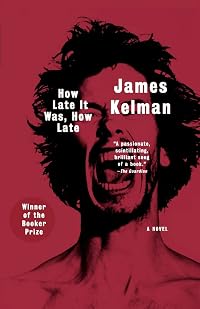
How Late It Was, How Late
by James Kelman
On This Page
Description
In Scotland, the portrait of a petty crook who had one run-in with police too many. It is a series of reflections as he sits in jail, contemplating his fate. He had been in trouble before, but this time it's different, the latest brawl with police cost him his eyesight. Now in addition to all his other troubles he is blind.Tags
Recommendations










Member Reviews
On to an old Booker prizewinner now, way back from 1994. This is possibly one of my favourite titles for a book for a long time. You just know it's going to be a great read.
How Late It Was, How Late is written in thick working-class Glaswegian vernacular, narrated by the protagonist Sammy in a stream of consciousness style. One page in and I thought I was going to hate it. The combination of keeping up with Sammy's inner dialogue and staying tuned in to the slang required close reading to begin with, but after a while you get used to it, with the local patter developing him into the most fantastically vivid character.
The book opens with Sammy waking up in someone else's too-small trainers after a two day bender. He doesn't know where he show more is, he doesn't know where his good shoes have gone to, and he's completely lost a day. Things get steadily worse, setting off a bizarre chain of events that we walk through with him for the rest of the novel.
To the outside world Sammy is a no-good drinker and troublemaker who's been in and out of prison a couple of times and isn't to be trusted. As readers, though, despite his nonsense we quickly fall for him as a brilliant anti-hero, a loveable rogue with a good heart who wants to change his lot but who just can't help himself. This time he's really landed in it, but Sammy being Sammy he just batters on, trying to find his way to the end of the rainbow.
Full of black comedy, this is a funny, brilliant and authentic novel. Given the vernacular, the prose is heavy on the swearing from start to finish so it may not be to everyone's taste. Without it, though, Sammy simply would not ring true as a character, and I had to laugh on many an occasion at his swearing creativity.
5 stars - naw, but I'm no jokin ye man, ye couldnay read this to the end and no end up lovin it. Nay point being fucking daft, now - ye get me? show less
How Late It Was, How Late is written in thick working-class Glaswegian vernacular, narrated by the protagonist Sammy in a stream of consciousness style. One page in and I thought I was going to hate it. The combination of keeping up with Sammy's inner dialogue and staying tuned in to the slang required close reading to begin with, but after a while you get used to it, with the local patter developing him into the most fantastically vivid character.
The book opens with Sammy waking up in someone else's too-small trainers after a two day bender. He doesn't know where he show more is, he doesn't know where his good shoes have gone to, and he's completely lost a day. Things get steadily worse, setting off a bizarre chain of events that we walk through with him for the rest of the novel.
To the outside world Sammy is a no-good drinker and troublemaker who's been in and out of prison a couple of times and isn't to be trusted. As readers, though, despite his nonsense we quickly fall for him as a brilliant anti-hero, a loveable rogue with a good heart who wants to change his lot but who just can't help himself. This time he's really landed in it, but Sammy being Sammy he just batters on, trying to find his way to the end of the rainbow.
Full of black comedy, this is a funny, brilliant and authentic novel. Given the vernacular, the prose is heavy on the swearing from start to finish so it may not be to everyone's taste. Without it, though, Sammy simply would not ring true as a character, and I had to laugh on many an occasion at his swearing creativity.
5 stars - naw, but I'm no jokin ye man, ye couldnay read this to the end and no end up lovin it. Nay point being fucking daft, now - ye get me? show less
This novel was a unique reading experience. First, there was the language. Warning: if the use of the f-word, in all of its glorious forms, many, many, many times or even the use of any word that many times bothers you or bores you, you should probably not read this book. Then there is the Glaswegian vernacular, which was a challenge initially but easily overcome. I found Urban Dictionary solved most of this problem for me. Once you have committed the most common words and their meaning to memory, the language actually flows very smoothly.
But what amazed me was how Kelman has written from the perspective of a character who has gone suddenly blind, and you spend much of the novel inside Sammy's head as he comes to understand and deal show more with his blindness. For me as a reader, this was both enlightening and depressing, thus only the three stars, because I had at times to push myself forward as I read the novel. I really enjoyed, though, two of the characters, Ally the rep and Peter, Sammy's son; they made the second half of the novel read more quickly.
I am not one to steer away from downtrodden characters or characters facing incredibly challenging obstacles or odds. Nelson Algren's The Man with the Golden Arm and several of Joan Didion's novels come to mind, but this one was more difficult for me. With all of its complexities and craft aside, I ultimately found this novel to be about trust or the inability to trust. How trust opens doors and the inability to trust closes doors. Have you ever wanted to whisper in someone's ear, "Just walk through the door. It is right there in front of you." But they can't see it. For them, that door is closed. show less
But what amazed me was how Kelman has written from the perspective of a character who has gone suddenly blind, and you spend much of the novel inside Sammy's head as he comes to understand and deal show more with his blindness. For me as a reader, this was both enlightening and depressing, thus only the three stars, because I had at times to push myself forward as I read the novel. I really enjoyed, though, two of the characters, Ally the rep and Peter, Sammy's son; they made the second half of the novel read more quickly.
I am not one to steer away from downtrodden characters or characters facing incredibly challenging obstacles or odds. Nelson Algren's The Man with the Golden Arm and several of Joan Didion's novels come to mind, but this one was more difficult for me. With all of its complexities and craft aside, I ultimately found this novel to be about trust or the inability to trust. How trust opens doors and the inability to trust closes doors. Have you ever wanted to whisper in someone's ear, "Just walk through the door. It is right there in front of you." But they can't see it. For them, that door is closed. show less
After a two-day drinking binge, Sammy wakes up to realize he has lost his good shoes, part of his memory, his girlfriend, and, after getting into a scrap with the police, his eyesight. It's not a riveting plotline, admittedly, but Kelman creates magic with his main character, a shifty ex-con who is terrified of authority and fatalistic to a fault. Sammy's ponderings and ramblings are nothing short of mesmerizing - it's like Kelman somehow poured the character's mind straight onto paper. Sammy completely draws you in with his stream-of-consciousness descriptions of getting used to his new-found disability and how he manages himself (or fails to) in a Kafkaesque red-tape society - you can't help but to be sympathetic to his fate, although show more he is in no way an agreeable character (albeit sometimes unintentionally funny).
Obviously, besides the descriptions of Sammy's very checkered past and present, a huge part of the novel deals with the claustrophobia sudden blindness would cause. There's a scene where Sammy, lost in thought, misses a turn on his way home and realizes he had no idea where he is. He senses that someone is following him, but can't be sure if there is really someone there, and who that someone might be, or if it's a "a false creation, proceeding from the heat-oppressèd brain," to borrow a line from Mr. Shakespeare. Even if Sammy is holding it together on the outside, he relays perfectly the utter panic you'd feel were you in the same situation. For the record, James Kelman isn't blind, although he could have fooled me, so well does he describe it.
It isn't always a very pleasant read and if you have a problem with foul language, you may have a slight issue with Sammy's Glaswegian working-class vernacular. If you need another reason to read it, one of the Booker Prize judges stormed off the judges' panel in protest when it won and, as much as I'm for not judging people for their taste in literature, I suspect that particular judge is an eedjit who shouldn't be allowed to have any public opinion about literature ever again. Not recommended for everyone, but for those who are character-readers and would like a view into someone else's mind, this is quite spectacular. show less
Obviously, besides the descriptions of Sammy's very checkered past and present, a huge part of the novel deals with the claustrophobia sudden blindness would cause. There's a scene where Sammy, lost in thought, misses a turn on his way home and realizes he had no idea where he is. He senses that someone is following him, but can't be sure if there is really someone there, and who that someone might be, or if it's a "a false creation, proceeding from the heat-oppressèd brain," to borrow a line from Mr. Shakespeare. Even if Sammy is holding it together on the outside, he relays perfectly the utter panic you'd feel were you in the same situation. For the record, James Kelman isn't blind, although he could have fooled me, so well does he describe it.
It isn't always a very pleasant read and if you have a problem with foul language, you may have a slight issue with Sammy's Glaswegian working-class vernacular. If you need another reason to read it, one of the Booker Prize judges stormed off the judges' panel in protest when it won and, as much as I'm for not judging people for their taste in literature, I suspect that particular judge is an eedjit who shouldn't be allowed to have any public opinion about literature ever again. Not recommended for everyone, but for those who are character-readers and would like a view into someone else's mind, this is quite spectacular. show less
I have a thing for the Vintage publisher series of books- nice graphic design cover, red spines all lined up nicely together on my shelf. Plus, I am slowly working through old Booker Prize winners, so this 1994 book fit the bill on a few counts. But when I started reading it, I was disappointed to see that from the get-go it is written not only in colloquial Glaswegian (no speech marks or even full-stops sometimes), but also in a stream of consciousness style. YIKES I thought. But after a few pages these styles grew on me. I mean really grew. So much so in fact that I feel now that this story could not have been told in nearly such an effective way without them.
We start (and end) with Sammy who is down and out. He wakes up with little show more memory of an alcohol-fueled weekend and spots some police officers who he decides to pick a fight with. So begins the story that is a week in the life of what sounds like a typical geezer from Glasgow. Only, very early on in this week or so of his life, Sammy goes blind. From this, let's face it, catastrophic event we get to see how Sammy copes with the fear and emotional turmoil that sets in with the realisation that he cannot, and may not ever see again. Because this revelation of his 'softer side' is written by his jumpy thoughts and many many swear words, it is so distinctive. I cant think of a time I have read such in-depth heart-felt commentary from such un-eloquent character. His thoughts jump from place to place, affectionately and angrily using the 'C' word to refer to all and sundry, revealing through repetition and just the volume of his head chatter his fears and feelings, his loves and his memories. He is alone. No one is offering help and he wouldn't take it if it were because of distrust of the establishment and his hatred of the monied upper classes. He manages OK, he always has and always will. It all adds up to a very deep book masquerading as the rantings of a down-trodden no-hoper. show less
We start (and end) with Sammy who is down and out. He wakes up with little show more memory of an alcohol-fueled weekend and spots some police officers who he decides to pick a fight with. So begins the story that is a week in the life of what sounds like a typical geezer from Glasgow. Only, very early on in this week or so of his life, Sammy goes blind. From this, let's face it, catastrophic event we get to see how Sammy copes with the fear and emotional turmoil that sets in with the realisation that he cannot, and may not ever see again. Because this revelation of his 'softer side' is written by his jumpy thoughts and many many swear words, it is so distinctive. I cant think of a time I have read such in-depth heart-felt commentary from such un-eloquent character. His thoughts jump from place to place, affectionately and angrily using the 'C' word to refer to all and sundry, revealing through repetition and just the volume of his head chatter his fears and feelings, his loves and his memories. He is alone. No one is offering help and he wouldn't take it if it were because of distrust of the establishment and his hatred of the monied upper classes. He manages OK, he always has and always will. It all adds up to a very deep book masquerading as the rantings of a down-trodden no-hoper. show less
This is an excellent novel (don’t take it from me – it won the Booker Prize) about a lowlife drunk and the indignities he suffers trying to get welfare. That it’s written in an accent would usually get on my nerves fast, but Kelman is simply too good. Here’s how it starts: “Ye wake in a corner and stay there hoping yer body will disappear, the thoughts smothering ye; these thoughts; but ye want to remember and face up to things, just something keeps ye from doing it, why can ye no do it; the words filling yer head: then the other words; there’s something wrong; there’s something far far wrong; ye’re no a good man, ye’re just no a good man.”
You're gony have to read this book. There's nay doubt about it, nay doubt.
Of course, if you're easily offended by strong language aye, then it's probably no for you.
For a potty mouth like me it was aye a bit of a shock like.
Of course I was completely sucked in by the Scottish accent. It was hard going though. I was beginning to wonder if it was ever going to end. With a hundred pages left I was telling anyone that was willing to listen that I deserved a bloody medal for finishing it. I read bits out aloud to the family so they knew what I was dealing with. Well, it just about made Bel's boyfriend fall off his chair in shock at a girl's mother speaking like that. The hubby pronounced it poetry aye. I suspect it's a bloke's book by and show more large and I'd welcome a discussion with blokes about it.
We are introduced to Sammy as he wakes up from a really bad hangover.....slumped in the corner of a pavement somewhere, wearing someone else's sneakers. He is the perfect anti-hero. I spent most of the book wishing he'd have a bath and a shave. Simple things aye but they really got on me nerves. Does anything happen?...well yes, in a way....You're on the edge of your seat most of the time waiting for it to happen. If you want to witness character development on a grandiose scale then this is the book for you. I felt I knew every inch of Sammy by the end. As readers, we're living and breathing his stream of consciousness, which is exhausting but I was up for the challenge.
Philosophers have argued about what constitutes reality since time immemorial. "What's reality?" they debate amongst themselves..."Is it me or is it you?...Is it this chair or is it this glass of wine?" Obviously some poor wretch is making the bed and cleaning the bath while they pontificate and excruciate over the wretched question. There was a bit of me that wondered while reading this novel..."Is it all in Sammy's head?" Which led me to the next philosophical thought...."How much of our life happens in our head?" Now you're probably thinking - "She's getting all philosophical like that Alex Daw." Aye - mebbe. But it's a fact isn't it? You cannay get away from the voice in your head. You try and avoid it like but it's always there - lurking....waiting to catch you. Commenting on your cleaning of the bath - ooh, it's not like your mam used to do it. Urging you to get on with that reading for Uni so you don't get behind like. Helping you tackle your life - or not, as may be the case.
Some would argue that this scumbag of a character is not worth knowing. But who are we to judge? If you got thumped by a scumbag like Sammy, you'd want to know what provoked him wouldn't you? Well, I would. But then I'm different. I've got that voice in my head. Have you? What does your voice say? Does it endlessly repeat itself ? Does it have a cute accent? Does it love you very much? Does it love anyone else? What makes it change its pitch? Does it keep you together?
Well I didn't get a medal but I did finish this book. As you would expect from an anti-hero, Sammy exits stage left at the end of the novel still wearing those wretched toe-pinching sneakers. And I was gunning for him too. Now that's a sign of a good book isn't it? - that even if it's a bloody struggle, you want to get to the end...to see what happens like.
I'd best get to scrubbing that bath, now...like....mebbe...aye. show less
Of course, if you're easily offended by strong language aye, then it's probably no for you.
For a potty mouth like me it was aye a bit of a shock like.
Of course I was completely sucked in by the Scottish accent. It was hard going though. I was beginning to wonder if it was ever going to end. With a hundred pages left I was telling anyone that was willing to listen that I deserved a bloody medal for finishing it. I read bits out aloud to the family so they knew what I was dealing with. Well, it just about made Bel's boyfriend fall off his chair in shock at a girl's mother speaking like that. The hubby pronounced it poetry aye. I suspect it's a bloke's book by and show more large and I'd welcome a discussion with blokes about it.
We are introduced to Sammy as he wakes up from a really bad hangover.....slumped in the corner of a pavement somewhere, wearing someone else's sneakers. He is the perfect anti-hero. I spent most of the book wishing he'd have a bath and a shave. Simple things aye but they really got on me nerves. Does anything happen?...well yes, in a way....You're on the edge of your seat most of the time waiting for it to happen. If you want to witness character development on a grandiose scale then this is the book for you. I felt I knew every inch of Sammy by the end. As readers, we're living and breathing his stream of consciousness, which is exhausting but I was up for the challenge.
Philosophers have argued about what constitutes reality since time immemorial. "What's reality?" they debate amongst themselves..."Is it me or is it you?...Is it this chair or is it this glass of wine?" Obviously some poor wretch is making the bed and cleaning the bath while they pontificate and excruciate over the wretched question. There was a bit of me that wondered while reading this novel..."Is it all in Sammy's head?" Which led me to the next philosophical thought...."How much of our life happens in our head?" Now you're probably thinking - "She's getting all philosophical like that Alex Daw." Aye - mebbe. But it's a fact isn't it? You cannay get away from the voice in your head. You try and avoid it like but it's always there - lurking....waiting to catch you. Commenting on your cleaning of the bath - ooh, it's not like your mam used to do it. Urging you to get on with that reading for Uni so you don't get behind like. Helping you tackle your life - or not, as may be the case.
Some would argue that this scumbag of a character is not worth knowing. But who are we to judge? If you got thumped by a scumbag like Sammy, you'd want to know what provoked him wouldn't you? Well, I would. But then I'm different. I've got that voice in my head. Have you? What does your voice say? Does it endlessly repeat itself ? Does it have a cute accent? Does it love you very much? Does it love anyone else? What makes it change its pitch? Does it keep you together?
Well I didn't get a medal but I did finish this book. As you would expect from an anti-hero, Sammy exits stage left at the end of the novel still wearing those wretched toe-pinching sneakers. And I was gunning for him too. Now that's a sign of a good book isn't it? - that even if it's a bloody struggle, you want to get to the end...to see what happens like.
I'd best get to scrubbing that bath, now...like....mebbe...aye. show less
How Late It Was, How Late is a stream of consciousness novel from the perspective of Sammy, a small-time criminal from Glasgow, Scotland. Sammy wakes up on the street after a weekend drinking binge, much of which he’s blacked out, and ends up getting further into trouble by antagonizing two undercover cops, who then beat him senseless. After waking up in jail, Sammy finds he’s gone blind. From that point, it all goes downhill for him.
Since losing his sight, Sammy is forced to make some important decisions and reevaluate certain aspects of his life. While he attempts this, his mental state alternates between paranoid belligerence and a zen-like acceptance of his situation. He is essentially on his own, without any family or close show more friends, for much of the novel. Long, painful passages where he walks alone from the police station to his apartment almost suffocate the reader with a deep sense of loneliness and isolation. The descriptions of Sammy’s dealings with doctors and social service workers are equally disturbing. He’s consistently treated as a nuisance or even subhuman, making it impossible for him to get the help he needs. No one actually listens to him.
All of this leads to one of the most fascinating aspects of the novel: Sammy is such an unlikely main character. It’s difficult to identify any qualities that might make him a convincing candidate for center stage. He would normally play a minor role, perhaps dying in the first act or hanging around for comic relief. I would compare him to someone like Skinny Pete from Breaking Bad... although older and Scottish. He’s not very bright. He doesn’t have good looks or sex appeal. And he’s not even a particularly skilled criminal. He’s also not bad enough to be an intriguing bad guy. But we’re inside his head for 374 pages and it really drives home the idea that everyone has a voice and a story and reasons for doing what they do. I would contrast this with the stories in The Acid House, by Irvine Welsh (which I read several years ago and hated), where all the characters are grotesque caricatures of down and out people. While Sammy comes from this same world, Kelman writes him with a great deal more respect.
Even though I think 75 pages or so could have been edited out, I really enjoyed this novel and recommend it. The Scottish dialect takes a few pages to get used to, but it was not as difficult as I thought it would be. If excessive swearing bothers you, please be aware that there are roughly 20 instances of the f-word per page. show less
Since losing his sight, Sammy is forced to make some important decisions and reevaluate certain aspects of his life. While he attempts this, his mental state alternates between paranoid belligerence and a zen-like acceptance of his situation. He is essentially on his own, without any family or close show more friends, for much of the novel. Long, painful passages where he walks alone from the police station to his apartment almost suffocate the reader with a deep sense of loneliness and isolation. The descriptions of Sammy’s dealings with doctors and social service workers are equally disturbing. He’s consistently treated as a nuisance or even subhuman, making it impossible for him to get the help he needs. No one actually listens to him.
All of this leads to one of the most fascinating aspects of the novel: Sammy is such an unlikely main character. It’s difficult to identify any qualities that might make him a convincing candidate for center stage. He would normally play a minor role, perhaps dying in the first act or hanging around for comic relief. I would compare him to someone like Skinny Pete from Breaking Bad... although older and Scottish. He’s not very bright. He doesn’t have good looks or sex appeal. And he’s not even a particularly skilled criminal. He’s also not bad enough to be an intriguing bad guy. But we’re inside his head for 374 pages and it really drives home the idea that everyone has a voice and a story and reasons for doing what they do. I would contrast this with the stories in The Acid House, by Irvine Welsh (which I read several years ago and hated), where all the characters are grotesque caricatures of down and out people. While Sammy comes from this same world, Kelman writes him with a great deal more respect.
Even though I think 75 pages or so could have been edited out, I really enjoyed this novel and recommend it. The Scottish dialect takes a few pages to get used to, but it was not as difficult as I thought it would be. If excessive swearing bothers you, please be aware that there are roughly 20 instances of the f-word per page. show less
Members
- Recently Added By
Lists

The Guardian's 1000 Novels Everyone Must Read
1,005 works; 550 members

Booker Prize
491 works; 62 members
Booker Prize Shortlist: Titles Read
103 works; 10 members

Top Five Books of 2014
1,064 works; 398 members

1,001 BYMRBYD Concensus
723 works; 27 members

Man Booker Prize Longlist 1994
6 works; 1 member

TML 200 Best Books 1950-1999
202 works; 10 members

Blue Pyramid 1,276 Best Books of All Time
1,248 works; 32 members

living room bookshelf
150 works; 1 member

The Modern Library (The Two Hundred Best Novels....
202 works; 1 member
Author Information

40+ Works 3,808 Members
Awards and Honors
Awards
Notable Lists
Common Knowledge
- Canonical title
- How Late It Was, How Late
- Original title
- How Late It Was, How Late
- Original publication date
- 1994
- People/Characters
- Sammy
- Important places
- Glasgow, Scotland, UK
- Dedication
- Alasdair Gray, Tom Leonard, Agnes Owens and Jeff Torrington are still around, thank christ
- First words
- Ye wake in a corner and stay there hoping yer body will disappear, the thoughts smothering ye; these thoughts; but ye want to remember and face up to things, just something keeps ye from doing it, why can ye not do it; the wo... (show all)rds filling yer head: then the other words; there's something wrong; there's something far wrong; ye're no a good man, ye're just no a good man.
- Last words
- (Click to show. Warning: May contain spoilers.)Sammy slung in the bag and stepped inside, then the door slammed and that was him, out of sight.
Classifications
Statistics
- Members
- 1,430
- Popularity
- 16,458
- Reviews
- 19
- Rating
- (3.58)
- Languages
- 9 — Dutch, English, German, Italian, Norwegian (Bokmål), Norwegian, Croatian, Slovenian, Spanish
- Media
- Paper, Ebook
- ISBNs
- 20
- ASINs
- 10