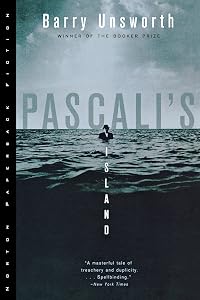
Pascali's Island
by Barry Unsworth
On This Page
Description
A Turkish spy for twenty years, Basil Pascali is puzzled by the arrival of a mysterious Englishman posing as an archaeologist.Tags
Recommendations























Member Reviews
A remarkable study of paranoia, supplication, and weakness--hardly the usual stuff of novels, especially historical ones. But Unsworth pulls off quite a feat here. His narrator, Basil Pascali, is a spy. Not your ordinary spy, though. He's an informant for the Ottoman Empire, stationed on a remote Greek island in 1908, when the Ottomans are in terminal decline. Nonetheless, he dutifully pens his observations to the Ottoman Emperor himself--the "Lord of the world" and "shadow of God on earth"--observations he can make because no one takes him seriously (he's described somewhat mockingly to his face as "one of the fixtures of the island"). Is the Ottoman Emperor himself reading any of this? Of course not. It's all terribly pathetic. But show more then, just as he becomes convinced his cover has been blown, a charming Englishman arrives and steals the heart of the woman he's been eyeing, setting off quite the dark game between the two.
This is a wonderful example of an unsympathetic unreliable narrator--a smarmy self-aggrandizing nobody who nonetheless grabs hold of your attention through his sheer need to tell his story, and his elegant mastery of prose and plot. show less
This is a wonderful example of an unsympathetic unreliable narrator--a smarmy self-aggrandizing nobody who nonetheless grabs hold of your attention through his sheer need to tell his story, and his elegant mastery of prose and plot. show less
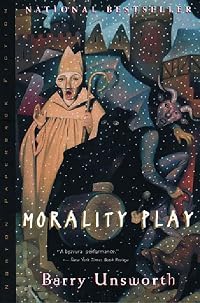
An atmospheric and rather curious story set on an Aegean island in 1908 that is part of the dying Ottoman empire, this is the sixth book I have read from the 1980 Booker shortlist, and in such a strong year it is probably the least impressive. Unsworth has written better books, notably Morality Play and his Booker winner Sacred Hunger.
The narrator Basil Pascali is a paid informer for the Ottomans, but this post is insufficient to sustain him and his pay has not increased in the 20 years he has been on the island, which makes him susceptible to various intrigues and petty acts of larceny. The book takes the form of his reports, but it gradually becomes clear that he does not believe these reports have any meaning, and he freely admits show more that he embellishes what he writes. The action starts when an Englishman, Bowles, arrives on the island seeking to explore an archaeological site. In this story nothing is quite what it seems, and nobody comes out of it with much credit, which makes it symbolic of the world of diplomacy before the First World War. Although it has some nice touches and a few memorable moments, the ending was too melodramatic for my liking. show less
The narrator Basil Pascali is a paid informer for the Ottomans, but this post is insufficient to sustain him and his pay has not increased in the 20 years he has been on the island, which makes him susceptible to various intrigues and petty acts of larceny. The book takes the form of his reports, but it gradually becomes clear that he does not believe these reports have any meaning, and he freely admits show more that he embellishes what he writes. The action starts when an Englishman, Bowles, arrives on the island seeking to explore an archaeological site. In this story nothing is quite what it seems, and nobody comes out of it with much credit, which makes it symbolic of the world of diplomacy before the First World War. Although it has some nice touches and a few memorable moments, the ending was too melodramatic for my liking. show less
The novel is set on a small Greek island in 1908. The Ottoman Empire is about to fall, but in this remote outpost a government informer pens his last report to the Sultan. Basil Pascali, an outsider of mixed-race, has loyally reported on the activities of the people of his community for twenty years, each month receiving a tiny stipend, but never a single response. As a writer he begins to take liberties with his reports, taking enormous pride in his ability to depict events with great clarity and flair.
When Englishman Anthony Bowles arrives on the island, he and Pascali become rivals for the affection of Lydia, a Viennese artist who has been living there for some time. Pascali suspects that Bowles may not be honest about his claim to show more be an archeologist (it takes a practiced confidence-trickster to recognise another of his kind, after all), so what is he doing there?
The atmospheric short novel is superbly plotted, there isn't a scene out of place. Nothing is as it seems and Pascali's Island keeps you guessing right up to the tragic ending as the characters become enmeshed in layers betrayal and deceit.
Literary fiction honestly doesn't come much better than this and I am actually surprised that the novel didn't win more recognition at the time.
It was shortlisted for the Booker in 1980, but was eclipsed by William Golding's win for Darkness Visible and Anthony Burgess' masterpiece Earthly Powers. I've read several other novels by Unsworth which I've greatly enjoyed and admired (Morality Play, Rum and Sugar, Losing Nelson, and Sacred Hunger, which finally did won Unsworth the Booker) but I like this by far the best. (I still have his latest novel A Ruby in her Navel to be read.)
Pascali's Island reminded me of several other novels I've greatly enjoyed : E.M. Forster's Passage to India, L.P. Hartley's The Go-Between, and the episode about the smugglers in Lermentov's A Hero of our Time ... all of them written much earlier. show less
When Englishman Anthony Bowles arrives on the island, he and Pascali become rivals for the affection of Lydia, a Viennese artist who has been living there for some time. Pascali suspects that Bowles may not be honest about his claim to show more be an archeologist (it takes a practiced confidence-trickster to recognise another of his kind, after all), so what is he doing there?
The atmospheric short novel is superbly plotted, there isn't a scene out of place. Nothing is as it seems and Pascali's Island keeps you guessing right up to the tragic ending as the characters become enmeshed in layers betrayal and deceit.
Literary fiction honestly doesn't come much better than this and I am actually surprised that the novel didn't win more recognition at the time.
It was shortlisted for the Booker in 1980, but was eclipsed by William Golding's win for Darkness Visible and Anthony Burgess' masterpiece Earthly Powers. I've read several other novels by Unsworth which I've greatly enjoyed and admired (Morality Play, Rum and Sugar, Losing Nelson, and Sacred Hunger, which finally did won Unsworth the Booker) but I like this by far the best. (I still have his latest novel A Ruby in her Navel to be read.)
Pascali's Island reminded me of several other novels I've greatly enjoyed : E.M. Forster's Passage to India, L.P. Hartley's The Go-Between, and the episode about the smugglers in Lermentov's A Hero of our Time ... all of them written much earlier. show less
Read this a while back, from recollection it is a slow-burning story of intrigue on a Greek island in the period before WWI. The main protagonist, a minor official in the pay of the Ottomans, is gradually caught in a claustrophobic web of deceit and faces his doom at the end.
Read during Spring 2004
This is one of my favorite movies and it was interesting to see how faithful an adaption it was. It was hard not to see the scenes in my head. The novel is written entirely as a letter by Pascali to the Emperor of the Ottman Empire, his employeer, in a sense, as a spy for the Empire. This style works much better than I would have expected but falters a bit at the end. Overall, it is extremely well-written and feels like a series of letters or journals. The writing in introspective and vauge at times but in a way that makes me think.
This is one of my favorite movies and it was interesting to see how faithful an adaption it was. It was hard not to see the scenes in my head. The novel is written entirely as a letter by Pascali to the Emperor of the Ottman Empire, his employeer, in a sense, as a spy for the Empire. This style works much better than I would have expected but falters a bit at the end. Overall, it is extremely well-written and feels like a series of letters or journals. The writing in introspective and vauge at times but in a way that makes me think.
Definitely not the right time to read this book. It take the reader into the ranting, paranoia and mind of a spy of a crumbling empire. I think I just had too much going on to give it its due. I've read to Unsworth previously. One I loved. One I just wondered, "Why is this in print? It is just dull and silly." Hope one day to pick this up again when I'm in the mood for some nothing-to-crazy madness. :-(
I did not enjoy this book nearly as much as Sacred Hunger. I found it well, frankly boring, and the movie was even worse.
Members
- Recently Added By
Lists

Booker Prize
491 works; 62 members

Middle East Fiction
179 works; 16 members

Man Booker Prize Longlist 1980
7 works; 2 members

Books Set on Islands
190 works; 24 members

Booker Prize Shortlist: Titles Not Yet Read
161 works; 4 members

Greece - a reading list
83 works; 4 members
Author Information

20+ Works 6,832 Members
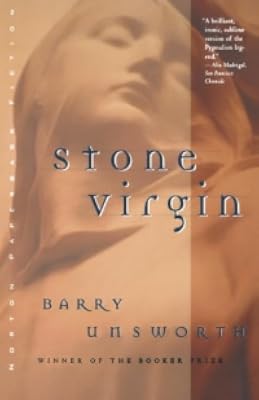
Barry Unsworth was born in Wingate, England on August 10, 1930. He received an undergraduate degree in English from the University of Manchester in 1951. He started out writing short stories, but soon switched to novels. His first novel, The Partnership, was published in 1966. He wrote 17 novels during his lifetime including Stone Virgin, Losing show more Nelson, The Songs of the Kings, Land of Marvels, and The Quality of Mercy. Sacred Hunger won a Booker Prize in 1992. Morality Play and Pascali's Island were both made into feature films. He died from lung cancer on June 5, 2012 at the age of 81. (Bowker Author Biography) show less
Awards and Honors
Awards
Work Relationships
Has the adaptation
Common Knowledge
- Canonical title
- Pascali's Island
- Alternate titles
- The Idol Hunter
- Original publication date
- 1980
- People/Characters
- Basil Pascali; Lydia; Anthony Bowles
- Important places
- Greece; Constantinople, Turkey
- Related movies
- Pascali's Island (1988 | IMDb)
- Epigraph
- Nothingness might save or destroy those who face it, but those who ignore it are condemned to unreality. -Demetrius Capetanakis
- Dedication
- To Jack and Shelia Carter
- First words
- July 1908
Lord of the world. - Last words
- (Click to show. Warning: May contain spoilers.)God bring you increase.
Classifications
Statistics
- Members
- 267
- Popularity
- 121,454
- Reviews
- 7
- Rating
- (3.59)
- Languages
- English, French, Italian, Turkish
- Media
- Paper, Ebook
- ISBNs
- 12
- ASINs
- 2