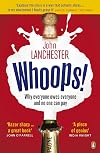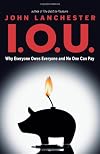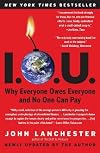
I.O.U.: Why Everyone Owes Everyone and No One Can Pay
by John Lanchester
On This Page
Description
The wildest story in the world these days is not fiction; it's what's really happening all around us as the world's global economy has gone into freefall. How did we get here? What does it all mean? How could so many smart people be so dumb and believe their own hype?Accessibly, cleverly, and with mordant humor, journalist John Lanchester trots the globe in search of the answers to these questions-to Iceland, the scene of catastrophic bank collapse; to Hong Kong, the city of his birth built show more at the altar of free-market capitalism; to the high-stakes leveraging of Wall Street; and to the tragedy of lost homes in small-town America. And in his capable hands, we see and understand what went wrong and why. Lanchester believes that the current crisis gives us an opportunity to bring about much-needed change and that a stronger and more compassionate system can emerge from the wreckage. show lessTags
Recommendations





Member Recommendations
Member Reviews
Lanchester writes regularly for the London Review of Books: a magazine that can be very left of centre in its approach and so it is no surprise that in his history of the 2008 credit crunch Lanchester is clear in his views that it was the fault of the bankers; aided and abetted by the insane right wing governments of Thatcher in the UK and Reagan in the US. Thatcher and Reagan were both history when the crash happened, but unfortunately the Americans had George W Bush and England had Chancellor Brown (Blair was probably on his welcome home hero tour after the glorious Iraqi war). When the “too big to fail” banks actually failed, neither government would consider nationalisation although both the US and the UK had to partially take show more control of the most desperate cases by becoming major shareholders. The result was taxpayers money being pumped into the banks (and their inflated bonuses) as a rescue package and the tax paying public are still footing the bill.
Lanchester’s book has the clearest explanation that I have read as to what actually went wrong. He starts off by reminding people about the mysteries of double entry bookkeeping and how this is the basis of much of the banks business; he goes on to explain about derivatives and how this led to CDS’s, CDO’s and the subprime loan market in the US. The bigger the risk the better the profit and if you can sell off the risk to other people then you really have touched the philosophers stone. He spices his explanation with actual events and some witty asides from the calamitous crash year. I have read other histories of the events in 2008, but Lanchester has simplified it enough for me to understand. It made me no less angry.
Lanchester has other strings to his bow; he ties up the crash within the context of events in the late 20th century, surmising that the fall of communism had left capitalism as the only viable working system and an increasing belief in the power of market forces. He also spends some time thinking about the psychology of the finance men (I am presuming that they were mostly men) who worked in the banks and the financial industry and who really believed that they were “Masters of the Universe”. They could not or would not believe that they were doing anything wrong. He also talks about the difference between an industry and a business: people who make things generally see themselves as an industry and people who make money are in business. Capitalism needs both to work, but government support has tipped the balance too far over to the business side and the banks are big, big business.
It all seems pretty simple now; a consistent policy in the US and the UK of deregulating the banks gave the green light for industry insiders to make lots of money. When the gravy train really picked up speed nobody wanted it to stop; too many people in the industry were getting very rich and they all believed that the money making spiral could go on forever. There were warnings, there were plenty of voices in the wilderness, but nobody wanted to listen. It seems obvious that if you are basing your business on extremely risky loans in the form of mortgages to people who are likely to default (the sub prime market in the US) then something has got to give. It beggars belief that regulatory bodies and government watchdogs went along for the ride. They must have realised it was not a question of if but when the crash would occur, although they might not have realised how big it was going to be.
This is a fascinating piece of recent history, but like most historical events it is one we are reluctant to heed in the future. My own view is that while culture in the Western world (and particularly the UK and The US) are based around greed then the credit crunch will certainly occur again. Nobody was held responsible within the banking industry (at the time I would have been happy to see some of them strung up) now I think that a more fitting punishment would have been to put them in specially built prisons (funded by their bonuses) with a sentence that stipulated that they must play roulette on a giant roulette wheel every day until they lost all their money (it would make great television). Shame and blame is the order of the day for me.
I really enjoyed getting angry again with John Lanchester. A Four star read show less
Lanchester’s book has the clearest explanation that I have read as to what actually went wrong. He starts off by reminding people about the mysteries of double entry bookkeeping and how this is the basis of much of the banks business; he goes on to explain about derivatives and how this led to CDS’s, CDO’s and the subprime loan market in the US. The bigger the risk the better the profit and if you can sell off the risk to other people then you really have touched the philosophers stone. He spices his explanation with actual events and some witty asides from the calamitous crash year. I have read other histories of the events in 2008, but Lanchester has simplified it enough for me to understand. It made me no less angry.
Lanchester has other strings to his bow; he ties up the crash within the context of events in the late 20th century, surmising that the fall of communism had left capitalism as the only viable working system and an increasing belief in the power of market forces. He also spends some time thinking about the psychology of the finance men (I am presuming that they were mostly men) who worked in the banks and the financial industry and who really believed that they were “Masters of the Universe”. They could not or would not believe that they were doing anything wrong. He also talks about the difference between an industry and a business: people who make things generally see themselves as an industry and people who make money are in business. Capitalism needs both to work, but government support has tipped the balance too far over to the business side and the banks are big, big business.
It all seems pretty simple now; a consistent policy in the US and the UK of deregulating the banks gave the green light for industry insiders to make lots of money. When the gravy train really picked up speed nobody wanted it to stop; too many people in the industry were getting very rich and they all believed that the money making spiral could go on forever. There were warnings, there were plenty of voices in the wilderness, but nobody wanted to listen. It seems obvious that if you are basing your business on extremely risky loans in the form of mortgages to people who are likely to default (the sub prime market in the US) then something has got to give. It beggars belief that regulatory bodies and government watchdogs went along for the ride. They must have realised it was not a question of if but when the crash would occur, although they might not have realised how big it was going to be.
This is a fascinating piece of recent history, but like most historical events it is one we are reluctant to heed in the future. My own view is that while culture in the Western world (and particularly the UK and The US) are based around greed then the credit crunch will certainly occur again. Nobody was held responsible within the banking industry (at the time I would have been happy to see some of them strung up) now I think that a more fitting punishment would have been to put them in specially built prisons (funded by their bonuses) with a sentence that stipulated that they must play roulette on a giant roulette wheel every day until they lost all their money (it would make great television). Shame and blame is the order of the day for me.
I really enjoyed getting angry again with John Lanchester. A Four star read show less
This is simply one of the most frightening books I have ever read. Lanchester sets out the causes of the current economic recession following the 'credit crunch' with a power and clarity that is superb - he manages to explain the culture of finance, the novel financial products and the relationships between the financial institutions and governments in a way which is understandable and memorable. The dominance of 'city culture', the drive for ever increasing profits, the belief in economic models that defied any sort of common sense or historical reality, a wider culture which both de-regulated the banking sector and allowed it to ignore the regulations still in place. All terrifying, but not nearly so much as the implication that we, show more as a society, haven't learnt our lesson.
Lanchester states while an industry makes products which, hopefully, makes money (shoes, movies, books, whatever) for the last thirty years we have increasingly moved into a world where the bottom line is everything, where making increasing profits is the primary goal of all sectors of the western economies - even such things as health care and education. He briefly makes the aside that some countries (Canada, for example) did not buy into the laissez faire free-for-all, but as we move into a century in which economic power moves from America and Europe to China and India, I fear that they have learnt the positive lessons from us but none of the negative ones. show less
Lanchester states while an industry makes products which, hopefully, makes money (shoes, movies, books, whatever) for the last thirty years we have increasingly moved into a world where the bottom line is everything, where making increasing profits is the primary goal of all sectors of the western economies - even such things as health care and education. He briefly makes the aside that some countries (Canada, for example) did not buy into the laissez faire free-for-all, but as we move into a century in which economic power moves from America and Europe to China and India, I fear that they have learnt the positive lessons from us but none of the negative ones. show less
IOU is a breezy overview of the financial crisis. It's great for anyone with no financial background and who somehow was unable to see a tv news report or read a magazine since 2007. With hindsight, it pulls together all the elements of the blowup, as if it were obvious, foreseeable, and inevitable. That is the benefit of hindsight, and Lanchester weaves it together as a coherent story that fits my description, with drama, with impact and with color.
He explains beautifully how banking is bogus, from the very basic perversion of balance sheets on through to new formulas for new products that don't work, even in theory. The most damning revelation is statistical - that the masters of the universe actually believed their own theories that show more such a blowup was not statistically possible, for a period of time longer than the universe has been in existence.
I was very concerned that there was no mention of the ratings agencies - but he came through, a little weakly, and very late, after page 208 (of 232), but hardly gave them the tonguelashing he gave others and which they richly deserve. They blessed these bogus products, for the money they received, and took down the entire world economy for their 40 pieces of silver. You must not minimize the role of the ratings agencies. They've gotten away with it utterly and completely.
One point missed was Alan Greenspan's overlooking of bank balance sheets. Of all people, the detail-obsessed Greenspan should have noticed that banks' balance sheets were ballooning outside of all proportion to their actual state of affairs. Dangerously, disastrously. That was after all, his very business. No one has ever called him on that one.
There is also an overriding theme that I got from IOU that the author didn't. That is debt. It seems that all efforts in investment banking, mortgage banking - banking in general - is to put customers in debt. The more they can put people in debt, the richer the bankers become - and of course, that's all that matters. So ways were found to make subprime loans, and then bundle them to make them more creditworthy than quality loans. The Thatcher government was all about getting people out of rentals into private homes they could not afford the way she ran the country. In the USA, no-docs loans, liar loans and the rest were all ways to get people into debt. If you read David Graeber's book Debt, you will see how powerfully crippling this is. It's not a zero sum game; you don't get rich by the amount you put someone else in debt. Leverage makes it far worse than that. And IOU dances all around that fact without ever recognizing it.
So while IOU is an easy, breezy overview, it really is just an good overview of a very deep flaw. show less
He explains beautifully how banking is bogus, from the very basic perversion of balance sheets on through to new formulas for new products that don't work, even in theory. The most damning revelation is statistical - that the masters of the universe actually believed their own theories that show more such a blowup was not statistically possible, for a period of time longer than the universe has been in existence.
I was very concerned that there was no mention of the ratings agencies - but he came through, a little weakly, and very late, after page 208 (of 232), but hardly gave them the tonguelashing he gave others and which they richly deserve. They blessed these bogus products, for the money they received, and took down the entire world economy for their 40 pieces of silver. You must not minimize the role of the ratings agencies. They've gotten away with it utterly and completely.
One point missed was Alan Greenspan's overlooking of bank balance sheets. Of all people, the detail-obsessed Greenspan should have noticed that banks' balance sheets were ballooning outside of all proportion to their actual state of affairs. Dangerously, disastrously. That was after all, his very business. No one has ever called him on that one.
There is also an overriding theme that I got from IOU that the author didn't. That is debt. It seems that all efforts in investment banking, mortgage banking - banking in general - is to put customers in debt. The more they can put people in debt, the richer the bankers become - and of course, that's all that matters. So ways were found to make subprime loans, and then bundle them to make them more creditworthy than quality loans. The Thatcher government was all about getting people out of rentals into private homes they could not afford the way she ran the country. In the USA, no-docs loans, liar loans and the rest were all ways to get people into debt. If you read David Graeber's book Debt, you will see how powerfully crippling this is. It's not a zero sum game; you don't get rich by the amount you put someone else in debt. Leverage makes it far worse than that. And IOU dances all around that fact without ever recognizing it.
So while IOU is an easy, breezy overview, it really is just an good overview of a very deep flaw. show less
Whoops! or Why Everyone Owes Everyone And No One Can Pay, by John Lanchester, is a book about the 2008 world financial crisis and what caused it. The greatest triumph of Whoops! is that – without over-simplifying the details of what can appear (deliberately I think) to be a forbiddingly complex subject – it’s a book that can be read and understood by /anyone/.
I’m serious: if you can read, you can read this book. In fact, you should. In the UK (where I'm typing this) we're currently experiencing the biggest cuts to public spending and services that have ever been attempted. If you want to know why that’s happening – why your school library can’t afford new books and your local public library is in danger of being closed, show more why you had to wait five hours in A&E before a doctor would see you when you broke your arm, why your family is worried about money – then read this book and you’ll find out.
The only sense in which this book is difficult to read is that it may make you angry. Successive governments around the world have allowed all our lives to be lashed to the activities of a small group of people who don’t do or make or care about anything except recklessly chasing quick profit for themselves. Moreover, our politicians have failed once more to take any real steps to curb them, or stop the crisis from happening again. It’s not a good feeling. But it’s an important truth, and the younger you are when you discover it, the sooner you can start thinking about how to do something about it.
I’d recommend Whoops! to everyone. show less
I’m serious: if you can read, you can read this book. In fact, you should. In the UK (where I'm typing this) we're currently experiencing the biggest cuts to public spending and services that have ever been attempted. If you want to know why that’s happening – why your school library can’t afford new books and your local public library is in danger of being closed, show more why you had to wait five hours in A&E before a doctor would see you when you broke your arm, why your family is worried about money – then read this book and you’ll find out.
The only sense in which this book is difficult to read is that it may make you angry. Successive governments around the world have allowed all our lives to be lashed to the activities of a small group of people who don’t do or make or care about anything except recklessly chasing quick profit for themselves. Moreover, our politicians have failed once more to take any real steps to curb them, or stop the crisis from happening again. It’s not a good feeling. But it’s an important truth, and the younger you are when you discover it, the sooner you can start thinking about how to do something about it.
I’d recommend Whoops! to everyone. show less
The best book I've read so far on the global financial crisis. He goes through it all with care, humour, and vituperation (where deserved). Despite my congenital disability with all things financial, I came out firmly convinced that I understood some of it. Maybe.
I read this because of Lanchester's essays in the LRB, which were well written, funny and clear-headed; the book's the same. I think I may actually now know what a collateralized debt obligation is. It's particularly useful for big-picture stuff. He traces and explains the financial instruments, and the mathematical research behind them, that reduced/massively increased the instability of the financial system; he traces the attitudes to home-ownership that increased demand for home loans while said financial instruments tremendously increased the demand for borrowers; he somewhat gently traces the growth of the laissez-faire mindset. His solution to all this is a world-wide rejection of the growth-above-all mindset. That would be nice, show more but how exactly would we pull it off?
Two problems with the book: the last two chapters a repetitive and dull. More importantly though, I worry that some of his translations (from professional/mathematical models to everyday language) might be a bit wonky. Particularly odd is the way he frames 'cognitive illusions'. Say a test for a disease is 95% accurate, and the disease affects on person in a thousand. You test positive. What's probability you have the disease? Lanchester says 2%: "if you test 1000 people, the test will give 50 positives, whereas only one of the population actually has the illness." It's been a long time since I did any statistics. But surely the test won't give 50 positives, but rather, 50 incorrect diagnoses for every 1000 people tested? There's nothing in Lanchester's presentation to say that those incorrect diagnoses *must* be false positives; they might be false negatives. I imagine the actual example is framed to exclude this possibility. On the other hand, maybe my maths is so rusty that I've messed this up. Very readable book in any case. show less
Two problems with the book: the last two chapters a repetitive and dull. More importantly though, I worry that some of his translations (from professional/mathematical models to everyday language) might be a bit wonky. Particularly odd is the way he frames 'cognitive illusions'. Say a test for a disease is 95% accurate, and the disease affects on person in a thousand. You test positive. What's probability you have the disease? Lanchester says 2%: "if you test 1000 people, the test will give 50 positives, whereas only one of the population actually has the illness." It's been a long time since I did any statistics. But surely the test won't give 50 positives, but rather, 50 incorrect diagnoses for every 1000 people tested? There's nothing in Lanchester's presentation to say that those incorrect diagnoses *must* be false positives; they might be false negatives. I imagine the actual example is framed to exclude this possibility. On the other hand, maybe my maths is so rusty that I've messed this up. Very readable book in any case. show less
Published under the title "Whoops!" in the UK, this is a 200-page aerial-photo of an economic bombsite, explaning the what, how, why and who of the global financial crisis. Each page brings jaw-dropping revelation, laugh-out-loud asides and a deep under-current of anger. A model of clarity and expositionary journalism. Required reading.
Members
- Recently Added By
Published Reviews
ThingScore 75
Wall Street has been so smitten with itself that it lost sight of the purpose—to provide credit and capital to the rest of us, remember?—that society entrusted to it. Lanchester, a British novelist and a banker’s son, excels at recalling, in comprehensible terms, this original—and betrayed—purpose. If his penchant for metaphor occasionally leads him off the rails, more often he spots show more latent truths that conventional banking reporters miss. show less
added by Shortride
Lists

The Enlightened Economist
107 works; 1 member

Books Read in 2019
4,052 works; 108 members
Author Information

13+ Works 6,456 Members
John Lanchester was the deputy editor of the London Review of Books and the restaurant critic for the London Observer. He is the author of a second novel, Mr. Phillips, and his work has appeared in The New Yorker. He lives in London. (Publisher Provided)
Awards and Honors
Awards
Distinctions
Notable Lists
Common Knowledge
- Alternate titles
- Whoops! Why Everyone owes Everyone and No One Can Pay
- Original publication date
- 2010
- Important events
- Great Recession (2008 | 2010)
- Epigraph
- "When the capital development of a country becomes the by-product of a casino, the job is likely to be ill-done." -John Manard Keynes, THE GENERAL THEORY OF EMPLOYMENT, INTEREST AND MONEY
" It's such a fine line between stupid and clever." -David St. Hubbins, This Is Spinal Tap - Dedication
- For Miranda and Finn and Jesse
- First words
- As a child, I was frightened by ATM's.
- Quotations
- You’re worse off relying on misleading information than on not having any information at all. If you give a pilot an altimeter that is sometimes defective he will crash the plane. Give him nothing and he will look out the w... (show all)indow. Technology is only safe when it is flawless. Nassim Taleb, qted on p 155.
There is a profound anthropological and cultural difference between an industry and a business. An industry is an entity which as its primary purpose makes or does something and makes money as a by-product. The car industry m... (show all)akes cars, the television industry makes TV programs the publishing industry makes books, and with a bit of luck they all make money too, but for the most part the people engaged in them don’t regard money as the ultimate purpose and justification of what they do. Money is a by-product of the business, rather than its fundamental raison d’etre. Who goes to work in the morning thinking that the most important thing he’s going to do that day is to maximize shareholder value? Ideologists of capital sometimes seem to think that that’s what w should be doing – which only goes to show how out of touch they are. Most human enterprises, especially the most worthwhile and meaningful ones, are in that sense industries, focused primarily on doing what they do; health care and education are both, from this anthropological perspective, industries.
At least that’s what they are from the point of view of the people who work in them. But many of these enterprises are increasingly owned by people who view them not as industries but as businesses: and the purpose of a business is, purely and simply, to make money. pp 197-198
And the level of our individual response is just as important. On that level, we have to start thinking about when we have sufficient – sufficient money, sufficient stuff – and whether we really need the things we thing w... (show all)e do, beyond what we already have. In a world running out of resources, the most important ethical, political, and ecological idea can be summed up in one simple word: ‘enough.’ p 232 - Last words
- (Click to show. Warning: May contain spoilers.)In a world running out of resources, the most important ethical, political, and ecological idea can be summed up in one simple word:"enough,"
- Blurbers
- Cramer, James J.; Self, Will
- Disambiguation notice
- Has been published under two different titles:
"Whoops! : why everyone owes everyone and no one can pay" and "I.O.U. : why everyone owes everyone and no one can pay".
Classifications
- Genres
- Economics, Nonfiction, Business, General Nonfiction, History
- DDC/MDS
- 330.90511 — Society, government, & culture Economics Jobs & Careers Economic geography and history Standard subdivisions and By Period 21st Century 2000-2009
- LCC
- HB3722 .L35 — Social sciences Economic theory. Demography Economic theory. Demography Business cycles. Economic fluctuations
- BISAC
Statistics
- Members
- 705
- Popularity
- 40,253
- Reviews
- 24
- Rating
- (4.00)
- Languages
- 6 — Chinese, Dutch, English, German, Italian, Spanish
- Media
- Paper, Audiobook, Ebook
- ISBNs
- 35
- ASINs
- 15