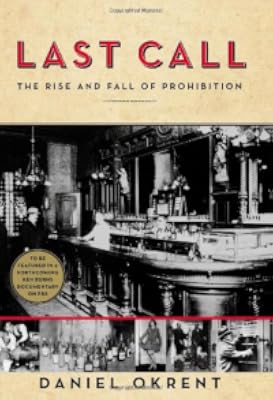
Last Call: The Rise and Fall of Prohibition
by Daniel Okrent
On This Page
Description
Okrent explores the origins, implementation, and failure of that great American delusion known as Prohibition. "Last Call" explains how Prohibition happened, what life under it was like, and what it did to the country.Tags
Recommendations









Member Reviews
These days "Prohibition" is basically a synonym for "failure", but less than hundred years ago, preventing "the manufacture, sale, or transportation of intoxicating liquors" in the US was thought to be a good enough idea to not only pass both houses of Congress, but also all but two of the 48 state legislatures by the fateful year of 1919. Last Call is the story of how the anti-alcohol crusade went from being a fringe rural movement to the unifier of a whole host of widely varying interest groups, from temperance activists to feminists and suffragettes, nativists, populists, evangelicals, socialists, and racists. I was really intrigued by the random endorsements that prohibition picked up (P. T. Barnum?), as it was an issue that cut show more across so many political lines that almost anyone could hitch their wagon to it. By far the most interesting to me of those political linkages was with female suffrage, as one of the main goals of Prohibition was to prevent men from drinking away their earnings and committing domestic violence; that something as seemingly obvious to a modern reader as granting women the right to vote was linked to the extirpation of alcohol is a reminder of far the political landscape has changed. Even though women ironically turned their backs on Prohibition after the passage of the 19th Amendment (and their discovery that they actually liked the freedom to drink), originally the movements were closely joined. Similarly with the classic liberal/conservative split - back then the progressive movement was gung-ho about Prohibition as a way to improve the lives of the uneducated, largely foreign lower classes, while established interests favored the status quo; whereas now it is liberals who favor laxer alcohol laws and conservatives who prefer restrictions on drinking.
Okrent has a bunch of great biographical detail on the major architects and forebears of Prohibition, many of whom are almost forgotten these days: Carrie Nation, axe-wielding radical of the Women's Christian Temperance Union; Wayne Wheeler of the ultra-powerful Anti-Saloon League; Andrew Volstead, of the infamous Volstead Act; Morris Shepard, author of the 18th Amendment. It's almost impressive, in a way, that these people were able to impose official sobriety in a country where the average person drank 7 gallons of pure alcohol per year (a stunning amount that is three times higher than the average today). They used all the tactics of any good interest group, like acquiring influence with legislators through various means, getting religious groups to sign off on their cause, distributing propaganda to children, wrapping themselves in the flag, and disparaging the patriotism of those who disagreed. Additionally, they tried to embed Prohibition in American society with larger strategies of varying degrees of reprehensibility: first, introducing a permanent income tax to offset the enormous revenue losses Prohibition represented (excise taxes on liquor made up 20 to 40% of federal revenue); second, refusing to reapportion Congressional seats in accordance with the 1920 Census to limit the influence of undoubtedly pro-alcohol Representatives from the cities, and eventually capping the total number of Representatives with the unprecedented Reapportionment Act of 1929; third, changing the makeup of the cities by passing immigration restrictions designed to limit the immigration of unfriendly Catholic or Jewish or non-WASP foreigners. The political angle is important: big-city saloons were vital political bases back then, and even after Prohibition connections to alcohol continued to provide wealth and power (fun fact: Joseph P. Kennedy is smeared as a bootlegger despite no evidence, but many families like the Bronfmans of the Seagrams brand did indeed illicitly make buckets of money).
Though Okrent doesn't really push the connection, the obvious modern parallel to Prohibition is the War on Drugs. Unfortunately there are problems with the analogy that make it seem like drug criminalization will last for much longer yet. First, drug use does not have the same long tradition in American society that drinking does. While a huge percentage of the US has taken one drug or another, drug use has never been legal and widely practiced in the same way that drinking was before Prohibition, so legalization is not seen as a natural "default state" the way that the pre-Prohibition status quo was. Second, while drugs like marijuana are huge cash crops, and the trade in other drugs like cocaine is billions per year, drugs aren't as central economically as alcohol was; few expect legalized and taxed drugs to make up more than a small revenue stream for any level of government. Third, there isn't really a large natural drug-using constituency in the US in the same way as Catholics or Jews with sacramental wine (Rastafarians are a tiny minority), so debate has to take place at a level of abstraction rather than at the visceral level of ethnicity, religion, and nativism. None of that changes the morality or sensibility of legalization, but it makes the debate slower. As Okrent's book shows, high-minded reform efforts don't always make final sense, and what makes sense often has nothing to do with good motives. While perhaps the one success of Prohibition was that it did indeed reduce the amount that people drank, the side-effects on society were nearly intolerable; yet Prohibition endured for over a decade, and was only ended due to the worst economic crisis in world history. We certainly haven't seen the last of these crusades. show less
Okrent has a bunch of great biographical detail on the major architects and forebears of Prohibition, many of whom are almost forgotten these days: Carrie Nation, axe-wielding radical of the Women's Christian Temperance Union; Wayne Wheeler of the ultra-powerful Anti-Saloon League; Andrew Volstead, of the infamous Volstead Act; Morris Shepard, author of the 18th Amendment. It's almost impressive, in a way, that these people were able to impose official sobriety in a country where the average person drank 7 gallons of pure alcohol per year (a stunning amount that is three times higher than the average today). They used all the tactics of any good interest group, like acquiring influence with legislators through various means, getting religious groups to sign off on their cause, distributing propaganda to children, wrapping themselves in the flag, and disparaging the patriotism of those who disagreed. Additionally, they tried to embed Prohibition in American society with larger strategies of varying degrees of reprehensibility: first, introducing a permanent income tax to offset the enormous revenue losses Prohibition represented (excise taxes on liquor made up 20 to 40% of federal revenue); second, refusing to reapportion Congressional seats in accordance with the 1920 Census to limit the influence of undoubtedly pro-alcohol Representatives from the cities, and eventually capping the total number of Representatives with the unprecedented Reapportionment Act of 1929; third, changing the makeup of the cities by passing immigration restrictions designed to limit the immigration of unfriendly Catholic or Jewish or non-WASP foreigners. The political angle is important: big-city saloons were vital political bases back then, and even after Prohibition connections to alcohol continued to provide wealth and power (fun fact: Joseph P. Kennedy is smeared as a bootlegger despite no evidence, but many families like the Bronfmans of the Seagrams brand did indeed illicitly make buckets of money).
Though Okrent doesn't really push the connection, the obvious modern parallel to Prohibition is the War on Drugs. Unfortunately there are problems with the analogy that make it seem like drug criminalization will last for much longer yet. First, drug use does not have the same long tradition in American society that drinking does. While a huge percentage of the US has taken one drug or another, drug use has never been legal and widely practiced in the same way that drinking was before Prohibition, so legalization is not seen as a natural "default state" the way that the pre-Prohibition status quo was. Second, while drugs like marijuana are huge cash crops, and the trade in other drugs like cocaine is billions per year, drugs aren't as central economically as alcohol was; few expect legalized and taxed drugs to make up more than a small revenue stream for any level of government. Third, there isn't really a large natural drug-using constituency in the US in the same way as Catholics or Jews with sacramental wine (Rastafarians are a tiny minority), so debate has to take place at a level of abstraction rather than at the visceral level of ethnicity, religion, and nativism. None of that changes the morality or sensibility of legalization, but it makes the debate slower. As Okrent's book shows, high-minded reform efforts don't always make final sense, and what makes sense often has nothing to do with good motives. While perhaps the one success of Prohibition was that it did indeed reduce the amount that people drank, the side-effects on society were nearly intolerable; yet Prohibition endured for over a decade, and was only ended due to the worst economic crisis in world history. We certainly haven't seen the last of these crusades. show less
Okrent presents a fascinating and thorough breakdown of the causes, practice (and lack thereof), and conclusion of fourteen years of Prohibition in America. The dreamy goal of the Anti Saloon League and other sponsors of the "dry" way of life thought that banning booze would elevate the American worker, end poverty, and perhaps even civilize uncouth immigrants who so favored the drink. The xenophobic reasons for the Volstead Act were quite clear--this was intended as a blow to the Irish, the Italians, the Jews, and in the south, against blacks who, it was claimed, became maniac rapists because of gin. The white wimmin must be kept safe, right?
The failure of Prohibition is well documented, and these days, celebrated. Drunkenness and show more night revels only increased. Small-time criminals developed the business acumen to found gangster corporations. The actual end of the bill came about, not just because of the public failure of it all, but because of the Great Depression. The federal government not only could not afford to enforce the law, but they desperately needed the tax money brought in by alcohol.
I read this book for research needs, and I found loads of good information. I would have liked a little more emphasis on Southern California, but that's pure selfishness on my part; there's no denying that New York, Chicago, and Detroit offered more dynamic settings to ficus on the drinking aspect of the Roaring Twenties. show less
The failure of Prohibition is well documented, and these days, celebrated. Drunkenness and show more night revels only increased. Small-time criminals developed the business acumen to found gangster corporations. The actual end of the bill came about, not just because of the public failure of it all, but because of the Great Depression. The federal government not only could not afford to enforce the law, but they desperately needed the tax money brought in by alcohol.
I read this book for research needs, and I found loads of good information. I would have liked a little more emphasis on Southern California, but that's pure selfishness on my part; there's no denying that New York, Chicago, and Detroit offered more dynamic settings to ficus on the drinking aspect of the Roaring Twenties. show less
My great-grandfather was a bootlegger. He didn't start out as one, of course--he learned his trade as an electrician in Parma, Italy, but according to my grandfather (who was understandably rather bitter at being dumped off, after his mother died in childbirth, at the local monastery to be raised by the holy brothers) there was always something a bit shiftless about him even after he started a new life in Canada and the United States. Unfortunately, he wasn't a very good one. After commencing his new profession in the waters between Windsor, Canada and Detroit--the famous "City on a Still"--wettest of the many prohibition defying cities--beating, according to author Daniel Okrent, such booze-loving towns as Boston, New Orleans, and San show more Francisco-the gunplay-and "probies"-became too intense for the casual criminal and he moved his operations to Vancouver. Even that semi-rural area, whose low population density never attracted the same amount of interest for criminals and the federal government alike-proved to be too much for the amateur he remained. He was caught by prohibition agents, despite scuttling his boat and making a run for it--and promptly deported. All of this--the start in the thirsty East--the ignominious end in laid-back West where highly organized criminal operations never gained a real foothold--the swift deportation as the US government used any excuse to get rid of immigrants--turned out to be a perfect template laid out in "Last Call". I just didn't realize it until this summer, when I both read the book and talked to my mother and her youngest sister about their grandfather's activites. (Any attempt to bring the subject up with my now-deceased grandfather invariably produced atypical agitation--even vitriol-as the passing of the years did nothing to mitigate my grandfather's annoyance with his own father).
For you see, my grandfather's life--indeed the fate our our entire family--got caught up with my great-grandfather's decision to run a bit of Seagrams through the San Juan Islands. My great-grandfather was refused entry back to Italy--Mussolini was in the middle of his big purge of home-grown organized crime and wasn't exactly interested in importing criminals. The French, however, were more sanguine. He settled in Cannes, where he remained through the outbreak of the war. Times were hard in Vichy France; my great-grandfather wrote a letter to his son in Canada pleading for money. My grandfather did the duitiful thing, stuffed some bills in an envelope, and as he was busy that day--gave the letter to his cousin and business partner to mail the letter in the United States, as the US was still neutral. (Back then, the border was more a slightly interesting concept than something most people paid attention to, and people flitted back and forth all the time). The cousin did mail the letter-except he forgot to mail it in the US and instead mailed it in Canada. My grandfather was promptly hauled in by the Canadian government, which wanted to know why he was aiding and abbetting the enemy.
My grandfather never got over his arrest. One of my mother's favorite anecdotes is the story of her father, white-faced and trembling, returning after his grilling by authorities and burning every communist magazine and tract in the house.(Parma is a very red part of Italy.) Anyway, my grandfather was finished with his adopted country from that moment. He insisted, until Alzheimer's overtook him, that his real reason for leaving was his inability to handle for any longer the quaint Canadian habit of leaving dead bodies in storage until the spring thaw, but the rest of the family knew better. He began plotting his escape. After the war, he moved to Southern California, despite my grandmother's protests, and set himself up as an electrician/glassblower, where he did his part to make the Southland the neoned tacky glory it was in the 50's and 60's.
All this is just a long-winded way of saying I have more than a normal interest in American Prohibition, and view it as the reason why I was born a Californian, or indeed why I was born at all. Of course, for all of us, there are a million causalities as to why we are here on earth, and if anything, I should point a finger at the idiotic cousin WHO COULD'T FOLLOW THE SIMPLEST INSTRUCTIONS. But this is my narration, and I'm sticking to my story. I like a grand historical spin.
But back to the book I'm supposed to be reviewing. It's wonderful. Yes, it could seem that I don't have the clearest perspective, but honestly, it is a great read, and an essential one for anyone who is interested in American history. I admit that I am a bit low-brow, and would have preferred a few more "Chicago typewriters" (tommy-guns) in the tale, but I know, as much as I like a bit of "Boardwalk Empire" sleaze, that the story of how the United States sort-of swore off booze for a dozen years has just as much to do with sweeping sociological movements and legislation. Daniel Okrent entertainingly explains how United States has always been awash with alcohol, and how there has always been an opposition to all that drinking, and how the anti-saloon movement started to gain force after the Great Awakening. I was the most annoying person while I was reading this book, prone to shooting out random tidbits of trivia whenenver anyone wandered within earshot. Did you know the Clan was dry-and pro suffrage? Did you know that plea-bargaining started as the government was overwhelmed by all the cases in the docket? Did you know that the federal income tax really started as a way of recouping projected lost revenue? Did you know that all the said lost revenue by illegal bootlegging was equal to the ENTIRE federal government budget--including the military--in 1926? Did you know....and so on. Everyone in the household was relieved when I finished the book.
All of this could have been as dry as some of the midwestern counties which actually OBEYED the Volstead act, but Okrent is a witty writer, and a master of the trenchant character sketch. On the axe wielding Carry Nation: "Carry Amelia Moore Gloyd nation was six feet tall, with the biceps of a stevedore, the face of a prison warden, and the persistence of a toothache." Or Calvin Coolidge's idea of governing "...it was if he viewed government as a vestigial organ of the body politic." And there are many amusing anecdotes along the way, from the time of the colonial distilleries, to the repealing of the Volstead act (which ironically helped to make many municipalities drier than they had been previously).
A fun read. For those who yearn for more than a bit of Al Capone-type action and are impatient with legislative maneuvering, 4 stars. For political wonks and those who are here on the planet thanks to American Prohibition, 5 Stars. show less
For you see, my grandfather's life--indeed the fate our our entire family--got caught up with my great-grandfather's decision to run a bit of Seagrams through the San Juan Islands. My great-grandfather was refused entry back to Italy--Mussolini was in the middle of his big purge of home-grown organized crime and wasn't exactly interested in importing criminals. The French, however, were more sanguine. He settled in Cannes, where he remained through the outbreak of the war. Times were hard in Vichy France; my great-grandfather wrote a letter to his son in Canada pleading for money. My grandfather did the duitiful thing, stuffed some bills in an envelope, and as he was busy that day--gave the letter to his cousin and business partner to mail the letter in the United States, as the US was still neutral. (Back then, the border was more a slightly interesting concept than something most people paid attention to, and people flitted back and forth all the time). The cousin did mail the letter-except he forgot to mail it in the US and instead mailed it in Canada. My grandfather was promptly hauled in by the Canadian government, which wanted to know why he was aiding and abbetting the enemy.
My grandfather never got over his arrest. One of my mother's favorite anecdotes is the story of her father, white-faced and trembling, returning after his grilling by authorities and burning every communist magazine and tract in the house.(Parma is a very red part of Italy.) Anyway, my grandfather was finished with his adopted country from that moment. He insisted, until Alzheimer's overtook him, that his real reason for leaving was his inability to handle for any longer the quaint Canadian habit of leaving dead bodies in storage until the spring thaw, but the rest of the family knew better. He began plotting his escape. After the war, he moved to Southern California, despite my grandmother's protests, and set himself up as an electrician/glassblower, where he did his part to make the Southland the neoned tacky glory it was in the 50's and 60's.
All this is just a long-winded way of saying I have more than a normal interest in American Prohibition, and view it as the reason why I was born a Californian, or indeed why I was born at all. Of course, for all of us, there are a million causalities as to why we are here on earth, and if anything, I should point a finger at the idiotic cousin WHO COULD'T FOLLOW THE SIMPLEST INSTRUCTIONS. But this is my narration, and I'm sticking to my story. I like a grand historical spin.
But back to the book I'm supposed to be reviewing. It's wonderful. Yes, it could seem that I don't have the clearest perspective, but honestly, it is a great read, and an essential one for anyone who is interested in American history. I admit that I am a bit low-brow, and would have preferred a few more "Chicago typewriters" (tommy-guns) in the tale, but I know, as much as I like a bit of "Boardwalk Empire" sleaze, that the story of how the United States sort-of swore off booze for a dozen years has just as much to do with sweeping sociological movements and legislation. Daniel Okrent entertainingly explains how United States has always been awash with alcohol, and how there has always been an opposition to all that drinking, and how the anti-saloon movement started to gain force after the Great Awakening. I was the most annoying person while I was reading this book, prone to shooting out random tidbits of trivia whenenver anyone wandered within earshot. Did you know the Clan was dry-and pro suffrage? Did you know that plea-bargaining started as the government was overwhelmed by all the cases in the docket? Did you know that the federal income tax really started as a way of recouping projected lost revenue? Did you know that all the said lost revenue by illegal bootlegging was equal to the ENTIRE federal government budget--including the military--in 1926? Did you know....and so on. Everyone in the household was relieved when I finished the book.
All of this could have been as dry as some of the midwestern counties which actually OBEYED the Volstead act, but Okrent is a witty writer, and a master of the trenchant character sketch. On the axe wielding Carry Nation: "Carry Amelia Moore Gloyd nation was six feet tall, with the biceps of a stevedore, the face of a prison warden, and the persistence of a toothache." Or Calvin Coolidge's idea of governing "...it was if he viewed government as a vestigial organ of the body politic." And there are many amusing anecdotes along the way, from the time of the colonial distilleries, to the repealing of the Volstead act (which ironically helped to make many municipalities drier than they had been previously).
A fun read. For those who yearn for more than a bit of Al Capone-type action and are impatient with legislative maneuvering, 4 stars. For political wonks and those who are here on the planet thanks to American Prohibition, 5 Stars. show less
An excellent narrative history of Prohibition in the United States, starting from the first stirrings in the 1840s through the end in the 1930s. As you might imagine, covering this period of time introduces many characters and situations to keep track of, but Okrent makes it manageable by focusing each section and chapter on some specific aspect or event. His style is lively and entertaining without being trivial or frivolous. Some folks might be put off a bit by some of his quirkiness, for instance at one point he compares one personality to someone in "The Simpsons" TV cartoon show. He also jokes how the unique spelling of "drys" defeats the best efforts of Spell Check. I think most readers will find the quirks a nice counterpoint to show more some of the more serious discussions in the book. I think "Last Call" is the best general history of Prohibition I've ever read, entertaining yet quite thorough and informative. show less
Okrent tells the a story that only occurred less than a century ago, but which shows how much some things have changed--and how much some things have not. Many of the "heroes" of prohibition are entirely forgotten. And the story of prohibition might make for valuable consideration by proponents of modern-day social causes, on both sides of today's national divide. There are strange bedfellows, crooked politicians, intelligent gangsters, clueless optimists, ur-NASCAR drivers, wily pragmatists, muckraking journalists, and many other crazy characters. Oh, and cunning, opportunistic Canadians just waiting to take advantage of the USA. ;-)
Okrent tells the a story that only occurred less than a century ago, but which shows how much some things have changed--and how much some things have not. Many of the "heroes" of prohibition are entirely forgotten. And the story of prohibition might make for valuable consideration by proponents of modern-day social causes, on both sides of today's national divide. There are strange bedfellows, crooked politicians, intelligent gangsters, clueless optimists, ur-NASCAR drivers, wily pragmatists, muckraking journalists, and many other crazy characters. Oh, and cunning, opportunistic Canadians just waiting to take advantage of the USA. ;-)
The story of temperance, prohibition and its eventual repeal comes alive in Daniel Okrent's brilliant examination of the era. The book's sharp wit and choice prose makes it clear early on that Last Call is more than just another history lesson. The best parts are the sprinkled bits of ironic humor, deadpanned and perfectly understated, which never fail to delight. I also appreciate the author's frequent use of period-specific quotes, allowing the who's who of Prohibition to speak for themselves.
There's no escaping America's long fascination with booze and how it punctuates our history. We are a nation of unapologetic drinkers. We are also a nation of fervent religious convictions (abstinence included) so it was only a matter of time show more before opposing forces collided. Given that temperance and prohibition are saturated with tales of moral grandstanding, political manipulation, opportunism, greed and hypocrisy, it's arguable that this sums up America's past better than we would care to admit. show less
There's no escaping America's long fascination with booze and how it punctuates our history. We are a nation of unapologetic drinkers. We are also a nation of fervent religious convictions (abstinence included) so it was only a matter of time show more before opposing forces collided. Given that temperance and prohibition are saturated with tales of moral grandstanding, political manipulation, opportunism, greed and hypocrisy, it's arguable that this sums up America's past better than we would care to admit. show less
Members
- Recently Added By
Published Reviews
added by lemontwist
Lists

2008-2012 Notable Books for Adults
127 works; 10 members

r/AskHistorians' Recommended Books
1,068 works; 19 members
Author Information

14+ Works 2,925 Members
Daniel Okrent was the first public editor of the New York Times, editor at large at Time Inc., and managing editor of Life magazine. He is the author of six books, including Great Fortune: The Epic of Rockefeller Center and Last Call: The Rise and Fall of Prohibition.
Awards and Honors
Common Knowledge
- Original title
- Last Call
- Original publication date
- 2010
- People/Characters
- Frances Willard; Carry A. Nation (Carrie Nation); Adolphus Busch; Wayne Bidwell Wheeler
- Important events
- Ratification of 18th Constitutional Amendment; Ratification of 19th Constitutional Amendment; Ratification of 21th Constitutional Amendment; Prohibition
- Dedication
- For my sister, Judith Simon,
and in memory of absent friends:
Robert N. Nylen (1944-2008)
Richard Seaver (1926-2009)
Henry Z Steinway (1915-2008) - First words
- (Prologue) The streets of San Francisco were jammed.
America had been awash in drink almost from the start - wading hip-deep in it, swimming in it, at various times in its history nearly drowning in it. - Quotations
- If a family or a nation is sober, nature in its normal course will cause them to rise to a higher civilization. If a family or a nation, on the other hand, is debauched by liquor, it must decline and ultimately perish.... (show all)
- Richmond P Hobson, in the U.S. House of Representatives, December 22, 1914
The prohibitionists say that the liquor issue is as dead as slavery. The wet people say that liquor can be obtained anywhere. You'd think they'd both be satisfied.
- Marjory Stoneman Douglas, in the Miami Herald... (show all), October 7, 1920
The thing that sticks out clearly now is that for years our politics promises to be thoroughly saturated with this wet and dry stuff. It will warp the whole political fabric, prevent clear thinking - even by those who are ... (show all)capable of thinking clearly - and hide the merits of the men who run for office in a fog of feeling.
- Frank Kent, Baltimore Sun, quoted in an Anti-Saloon League reprint, circa 1922
As was said before upon a memorable occasion when the very incarnation of morality was about to be sacrificed, 'What thou doest, do quickly.' - Malcolm C. Tarver, a Georgia dry, in the House of Representatives, Decembe... (show all)r 5, 1932 - Last words
- (Click to show. Warning: May contain spoilers.)But Joe Kennedy didn't have to be a bootlegger. After all, nearly everyone else was.
(Click to show. Warning: May contain spoilers.)(Epilogue) There was really only one explanation for what happened during Prohibition, he said: "You people were thirsty." - Blurbers
- Kidder, Tracy; Thomas, Evan; Branch, Taylor; Isaacson, Walter; Wright, Lawrence; Korda, Michael
- Canonical DDC/MDS
- 363.41097309042
- Canonical LCC
- HV5089
Classifications
- Genres
- History, General Nonfiction, Nonfiction
- DDC/MDS
- 363.41097309042 — Society, government, & culture Social problems and social services Public Safety - Police, Crime Investigation Prohibition, Temperance
- LCC
- HV5089 — Social sciences Social pathology. Social and public welfare. Criminology Social pathology. Social and public welfare. Alcoholism. Intemperance. Temperance reform
- BISAC
Statistics
- Members
- 1,558
- Popularity
- 14,705
- Reviews
- 46
- Rating
- (4.01)
- Languages
- English, Spanish
- Media
- Paper, Audiobook, Ebook
- ISBNs
- 11
- ASINs
- 10