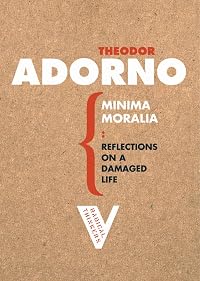
Minima Moralia: Reflections on a Damaged Life
by Theodor W. Adorno
On This Page
Description
A reflection on everyday existence in the 'sphere of consumption of late Capitalism', this work is Adorno's literary and philosophical masterpiece.Tags
Recommendations





Member Recommendations

Member Reviews
MInima Moralia : Reflections from damaged life
Published in 1951in Germany, I read the 2011 translation by Dennis Redmond. It was not an easy read. It consists of 153 short essays, which reflect on the nature of modern life and the impact of capitalism, fascism and mass culture. The sub-heading; Reflections from a damaged life promises that it would not be a barrel of laughs. Adorno was a German philosopher, cultural and music critic and he emigrated from Germany to the United States in 1937. He said that “The violence that expelled me,” left him with an enduring sense of guilt at the very fact of his survival. The essays were written mainly between 1944 and 1949 while he was in exile. They take the form of a short aphorism that acts show more as a title and starting point for each essay.
I approach philosophical books with caution and I was right to do so in this case. Adorno's sentences are elegantly formed (according to this translation) but require some picking through to get at the meaning. I read them in under two weeks, which was a little optimistic as they really needed more time spent with them. There are attributions to important European authors: the first essay is entitled "For Marcel Proust" and philosophers Frederic Nietzsche and Karl Marx among others are referred to often. There are no footnotes and so the reader needs some relevant knowledge to assist with untangling some of the essays.
The essays are pessimistic and fiercely criticise what Adorno calls "late capitalism" They become passionate when he writes about fascism and how it seemed unstoppable at the time in Germany. A recurring theme is the loss of individualism and the bourgeoise are held up to demonstrate all that is wrong with society, their greed and avarice and willingness to adapt to fascism goes to the root of much of what is wrong. Not all the essays are political, for example there are essays on family relationships, on mass culture particularly the cinema, intellectuals and non intellectuals, ethics, literature, barbarism and the Nazis. Any advice on how to live your life can be gleaned from what you should not do. Most of the essays stand on their own and it is for the reader to pull out more general threads of meaning, but they are certainly there to be found and Adorno does not flinch in hitting home the points that he wishes to make.
This book has been influential for scholars in various fields ever since it was published. Its critique of the rise in fascism is of its time, but it is interesting to make the connection with some of the far right movements of today. I am torn between a desire to re-read the essays more carefully, or to just move on, because I have the overall impression that maybe they have had their day and while relevant to the mid 20th century, they have lost much of their relevance for critical thought today. 4 stars. show less
Published in 1951in Germany, I read the 2011 translation by Dennis Redmond. It was not an easy read. It consists of 153 short essays, which reflect on the nature of modern life and the impact of capitalism, fascism and mass culture. The sub-heading; Reflections from a damaged life promises that it would not be a barrel of laughs. Adorno was a German philosopher, cultural and music critic and he emigrated from Germany to the United States in 1937. He said that “The violence that expelled me,” left him with an enduring sense of guilt at the very fact of his survival. The essays were written mainly between 1944 and 1949 while he was in exile. They take the form of a short aphorism that acts show more as a title and starting point for each essay.
I approach philosophical books with caution and I was right to do so in this case. Adorno's sentences are elegantly formed (according to this translation) but require some picking through to get at the meaning. I read them in under two weeks, which was a little optimistic as they really needed more time spent with them. There are attributions to important European authors: the first essay is entitled "For Marcel Proust" and philosophers Frederic Nietzsche and Karl Marx among others are referred to often. There are no footnotes and so the reader needs some relevant knowledge to assist with untangling some of the essays.
The essays are pessimistic and fiercely criticise what Adorno calls "late capitalism" They become passionate when he writes about fascism and how it seemed unstoppable at the time in Germany. A recurring theme is the loss of individualism and the bourgeoise are held up to demonstrate all that is wrong with society, their greed and avarice and willingness to adapt to fascism goes to the root of much of what is wrong. Not all the essays are political, for example there are essays on family relationships, on mass culture particularly the cinema, intellectuals and non intellectuals, ethics, literature, barbarism and the Nazis. Any advice on how to live your life can be gleaned from what you should not do. Most of the essays stand on their own and it is for the reader to pull out more general threads of meaning, but they are certainly there to be found and Adorno does not flinch in hitting home the points that he wishes to make.
This book has been influential for scholars in various fields ever since it was published. Its critique of the rise in fascism is of its time, but it is interesting to make the connection with some of the far right movements of today. I am torn between a desire to re-read the essays more carefully, or to just move on, because I have the overall impression that maybe they have had their day and while relevant to the mid 20th century, they have lost much of their relevance for critical thought today. 4 stars. show less
‘Minima Moralia’ took some time and effort to read. It deserves four stars for content but I’m giving it three for my own inadequacy. There were quite a few sentences (especially those involving Nietzsche) that took me four readings to parse, let alone comprehend. To be honest, I can only claim to have understood about a fifth of the book. My grounding in philosophy is weak and patchy; I’ve never actually studied it. However, the fifth that I did understand I greatly appreciated. Notably, many insights seemed strangely contemporary. The book was first published in 1951 and was largely written during the Second World War. It is structured in many short chapters, each making a particular point. Although some overarching themes show more could be discerned, I did not detect a singular linking narrative or message that ran through the whole thing.
The parts of the book that will stay with me concerned gender politics, an apparent indictment of hipsters, and the corrosive influence of mass production capitalism, which equates exchange value with any value at all. The latter point is made in many different ways, each with a differing emphasis. My favourite example of the former is chapter 24, titled ‘Tough Baby’ and deserves an extended quote:
Suck on that, Hemingway. Even now the tedious macho archetype pervades popular culture. I can’t locate the indictment of hipsters right now, but was amused that included a comment about people who wear clear-glass spectacles in order to appear more intellectual. Plus ça change, plus c'est la même chose. More seriously, Adorno says some very interesting things about the role of intellectuals in society, the toxicity of fascism, and the psychological implications of mass consumption. Just don’t ask me to explain them all. My favourite chapter, though, was number 106 ‘All the Little Flowers’. This cautioned against treating memories as inviolable artefacts from the past, as they are modified and mediated by the present. Adorno explained this with especial elegance. show less
The parts of the book that will stay with me concerned gender politics, an apparent indictment of hipsters, and the corrosive influence of mass production capitalism, which equates exchange value with any value at all. The latter point is made in many different ways, each with a differing emphasis. My favourite example of the former is chapter 24, titled ‘Tough Baby’ and deserves an extended quote:
’There is a certain gesture of virility, be it one’s own or someone else’s, that calls for suspicion. [...] It’s archetype is the handsome, dinner-jacketed figure returning late to his bachelor flat, switching on the indirect lighting and mixing himself a whisky and soda: the carefully recorded hissing of the mineral water says what the arrogant mouth keeps to itself: that he despises anything that does not smell of smoke, leather and shaving cream, particularly women, which is why they, precisely, find him irresistible. [...] The pleasures of such men, or rather of their models, which are seldom equalled in reality, for people are even now better than their culture, all have about them a latent violence. [...] It is in fact violence against himself.’
Suck on that, Hemingway. Even now the tedious macho archetype pervades popular culture. I can’t locate the indictment of hipsters right now, but was amused that included a comment about people who wear clear-glass spectacles in order to appear more intellectual. Plus ça change, plus c'est la même chose. More seriously, Adorno says some very interesting things about the role of intellectuals in society, the toxicity of fascism, and the psychological implications of mass consumption. Just don’t ask me to explain them all. My favourite chapter, though, was number 106 ‘All the Little Flowers’. This cautioned against treating memories as inviolable artefacts from the past, as they are modified and mediated by the present. Adorno explained this with especial elegance. show less
A languorous howl of despair and anger - but who would not feel these things in the ashes of Germany 1945?
I was surprised by how fierce Adorno can be - I've heard horror stories of his impenetrable style. Here, I was surprised, both at the crispness of his style, and the depth of his cultural references. If anyone wants to start with him, here's a place to do so. His barbed aphorisms will remain with you, vicious and snarling, a rabid dog tearing into your leg.
This book offers a damning critique of all of society, from fascism to door handles - although, at times it feels like the ramblings of a grumpy old man, who offers not even the hint of a solution, and despairs that all is lost. The theory and practice of despair. Not for everyone.
I was surprised by how fierce Adorno can be - I've heard horror stories of his impenetrable style. Here, I was surprised, both at the crispness of his style, and the depth of his cultural references. If anyone wants to start with him, here's a place to do so. His barbed aphorisms will remain with you, vicious and snarling, a rabid dog tearing into your leg.
This book offers a damning critique of all of society, from fascism to door handles - although, at times it feels like the ramblings of a grumpy old man, who offers not even the hint of a solution, and despairs that all is lost. The theory and practice of despair. Not for everyone.
This book (perhaps along with the essays in Prisms) is Adorno's most accessible work. It is written in the maxim/eprigram style usually associated with Nietzsche (and thus Adorno's academic employers found it unsufficiently scholarly). Adorno's ideas about the intellectual and cultural poverty of contemporary life seem right on target to me. At the end of the book--after page upon page upon page of indictments of the vacuousness of our world today--Adorno concludes by stating that the only possible way of meaningfully existing in this world is to view it from the standpoint of how it would be if it were all redeemed. This unusually optimistic ending is probably more true to the real spirit of Adorno's thought than the bleak, show more condemnatory ideas (which he certainly expresses at length) stereotypically associated with his philosophy. I initially read the book at a very difficult time in my life and--despite its unflinching look at the horrors and blankness of the world--found it quite comforting. show less
One moment he’s right on the money with a nihilistic outlook of post-war capitalism, the next he’s talking about a literary critique I don’t have the context for. I’m sure if I did it would be cool, but I spent too long feeling lost and skipping a page or two.
Adorno somehow convinces me that it's possible-- and worth it-- to go on, in spite of it all.
This book read more as a list of densely rendered pessimistic thoughts by a very cynical person than anything else. Clearly, Theodor was not a happy camper living in exile after WWII.
Members
- Recently Added By
Lists

Filosofía - Clásicos
217 works; 1 member
Author Information

324+ Works 14,312 Members
Theodor W. Adorno is the progenitor of critical theory, a central figure in aesthetics, and the century's foremost philosopher of music. He was born and educated in Frankfurt, Germany. After completing his Ph.D. in philosophy, he went to Vienna, where he studied composition with Alban Berg. He soon was bitterly disappointed with his own lack of show more talent and turned to musicology. In 1928 Adorno returned to Frankfurt to join the Institute for Social Research, commonly known as The Frankfurt School. At first a privately endowed center for Marxist studies, the school was merged with Frankfort's university under Adorno's directorship in the 1950s. As a refugee from Nazi Germany during World War II, Adorno lived for several years in Los Angeles before returning to Frankfurt. Much of his most significant work was produced at that time. Critics find Adorno's aesthetics to be rich in insight, even when they disagree with its broad conclusions. Although Adorno was hostile to jazz and popular music, he advanced the cause of contemporary music by writing seminal studies of many key composers. To the distress of some of his admirers, he remained pessimistic about the prospects for art in mass society. Adorno was a neo-Marxist who believed that the only hope for democracy was to be found in an interpretation of Marxism opposed to both positivism and dogmatic materialism. His opposition to positivisim and advocacy of a method of dialectics grounded in critical rationalism propelled him into intellectual conflict with Georg Hegel, Martin Heidegger, and Heideggerian hermeneutics. (Bowker Author Biography) show less
Some Editions
Awards and Honors
Series
Belongs to Publisher Series
Work Relationships
Common Knowledge
- Canonical title
- Minima Moralia: Reflections on a Damaged Life
- Original title
- Minima Moralia: Reflexionen aus dem beschädigten Leben
- Original publication date
- 1951
- Dedication
- For Max
In gratitude and promise - First words
- For Marcel Proust. – The son of well-to-do parents who, whether out of talent or weakness, chooses a so-called intellectual occupation as an artist or scholar, has special difficulties with those who bear the distasteful ti... (show all)tle of colleagues.
- Quotations
- The dialectic advances by way of extremes, driving thoughts with the utmost consequentiality to the point where they turn back on themselves, instead of qualifying them.
- Last words
- (Click to show. Warning: May contain spoilers.)It must comprehend even its own impossibility for the sake of possibility. In relation to the demand thereby imposed on it, the question concerning the reality or non-reality of redemption is however almost inconsequential.
- Original language
- German
Classifications
Statistics
- Members
- 1,976
- Popularity
- 10,685
- Reviews
- 9
- Rating
- (4.09)
- Languages
- 16 — Catalan, Czech, Danish, Dutch, English, French, German, Greek, Italian, Norwegian (Bokmål), Polish, Portuguese, Romanian, Spanish, Swedish, Turkish
- Media
- Paper, Ebook
- ISBNs
- 53
- ASINs
- 16