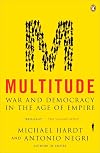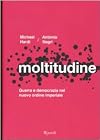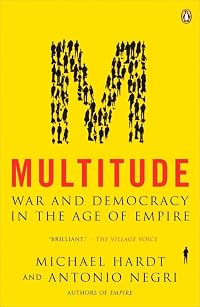
Multitude: War and Democracy in the Age of Empire
by Michael Hardt, Antonio Negri
On This Page
Description
Examines empire networks throughout history and in the present day, arguing that key issues within the new world order may enable significant social transformation and global democracy.Tags
Recommendations











Member Reviews
the most insightful part is definitely the first, about the primacy/universality of war and its consequences for networked insurgent resistance
the critique of democracy in terms of representation is obvious and also rather weakly presented, since negri still seems a little attached to his own ideal notion of democracy
the articulation of the common, beyond public/private, is extremely vague and poorly done; critically, there is no exploration of the relationship bw production of the truly common and the securitized regime under the civil war of empire
and ofc their elaboration of the universal identity of the multitude (and the singularity of its constituents) is somewhat pointless and incoherent
the critique of democracy in terms of representation is obvious and also rather weakly presented, since negri still seems a little attached to his own ideal notion of democracy
the articulation of the common, beyond public/private, is extremely vague and poorly done; critically, there is no exploration of the relationship bw production of the truly common and the securitized regime under the civil war of empire
and ofc their elaboration of the universal identity of the multitude (and the singularity of its constituents) is somewhat pointless and incoherent
On Hardt and Negri
EMPIRE and MULTITUDE, by Hardt and Negri, are frustrating and irritating books. But most critics miss their one great innovation. They have replaced capital and commodity as the key concepts of Marxism and postmarxism. Instead, what is most important for studying social change is the production and reproduction of society itself. The technical term they have invented to try to explain this is bioproduction.
But they do not know what to do with this one great innovation. Class analysis may be less useful now than it was for classical Marxism, but we could start by imitating Marx. How would we define classes by their relation to the means of production of society? An elementary beginning would be: the state; non-state show more persons who control the big institutions; workers who have enough resources so that they can start their own businesses, or join worker coops, if they do not like their bosses; lesser workers; and everyone else.
Something missing? Yes. Women as a class, mothers and other child rearers, but also women as the primary transmitters of the local system of morality. More than all the others, they create society. They are the least appreciated source of future social change.
(I have also posted this at my Academia.edu website. See my LT profile.) show less
EMPIRE and MULTITUDE, by Hardt and Negri, are frustrating and irritating books. But most critics miss their one great innovation. They have replaced capital and commodity as the key concepts of Marxism and postmarxism. Instead, what is most important for studying social change is the production and reproduction of society itself. The technical term they have invented to try to explain this is bioproduction.
But they do not know what to do with this one great innovation. Class analysis may be less useful now than it was for classical Marxism, but we could start by imitating Marx. How would we define classes by their relation to the means of production of society? An elementary beginning would be: the state; non-state show more persons who control the big institutions; workers who have enough resources so that they can start their own businesses, or join worker coops, if they do not like their bosses; lesser workers; and everyone else.
Something missing? Yes. Women as a class, mothers and other child rearers, but also women as the primary transmitters of the local system of morality. More than all the others, they create society. They are the least appreciated source of future social change.
(I have also posted this at my Academia.edu website. See my LT profile.) show less
A lot more readable than Empire but lacks the almost poetic beauty in philosophical composition that brought Empire together. Largely seems to want to explain, sometimes almost apologize for the first work.
A sequel and defence of the authors' 'Empire'.
5 estante atrás
Apr 11, 2020Spanish
(C06 Konkrete Beispiele zu Orten / Städten
Nov 13, 2018German
Ratings
Members
- Recently Added By
Lists

04
34 works; 1 member
Author Information

26+ Works 2,852 Members

139+ Works 4,263 Members
Antonio Negri is former Professor of State Theory at the University of Padua.
Classifications
- Genres
- Philosophy, Politics and Government, Nonfiction, Economics, General Nonfiction, History
- DDC/MDS
- 321.8 — Society, government, & culture Political science Systems of governments and states Democratic government [formerly : Republic]
- LCC
- JC423 .H364 — Political Science Political theory Political theory. The state. Theories of the state Forms of the state
- BISAC
Statistics
- Members
- 717
- Popularity
- 39,639
- Reviews
- 6
- Rating
- (3.84)
- Languages
- 10 — Dutch, English, French, German, Italian, Portuguese, Croatian, Spanish, Swedish, Turkish
- Media
- Paper, Ebook
- ISBNs
- 20
- ASINs
- 3