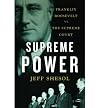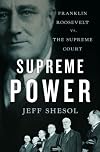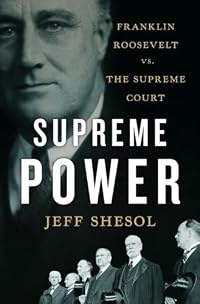
Supreme Power: Franklin Roosevelt vs. the Supreme Court
by Jeff Shesol
On This Page
Description
Recounts Franklin Roosevelt's fight during his first term with a narrow conservative majority on the U.S. Supreme Court who struck down several key elements of the New Deal legislation--forever transforming the political and constitutional landscape, saving the New Deal, splitting the Democratic Party, and ushering in an era of Republican dominance.--[source unknown]Tags
Recommendations




Member Reviews
Numerous books have been written about Franklin Roosevelt's effort to "pack" the Supreme Court in 1937. Jeff Shesol's is not only the latest but it ranks as the best. He does an excellent job of tracing the origins of the plan to the legal and constitutional battles over New Deal legislation in the mid-1930s, battles which threatened the very core of Roosevelt's agenda. He describes the cases in clear and accessible prose, bringing both the personalities of the major figures and their ideologies to life and making their struggle in the courts and Congress every bit as dramatic as it was when it unfolded. This is a must-read for anyone interested in well-written history, and an indispensable guide for anyone seeking to learn about the show more packing plan and its importance in U.S. history. show less
5738. Supreme Power Franklin Roosevelt vs. The Supreme Court by Jeff Shesol (read 6 Mar 2021) This is a most readable account of the effort in 1937 by FDR to change the Supreme Court so it would quit blocking New Deal measures. It tells in detail the course of the Court in 1934, 1935, and 1936 and its repeated nullifying of New Deal measures. FDR and his Attorney-General, Homer Cummings, sought a way to overcome the Court's intransigent holdings and in February 1937 FDR unveiled his plan to add a justice for every justice over 70 years old. This produced a huge outcry but FDR continued to push the plan. Opposition to it in the Senate was led by Democrats--there were less than 20 Republicans in the Senate. since FDR had won such an show more overwhelming victory in 1936--and the bill was eventually changed to delete adding justices. So FDR lost the battle but won the war since the Court never again held a New Deal measure unconstitutional and FDR at the end of his time had appointed all but one of the justices. After the bill was introduced Justice Roberts and Chief Justice Hughes voted differently and the other four justices one by one resigned from the Court and FDR replaced them with more enlightened men. So, while FDR was not able to get the bill passed which he asked for he got what he needed to save his program. The book is super interesting. I remember the battle as it was going on but was only 9 then, and of course I learned of the cases in law school but this account is so well done that reading it was a delight. Certainly one of the most interesting books I have read this year. show less
Very readable account of FDR assault on the Supreme Court, albeit from the Progressive perspective. The author is a former member of the Clinton administration and is certainly sympathetic to FDR.
Mr. Sesol managed to keep conservative slights to a minimum, though I took offense to his remarks implying the racist 'Southern Conservative Democrats' became Republicans after Civil Rights act of 1964 because the Republican party was closer to their racist views. When in fact the Civil Rights act could not have passed without strong Republican support, a fact Mr. Shesol, like many Progressives, ignores.
Mr. Sesol managed to keep conservative slights to a minimum, though I took offense to his remarks implying the racist 'Southern Conservative Democrats' became Republicans after Civil Rights act of 1964 because the Republican party was closer to their racist views. When in fact the Civil Rights act could not have passed without strong Republican support, a fact Mr. Shesol, like many Progressives, ignores.
I feel like I knew the broad theme of this book before, but I didn't realize all the details. It was a very prescient book given the issues with the Supreme Court today. It gave me ma lot to think about.
it’s an interesting subject and the first part of the book, describing the court cases is much more interesting than the second part describing the fight over court-packing. What I found wanting is a better explanation of the Hughes and Roberts rulings that in essence killed the court-packing scheme. Also, too many snarky references to the backwardness and ignorance of Republicans.
Ratings
Members
- Recently Added By
Published Reviews
ThingScore 81
[An] engrossing, well-calibrated account of what is commonly regarded as F.D.R.’s lowest moment.
added by Shortride
It's no secret that the three branches of American government don't always get along — fights among the executive, legislative and judicial branches became a "dog bites man" story shortly after the founding of the republic. While it's tempting to succumb to nostalgia and assume that government was a kinder, gentler, more collegial institution back in the day, it's just not true.
Case in show more point: President Franklin D. Roosevelt's epic fight with the Supreme Court, which began not long after the president instituted the New Deal — various parts of which the court wasted little time in declaring unconstitutional. This is the fascinating power struggle that Jeff Shesol expertly chronicles in his new book, Supreme Power: Franklin Roosevelt vs. the Supreme Court. show less
Case in show more point: President Franklin D. Roosevelt's epic fight with the Supreme Court, which began not long after the president instituted the New Deal — various parts of which the court wasted little time in declaring unconstitutional. This is the fascinating power struggle that Jeff Shesol expertly chronicles in his new book, Supreme Power: Franklin Roosevelt vs. the Supreme Court. show less
added by cinaedus
It seems fair and useful to note here that this book of history focusing on 75-year-old events at times contains a "ripped from today's headlines" feel, and that is a compliment. Author Jeff Shesol does not emphasize the relevance of his historical account to current events, with a conservative court facing off against a president who is trying to lead the nation out of an economic disaster. show more But the publisher's publicity does and should. Shesol is blessed with coincidentally superb timing.
His research is impressive and so is his writing. Supreme Power is history come alive. show less
His research is impressive and so is his writing. Supreme Power is history come alive. show less
added by cinaedus
Author Information

4 Works 607 Members
Jeff Shesol is the author of Supreme Power and Mutual Contempt, both selected as New York Times Notable Books of the Year. He is a former speechwriter for President Bill Clinton and is a founding partner of West Wing Writers.
Awards and Honors
Common Knowledge
- People/Characters
- Franklin Delano Roosevelt
- Dedication
- To Rebecca
Classifications
- Genres
- Politics and Government, History, Nonfiction, General Nonfiction, Biography & Memoir
- DDC/MDS
- 347.73 — Society, Government, and Culture Law U.S. Supreme Court - Judicial Decisions North America Civil procedure and courts of the United States
- LCC
- KF8742 .S495 — Law Law of the United States Law of the United States (Federal) Courts. Procedure Court organization and procedure
- BISAC
Statistics
- Members
- 246
- Popularity
- 130,944
- Reviews
- 5
- Rating
- (4.20)
- Languages
- English, French
- Media
- Paper, Audiobook, Ebook
- ISBNs
- 10
- ASINs
- 5