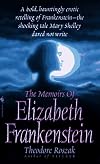
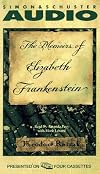
The Memoirs of Elizabeth Frankenstein
by Theodore Roszak
On This Page
Description
A rewrite of Mary Shelley's 19th Century horror classic, Frankenstein, from the point of view of Elizabeth, the murdered bride of Victor Frankenstein. The novel describes her life, from her gypsy origins to her "chemical" marriage to Victor, which involved mixing her menstrual blood with his semen. By the author of The Making of a Counterculture.Tags
Recommendations















Member Reviews
I picked up this book when a medical library was clearing out its shelves of fiction, and it was an interesting sensation to be reading about 18th century mysticism and natural philosophy knowing that some 21st century medical students might have also read this edition.
The conceit is that the man who recorded the last words of Victor Frankenstein is presenting the memoirs of Victor's wife, Elizabeth. Elizabeth is fascinating, an Italian girl whose father gives her, after her mother's death, to the Romany midwife who delivered her. The Baroness Frankenstein adopts her to be Victor's sister, partner in the Great Work, and wife, raising Elizabeth in women's mysteries. She is to provide a stabilising influence on Victor, but his manic show more nature is hard to control. It's a pretty dark book, with incest, rape and murder, and I found it disruptive that at the ends of various sections the naturalist character steps in as an editor and discredits Elizabeth's experiences, dismissing them as the overwrought imaginations of a weak an intellectually inferior woman. I would have enjoyed the book a lot more without the editoralising, but I see the point of it, as it gave more context to how she was perceived in her own time and just after. show less
The conceit is that the man who recorded the last words of Victor Frankenstein is presenting the memoirs of Victor's wife, Elizabeth. Elizabeth is fascinating, an Italian girl whose father gives her, after her mother's death, to the Romany midwife who delivered her. The Baroness Frankenstein adopts her to be Victor's sister, partner in the Great Work, and wife, raising Elizabeth in women's mysteries. She is to provide a stabilising influence on Victor, but his manic show more nature is hard to control. It's a pretty dark book, with incest, rape and murder, and I found it disruptive that at the ends of various sections the naturalist character steps in as an editor and discredits Elizabeth's experiences, dismissing them as the overwrought imaginations of a weak an intellectually inferior woman. I would have enjoyed the book a lot more without the editoralising, but I see the point of it, as it gave more context to how she was perceived in her own time and just after. show less
First of all, let me say that this novel is well written (although a bit repetitive). The male author produces a very believable female voice which is distinct from the voice of the persnickety “editor” – not many authors can do that.
Readers of many books, for example Marion Zimmer Bradley’s “Mists of Avalon” will be familiar with the Druidic concept of “The Great Marriage”, “Marriage With the Land”, or “The Sacred Marriage” as Dan Brown calls it in “The DaVinci Code”. In this novel, Baroness Frankenstein, mother of Victor and adopted mother of Elizabeth tries to indoctrinate her pre-teen step-siblings into the Druidic mysteries / tantric sex rites / alchemical ceremonies to further “The Great Work” of show more “The Chymical Marriage”. So, the author describes in great detail how these two kids are encouraged and instructed in how to perform these esoteric sex acts while the adult teachers look on. Somehow this was supposed to further alchemical outcomes, like producing the philosopher’s stone, but I never understood that part.
Elizabeth’s journal tells how she was systematically brainwashed and raped over and over again at the direction of her mother. Think this description is too harsh, that it was in the name of religion and divine mysteries? Just imagine that the leader was the father instead. Not many books offend me, but this one did. show less
Readers of many books, for example Marion Zimmer Bradley’s “Mists of Avalon” will be familiar with the Druidic concept of “The Great Marriage”, “Marriage With the Land”, or “The Sacred Marriage” as Dan Brown calls it in “The DaVinci Code”. In this novel, Baroness Frankenstein, mother of Victor and adopted mother of Elizabeth tries to indoctrinate her pre-teen step-siblings into the Druidic mysteries / tantric sex rites / alchemical ceremonies to further “The Great Work” of show more “The Chymical Marriage”. So, the author describes in great detail how these two kids are encouraged and instructed in how to perform these esoteric sex acts while the adult teachers look on. Somehow this was supposed to further alchemical outcomes, like producing the philosopher’s stone, but I never understood that part.
Elizabeth’s journal tells how she was systematically brainwashed and raped over and over again at the direction of her mother. Think this description is too harsh, that it was in the name of religion and divine mysteries? Just imagine that the leader was the father instead. Not many books offend me, but this one did. show less
I originally picked up this book because Roszak's FLICKER is one of the best books I have ever read...I am still in awe of it. Incidentally, I am also a huge fan of Shelley's FRANKENSTEIN after reading it for school and falling in love with the haunting story of man and monster. You would think this book was tailor-made for me, consider its feminist take on a classic tale as it attempts to shed light on the story of Elizabeth Lavenza, Frankenstein's paramour. In reality, the book ends up being kind of okay. The writing, as I said before, is stellar and crisp, almost as precise as a scalpel, and because of this Elizabeth does feel like a fully-realized counterpart to the famous Dr. Frankenstein. However, the book doesn't really follow show more the original FRANKENSTEIN narrative so closely which was of some disappointment to me. No mention of Justine or other plot points that chilled me to the bone from the original novel left me a bit deflated, but I hoped Roszak would have something better in store because of this. But instead of transcending the original (a daunting task, admittedly), a new world of witchcraft the author introduces with meticulous detail manages to feel excessive and insufficient at the same time. The issue of sexuality, while strongly utilized, felt a bit "much" by the end. I'm no prude, but I felt like a lot of the sexual content could have been pared down for the same effect. I think it's safe to say that this book isn't sexy so much as graphic graphic GRAPHIC. The most exciting pages were the last fifty, which is such a shame because they should come so much earlier in the story than they do. Those final pages made this book worthwhile, but just barely as a devout Roszak and FRANKENSTEIN fan. show less
http://nwhyte.livejournal.com/2324190.html
Won the 1995 Tiptree Award. I wasn't quite sure what to expect; it's not terribly closely related to Shelley's own Frankenstein (and I'm baffled by the numerous online reviews whining that it's not a "sequel" - most of the book is set before the action of the original novel, so if anything it would be a prequel; but in reality it is an extended meditation on the character of Elizabeth Frankenstein and what might have shaped her life and Victor's to their date with destiny. It provides an unexpected background of the creation of the monster in the obsession of the senior Baroness Frankenstein with alchemy, and her manipulation of Elizabeth (who is presented as Victor's adopted sister, as well as show more his eventual wife) and Victor as part of her own grand plan, which inevitably grinds to a halt against Victor's interest in science rather than alchemy, though he shares the goal of creating a new form of life (and indeed is more successful). Poor Elizabeth is nastily manipulated by everyone, though I was amused by the outraged scholarly apparatus purportedly provided by an older Robert Walton (who, as everyone forgets, is the narrator of the framing story in Shelley). Inevitably one must compare with Mists of Avalon, which is the same sort of book (reframing of familiar legendary material through perspective of an alternative, more female-centred and largely fictional belief system). I think Roszak is a bit more disciplined than Bradley, but is also drawing on a smaller canvas which may make that easier. show less
Won the 1995 Tiptree Award. I wasn't quite sure what to expect; it's not terribly closely related to Shelley's own Frankenstein (and I'm baffled by the numerous online reviews whining that it's not a "sequel" - most of the book is set before the action of the original novel, so if anything it would be a prequel; but in reality it is an extended meditation on the character of Elizabeth Frankenstein and what might have shaped her life and Victor's to their date with destiny. It provides an unexpected background of the creation of the monster in the obsession of the senior Baroness Frankenstein with alchemy, and her manipulation of Elizabeth (who is presented as Victor's adopted sister, as well as show more his eventual wife) and Victor as part of her own grand plan, which inevitably grinds to a halt against Victor's interest in science rather than alchemy, though he shares the goal of creating a new form of life (and indeed is more successful). Poor Elizabeth is nastily manipulated by everyone, though I was amused by the outraged scholarly apparatus purportedly provided by an older Robert Walton (who, as everyone forgets, is the narrator of the framing story in Shelley). Inevitably one must compare with Mists of Avalon, which is the same sort of book (reframing of familiar legendary material through perspective of an alternative, more female-centred and largely fictional belief system). I think Roszak is a bit more disciplined than Bradley, but is also drawing on a smaller canvas which may make that easier. show less
Not too bad on its own merits, I guess, but it doesn't mesh well with the original novel. There isn't a single mention of Justine or her death, despite how anguished Elizabeth seemed to be over it in "Frankenstein." There isn't even a single mention of Victor's little brother, William, who was strangled by the Monster. In this novel, the Monster apparently didn't kill anyone. There is also not a single mention of Victor's boyhood friend, Clerval.
Those were three important figures in the original novel, all killed by the Monster, and NONE of them figure in this novel... not even a single mention of their names. The author mentions Victor's other brother, but not the one that died. I found that disappointing.
Those were three important figures in the original novel, all killed by the Monster, and NONE of them figure in this novel... not even a single mention of their names. The author mentions Victor's other brother, but not the one that died. I found that disappointing.
Pages read: All
This book was very good. It talks about Victor Frankenstein's wife Elizabeth. It is her adventure through her life and how she gets to know herself as a women and growing up.
I think that this book is an ideal read for female teens and women.
This book was very good. It talks about Victor Frankenstein's wife Elizabeth. It is her adventure through her life and how she gets to know herself as a women and growing up.
I think that this book is an ideal read for female teens and women.
Tiptree winner 1995
Members
- Recently Added By
Lists

Jones & Newman: Best Horror Books Further Recommended Reading
577 works; 4 members
Author Information

22+ Works 3,299 Members
Theodore Roszak was born in Chicago, Illinois on November 15, 1933. He received a B.A. from UCLA and a Ph.D. in English history from Princeton University. He taught at Stanford University, the University of British Columbia, San Francisco State University, and California State University, Hayward. His only lengthy departure from academia was when show more he served as editor of Peace News in London during 1964 and 1965. His writings and social philosophy have been controversial since the publication of The Making of a Counter Culture in 1968. His other nonfiction works include Where the Wasteland Ends, Person/Planet, The Voice of the Earth, The Cult of Information, and Ecopsychology: Healing the Mind, Restoring the Earth. He also wrote several novels including Flicker, The Devil and Daniel Silverman, and Memoirs of Elizabeth Frankenstein, which won the Tiptree Award. He died of cancer on July 5, 2011 at the age of 77. (Bowker Author Biography) show less
Awards and Honors
Awards
Common Knowledge
- Original publication date
- 1995
- People/Characters
- Elizabeth Lavenza; Victor Frankenstein
Classifications
- Genres
- Fiction and Literature, General Fiction, Horror, Science Fiction, Historical Fiction
- DDC/MDS
- 813.54 — Literature & rhetoric American literature in English American fiction in English 1900-1999 1945-1999
- LCC
- PS3568 .O8495 .M46 — Language and Literature American literature American literature Individual authors 1961-
- BISAC
Statistics
- Members
- 298
- Popularity
- 107,747
- Reviews
- 7
- Rating
- (3.39)
- Languages
- English, French, German
- Media
- Paper, Audiobook
- ISBNs
- 7
- ASINs
- 2