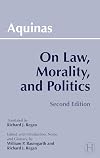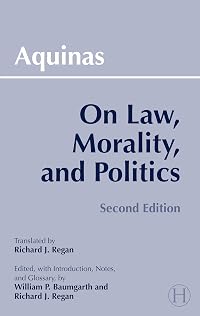
On Law, Morality, and Politics
by Thomas Aquinas
On This Page
Description
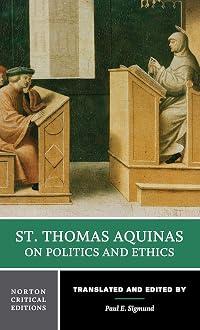
The second edition of Aquinas, On Law, Morality, and Politics retains the selection of texts presented in the first edition but offers them in new translations by Richard J. Regan--including that of his Aquinas, Treatise on Law (Hackett, 2000). A revised Introduction and glossary, an updated select bibliography, and the inclusion of summarizing headnotes for each of the units--Conscience, Law, Justice, Property, War and Killing, Obedience and Rebellion, and Practical Wisdom and show more Statecraft--further enhance its usefulness. show lessTags
Recommendations



Member Reviews
Combining the Neo-Platonist influenced theological and political thoughts of St. Augustine with Aristotelian influenced reasoning, St. Thomas Aquinas drastically changed medieval theology and political thought which would far-reaching consequences ever since. On Law, Morality, and Politics is a selection of excerpts from Aquinas’ Summa Theologica and two from On Kingship that provide the reader a glimpse at his thinking.
Of the roughly 280 pages in this collection, almost four-fifths of dedicated to the exploration of law and justice in various facets. The minute differences between types of law (divine, natural, and human) that Aquinas discusses in full then the various types of justice is a mind-numbing exercise of reading that show more almost makes one throw away the book. The final fifth of the book of selections features a little morality but mostly on politics from leadership to church-state relations of various types. With exception of the two selections from On Kingship, Aquinas’ style of listing objections to the points he is about to make then stating his opinion and finally replying to the previous objections is rather self-aggrandizing. Yet save for a short introduction, there was no commentary to help the layman reader to understand what Aquinas was saying—though in the last fifth of the book it was easier because Aquinas’ thoughts were straightforward compared to the law and justice sections—and making it hard to keep reading.
On Law, Morality, and Politics by St. Thomas Aquinas is a collection of excerpts, with two exceptions, from his most famous work yet only the last fifth of the book is clear cut and straightforward. The lack of commentary to help the read understand what Aquinas is trying to make clear and why it is important makes understanding the thinking of the man hard. show less
Of the roughly 280 pages in this collection, almost four-fifths of dedicated to the exploration of law and justice in various facets. The minute differences between types of law (divine, natural, and human) that Aquinas discusses in full then the various types of justice is a mind-numbing exercise of reading that show more almost makes one throw away the book. The final fifth of the book of selections features a little morality but mostly on politics from leadership to church-state relations of various types. With exception of the two selections from On Kingship, Aquinas’ style of listing objections to the points he is about to make then stating his opinion and finally replying to the previous objections is rather self-aggrandizing. Yet save for a short introduction, there was no commentary to help the layman reader to understand what Aquinas was saying—though in the last fifth of the book it was easier because Aquinas’ thoughts were straightforward compared to the law and justice sections—and making it hard to keep reading.
On Law, Morality, and Politics by St. Thomas Aquinas is a collection of excerpts, with two exceptions, from his most famous work yet only the last fifth of the book is clear cut and straightforward. The lack of commentary to help the read understand what Aquinas is trying to make clear and why it is important makes understanding the thinking of the man hard. show less
Ratings
Members
- Recently Added By
Author Information

2,200+ Works 27,993 Members
Thomas Aquinas, the most noted philosopher of the Middle Ages, was born near Naples, Italy, to the Count of Aquino and Theodora of Naples. As a young man he determined, in spite of family opposition to enter the new Order of Saint Dominic. He did so in 1244. Thomas Aquinas was a fairly radical Aristotelian. He rejected any form of special show more illumination from God in ordinary intellectual knowledge. He stated that the soul is the form of the body, the body having no form independent of that provided by the soul itself. He held that the intellect was sufficient to abstract the form of a natural object from its sensory representations and thus the intellect was sufficient in itself for natural knowledge without God's special illumination. He rejected the Averroist notion that natural reason might lead individuals correctly to conclusions that would turn out false when one takes revealed doctrine into account. Aquinas wrote more than sixty important works. The Summa Theologica is considered his greatest work. It is the doctrinal foundation for all teachings of the Roman Catholic Church. show less
Some Editions
Series
Belongs to Publisher Series
Common Knowledge
- First words
- Preface -- The writings of Thomas Aquinas on morals and politics deserve wide circulation for a host of reasons. No student of political thought can be considered well-grounded in the Western tradition if the contribution of ... (show all)the Middle Ages in that tradition is ignored.
- Blurbers
- Davies, Brian; Murphy, James B.; Butterworth, Charles E.; Gomez-Lobo, Alfonso
- Original language
- Latin
Classifications
Statistics
- Members
- 461
- Popularity
- 66,413
- Reviews
- 2
- Rating
- (3.18)
- Languages
- English
- Media
- Paper, Ebook
- ISBNs
- 6
- ASINs
- 4