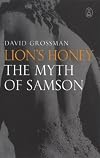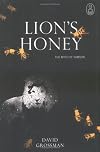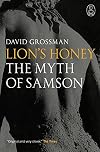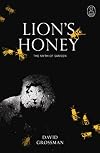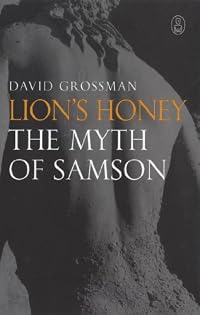
Lion's Honey: The Myth of Samson
by David Grossman
On This Page
Description
The Myth of Samson retold unabridged in exhilarating and lucid prose. The journey of a lonely and tortured soul who never found a true home in the world, who was uncomfortable in his very body and who, some might say, was the precursor of today's suicide bombers.Tags
Recommendations




















Member Reviews
I have no time for the biblical Samson, who seemed like a thug of the first order, a feeling only reconfirmed by re-reading the passage from Judges included at the start of the book.
And then the book proper begins and it's .. an essay, which is not what I was expecting. And it's a very detailed one at that - almost a line by line analysis, pulling in material from other sources, psychoanalysis - and initially it seems quite a stretch, rather too much from too little.
But by the end, and this was even less expected, it's quite gripping, and convincing even, to the extent that I feel I have not only a whole new understanding of Samson but also a new awareness of the care required when approaching these ancient texts.
And then the book proper begins and it's .. an essay, which is not what I was expecting. And it's a very detailed one at that - almost a line by line analysis, pulling in material from other sources, psychoanalysis - and initially it seems quite a stretch, rather too much from too little.
But by the end, and this was even less expected, it's quite gripping, and convincing even, to the extent that I feel I have not only a whole new understanding of Samson but also a new awareness of the care required when approaching these ancient texts.
This was a book I wasn't entirely sure whether I'd enjoy it or not. In the end I did. I read it in two or three extremely separated sittings, and that probably added to my overall experience of it as a somewhat ethereal and dreamlike experience. I thought, possibly like many of us, that I knew the biblical story of Samson reasonably well, but Grossman's careful exploration of the text exposed to me just how much of it I'd either forgotten or never knew. It's a wonderfully beguiling story.
The author's examination of Samson's Israel is full of fleeting glimpses of a slow and gritty landscape; hints of a 'land of milk and honey' set against a backdrop of harsh nature and sporadically warring peoples with rival deities and belief systems. show more This is a thought provoking look at a vivid chapter from the Book of Judges that some may find perplexing, but I think that most interested readers would find worthwhile.
In those days the area was thickly wooded - 'as plentiful as sycamores in the Shephelah plain' was once a simile for abundance - but today the trees are sparse, the hills exposed. show less
The author's examination of Samson's Israel is full of fleeting glimpses of a slow and gritty landscape; hints of a 'land of milk and honey' set against a backdrop of harsh nature and sporadically warring peoples with rival deities and belief systems. show more This is a thought provoking look at a vivid chapter from the Book of Judges that some may find perplexing, but I think that most interested readers would find worthwhile.
In those days the area was thickly wooded - 'as plentiful as sycamores in the Shephelah plain' was once a simile for abundance - but today the trees are sparse, the hills exposed. show less
An analysis rather than a retelling of the Samson story. I love DG's writing and I loved this book but I couldn't really tell you why except that it's like having a really smart friend talk to you over coffee. The prose is passionate, bright and compelling.
I never liked Samson. I've said before that if the two of us meet someday in heaven, there will probably be a personality clash to end all clashes. I'm hoping that my new heavenly body won't be quite so easy to beat up.
Then I read David Grossman's little book. David carries us deep into the mind--nay, the very heart--of this ancient hero, to uncover what makes him tick. Sampson has been transformed from a turbulent, macho man into a needy, troubled misfit. A muscle-bound one, no less, which makes for an explosive combination.
I like him even less this way. I would shake Delilah's hand for uncovering his secret. No, not his long hair, but the inner child that longs to be normal, which she then carefully and deliberately manipulates.
Yeah, show more I'm fine with the tragic ending, Samson deserved it. Nevertheless, David's clever retelling succeeds in adding life to the myth. Kudos! David draws upon various Hebrew traditions to spice up Samson's twisted personality, then leaves the poor man without even a decent shrink. How else could the story end?
Sorry, David, I never did feel any sympathy for your guy. But I absolutely loved reading your story. show less
Then I read David Grossman's little book. David carries us deep into the mind--nay, the very heart--of this ancient hero, to uncover what makes him tick. Sampson has been transformed from a turbulent, macho man into a needy, troubled misfit. A muscle-bound one, no less, which makes for an explosive combination.
I like him even less this way. I would shake Delilah's hand for uncovering his secret. No, not his long hair, but the inner child that longs to be normal, which she then carefully and deliberately manipulates.
Yeah, show more I'm fine with the tragic ending, Samson deserved it. Nevertheless, David's clever retelling succeeds in adding life to the myth. Kudos! David draws upon various Hebrew traditions to spice up Samson's twisted personality, then leaves the poor man without even a decent shrink. How else could the story end?
Sorry, David, I never did feel any sympathy for your guy. But I absolutely loved reading your story. show less
"Important, but not quite loved." -Thoughts on Lion's Honey by David Grossman (translated from Hebrew by Scott Schoffman)
I am no stranger to the story of Samson; I studied in a private, religious school for 13 years, during which I was - for lack of a better, or nicer, word - force-fed the Bible and its stories*. Samson's feats of strength (the only one I was ever able to remember was the one at the end, really - collapsing the two pillars and killing three thousand Philistines in one blow) and his treacherous, short-lived romance with Delilah ("you are my sweetest downfall," so sings Regina Spektor) made a mark on me early on, if only because a) every child remembers stories of superhuman feats, b) Samson and Delilah was my first show more fatalist love story - I was yet to be introduced to Romeo and Juliet, and c) I was, at a very young age, wondering why Samson had to die together with the Philistines - sure, he had his eyes gouged out and was weak from his recent haircut, but if God really loved Samson, shouldn't He have saved him? Enveloped Samson in a force field while the arena tumbled down around him, perhaps?
I didn't find the answer to that question in Lion's Honey, David Grossman's interpretation (or maybe it's called an analysis?) of the story of Samson (the Book of Judges, chapter 13-16, in case you want to brush up on biblical history). However, Grossman did shed quite the new light on Samson that made me go "why didn't I think of that?" and "oh my ... goodness, he's right!": that Samson was - and these are my words, not Grossman's - a misunderstood freak who never realized that he was exploited (nationalised was Grossman's term) by God, and that his womanizing (which really is too big a word in his case; does being with three women - not even simultaneously, no - count as womanizing? Then again it was the biblical times) was in truth a need for intimate connection which he'd lacked his entire life, beginning with his miraculous conception (they say his mother was barren, but hey, the patriarch should be under suspicion for infertility, too), ending with his first love Delilah's treachery (the three times she tried to harm him should have been enough of a warning - but, alas, the poor guy was in love) and ultimately leading to his demise under the two pillars with the Philistines (which in any case looked like a suicide but since it's in the Bible, it counts as a sacrifice).
Grossman wasn't as blunt, though.
The exploration of Samson's life is so detailed, so intricate, that Grossman even had footnotes; his discussion alone of how an angel informed Samson's mother of her impending divine pregnancy ate up the first 30 pages of the book. That Samson was a misunderstood person "who has been planted in the world and operated as a lethal weapon of divine will," at the same time clueless as to his purpose in life - "He goes through life like a walking enigma, marvelling over his secret, his riddle." - and his greatest struggle being pre-destined for such greatness as God's instrument (or puppet, depending on how one views it), a destiny which has made him different, an outcast, when all he ever wanted was to fit in. His story is littered with allusions to his great disconnect - with his parents, his people, even to himself; Samson was larger than life, yet despite his great strength, he was emotionally inadequate for the job. "How astonishing and poignant, this gulf between enormous physical strength and an immature, childlike soul."
Grossman's interpretation of the story of Samson is so far, far removed from what I've grown up with; Scott Schoffman's translation is delicious in its simplicity - what could have turned out to be a boring, seemingly academic book became vivid in giving a new (albeit quite the eccentric) definition of one of the Bible's greatest heroes. I was honestly expecting a work of fiction when I picked up the book, but I'm glad I was wrong.
Samson's story, though full of great feats of strength, ended sadly with his death; Lion's Honey, however, has made me even more melancholic, sadder for a man whose greatest wish was "that one person love him simply, wholly, naturally, not because of his miraculous quality, but in spite of it."
I hope he didn't die in vain.
PS. A thought, in retrospect: everyone's trying to be different, "but maybe it is not a weakness, an illness, to be like everyone else."
* I have nothing against the Bible, though. In fact, my copy is quite the confidante (I hide small notes and the occasional rainy-day bill between its pages) and great giver of advice (the occasional Bible-dipping, as introduced by Augusten Burroughs' Running with Scissors). I'm not trying to be blasphemous, I swear.
Originally posted here. show less
I am no stranger to the story of Samson; I studied in a private, religious school for 13 years, during which I was - for lack of a better, or nicer, word - force-fed the Bible and its stories*. Samson's feats of strength (the only one I was ever able to remember was the one at the end, really - collapsing the two pillars and killing three thousand Philistines in one blow) and his treacherous, short-lived romance with Delilah ("you are my sweetest downfall," so sings Regina Spektor) made a mark on me early on, if only because a) every child remembers stories of superhuman feats, b) Samson and Delilah was my first show more fatalist love story - I was yet to be introduced to Romeo and Juliet, and c) I was, at a very young age, wondering why Samson had to die together with the Philistines - sure, he had his eyes gouged out and was weak from his recent haircut, but if God really loved Samson, shouldn't He have saved him? Enveloped Samson in a force field while the arena tumbled down around him, perhaps?
I didn't find the answer to that question in Lion's Honey, David Grossman's interpretation (or maybe it's called an analysis?) of the story of Samson (the Book of Judges, chapter 13-16, in case you want to brush up on biblical history). However, Grossman did shed quite the new light on Samson that made me go "why didn't I think of that?" and "oh my ... goodness, he's right!": that Samson was - and these are my words, not Grossman's - a misunderstood freak who never realized that he was exploited (nationalised was Grossman's term) by God, and that his womanizing (which really is too big a word in his case; does being with three women - not even simultaneously, no - count as womanizing? Then again it was the biblical times) was in truth a need for intimate connection which he'd lacked his entire life, beginning with his miraculous conception (they say his mother was barren, but hey, the patriarch should be under suspicion for infertility, too), ending with his first love Delilah's treachery (the three times she tried to harm him should have been enough of a warning - but, alas, the poor guy was in love) and ultimately leading to his demise under the two pillars with the Philistines (which in any case looked like a suicide but since it's in the Bible, it counts as a sacrifice).
Grossman wasn't as blunt, though.
The exploration of Samson's life is so detailed, so intricate, that Grossman even had footnotes; his discussion alone of how an angel informed Samson's mother of her impending divine pregnancy ate up the first 30 pages of the book. That Samson was a misunderstood person "who has been planted in the world and operated as a lethal weapon of divine will," at the same time clueless as to his purpose in life - "He goes through life like a walking enigma, marvelling over his secret, his riddle." - and his greatest struggle being pre-destined for such greatness as God's instrument (or puppet, depending on how one views it), a destiny which has made him different, an outcast, when all he ever wanted was to fit in. His story is littered with allusions to his great disconnect - with his parents, his people, even to himself; Samson was larger than life, yet despite his great strength, he was emotionally inadequate for the job. "How astonishing and poignant, this gulf between enormous physical strength and an immature, childlike soul."
Grossman's interpretation of the story of Samson is so far, far removed from what I've grown up with; Scott Schoffman's translation is delicious in its simplicity - what could have turned out to be a boring, seemingly academic book became vivid in giving a new (albeit quite the eccentric) definition of one of the Bible's greatest heroes. I was honestly expecting a work of fiction when I picked up the book, but I'm glad I was wrong.
Samson's story, though full of great feats of strength, ended sadly with his death; Lion's Honey, however, has made me even more melancholic, sadder for a man whose greatest wish was "that one person love him simply, wholly, naturally, not because of his miraculous quality, but in spite of it."
I hope he didn't die in vain.
PS. A thought, in retrospect: everyone's trying to be different, "but maybe it is not a weakness, an illness, to be like everyone else."
* I have nothing against the Bible, though. In fact, my copy is quite the confidante (I hide small notes and the occasional rainy-day bill between its pages) and great giver of advice (the occasional Bible-dipping, as introduced by Augusten Burroughs' Running with Scissors). I'm not trying to be blasphemous, I swear.
Originally posted here. show less
I was a little surprised as to what comprised this book, as I expected to find a fictional retelling after the reproduction of Judges 13-16 of the King James Bible. Instead, what follows is a detailed commentary that examines and dissects the Biblical account, using even the original language to understand the full meaning of the text, with all of its nuances and allusions. As many times that I have studied the story of Samson in church growing up, there is apparently quite a bit that I never knew about such an interesting character in Hebrew history.
As any person chosen of God to do His will, Samson is a man plagued by his destiny and how it separates him from the rest of humanity. Though chosen of God from the womb to live as a show more Nazarite, he is still very much human with human urges. Almost constantly at war with himself, Samson seems to set himself up to be hurt by those he puts his trust in so that he may let loose his anger and rage against those who hold his people captive -- the Philistines. Like so many modern-day psychological head cases, much of his choices are also driven by a need for that hidden something lacking in his relationship with his parents. He looks for it in the wrong places and the wrong women, even paying a visit to a prostitute. He seems to use his strength and anger with an artistic flair, first setting up a group of Philistines at his wedding with an unsolvable riddle, and later finding rather unique ways of further punishing the Philistines, such as using the jawbone of an ass to kill a thousand of them. Furthermore, every verbal account from Samson is spoken poetically.
What I found most interesting is the way that David Grossman explored the account of Samson and Delilah. He alludes that Samson in fact knew the betrayal that Delilah harbored and welcomed it in order to finally shed his God-given destiny. While he ends his life in a final act of redemption, I have to wonder if he did complete the task that God had given him to "begin to deliver Israel out of the hand of the Philistines."
Despite the intense detail that David Grossman goes into when writing this study of Samson, the book is a very good read and well worth my time. show less
As any person chosen of God to do His will, Samson is a man plagued by his destiny and how it separates him from the rest of humanity. Though chosen of God from the womb to live as a show more Nazarite, he is still very much human with human urges. Almost constantly at war with himself, Samson seems to set himself up to be hurt by those he puts his trust in so that he may let loose his anger and rage against those who hold his people captive -- the Philistines. Like so many modern-day psychological head cases, much of his choices are also driven by a need for that hidden something lacking in his relationship with his parents. He looks for it in the wrong places and the wrong women, even paying a visit to a prostitute. He seems to use his strength and anger with an artistic flair, first setting up a group of Philistines at his wedding with an unsolvable riddle, and later finding rather unique ways of further punishing the Philistines, such as using the jawbone of an ass to kill a thousand of them. Furthermore, every verbal account from Samson is spoken poetically.
What I found most interesting is the way that David Grossman explored the account of Samson and Delilah. He alludes that Samson in fact knew the betrayal that Delilah harbored and welcomed it in order to finally shed his God-given destiny. While he ends his life in a final act of redemption, I have to wonder if he did complete the task that God had given him to "begin to deliver Israel out of the hand of the Philistines."
Despite the intense detail that David Grossman goes into when writing this study of Samson, the book is a very good read and well worth my time. show less
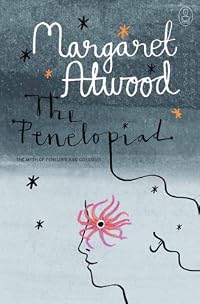
I was surprised by the form this book took; having read the other books in the Canongate myths series, I was expecting a retelling--albeit in a broad sense--but what I found was both analysis and story. Grossman tells the traditional story of Samson, but mixes in analytical, even psychological observations on his character's emotional state, motivations, etc. Rather than resetting the story, as some of the authors in this series have done, or retelling it from a different character perspective, as Atwood did with the Penelopiad, Grossman simply fills in the blanks, those holes in the original Biblical story.
It may seem reductive to say "simply" because no doubt it is a complex process, but the style of this piece--straightforward, even show more clinical at times--makes it feel more like a textbook than fiction. (It should be noted here that this text is translated from the Hebrew, so some of the style may be a result of translation choices.) That is not to say that I didn't enjoy it; it was enjoyable in an unexpected way. Overall, a fascinating read, but not something that I will be rereading right away. show less
It may seem reductive to say "simply" because no doubt it is a complex process, but the style of this piece--straightforward, even show more clinical at times--makes it feel more like a textbook than fiction. (It should be noted here that this text is translated from the Hebrew, so some of the style may be a result of translation choices.) That is not to say that I didn't enjoy it; it was enjoyable in an unexpected way. Overall, a fascinating read, but not something that I will be rereading right away. show less
Members
- Recently Added By
Author Information

91+ Works 8,019 Members
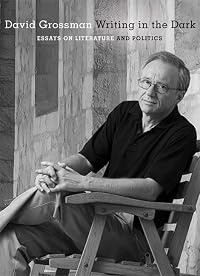
David Grossman was born in Jerusalem on January 25, 1954, is an Israeli author of fiction, nonfiction, and youth and children's literature. His books have been translated into many languages. He is most known for his non-fiction work, The Yellow Wind. This is his study of the Palestinians in the Israeli-occupied West Bank and Gaza Strip. He was show more awarded the Prime Minister's Prize for Hebrew literature (1984) and the Israeli Publishers Association Prize for best Hebrew novel (1985). Grossman lives in Mevasseret Zion on the outskirts of Jerusalem. He is married to Michal Grossman, a child psychologist and the mother of his three children. (Bowker Author Biography) show less
Some Editions
Series
Belongs to Publisher Series
Work Relationships
Is contained in
Common Knowledge
Classifications
- Genre
- Fiction and Literature
- DDC/MDS
- 398 — Society, Government, and Culture Customs, etiquette & folklore Folklore & Folktales
- LCC
- BS580 .S15 .G7613 — Philosophy, Psychology and Religion The Bible The Bible Works about the Bible Men, women, and children of the Bible Individual Old Testament characters
- BISAC
Statistics
- Members
- 393
- Popularity
- 79,059
- Reviews
- 25
- Rating
- (3.48)
- Languages
- 10 — Dutch, English, Finnish, German, Hebrew, Hungarian, Italian, Portuguese, Spanish, Swedish
- Media
- Paper, Audiobook, Ebook
- ISBNs
- 36
- ASINs
- 2