On This Page
Description
A collection of short poems which, when reversed, provide new perspectives on the fairy tale characters they feature.Tags
Recommendations


Member Reviews
Marilyn Singer presents fourteen "reverso" poems in this delightful picture-book, each of which offers a dual retelling of a classic fairy-tale. Read down the page, the poem tells one side of the story, but when the lines are printed in the opposite order, it gives another perspective. Consider In the Hood, from both Little Red Riding Hood and the Wolf's perspective:
In my hood / skipping through the wood, / carrying a basket, /
picking berries to eat - / juicy and sweet / what a treat! /
But a girl / mustn't dawdle. / After all, Grandma's waiting.
After all, Grandmother's waiting / mustn't dawdle... / But a girl! /
What a treat - / juicy and sweet, / picking berries to eat, /
carrying a basket, / skipping through the wood / in my 'hood.
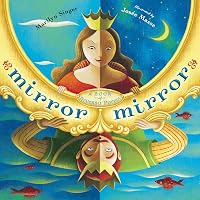
Some show more of these selections work better than others, but when done right, they are immensely appealing and quite thought-provoking. They're obviously also very clever! The illustrations are colorful, and while I wouldn't describe them as a particular favorite, I appreciated the way in which the dual nature of the poems in question is captured in the artwork.
I was a little confused to see that the author claims to have invented this form, which she has named the "reverso," as I believe that the ancient Greeks and Romans also had (very short) "palindrome poems," and the epic Sanskrit poems Kirātārjunīya and Shishupala Vadha (neither of which I have read) are said to contain longer passages in the form. But leaving that aside (after all, not everyone has studied ancient literature!), I do think that, in the field of contemporary poetry, and specifically, children's poetry, Singer has done something innovative and exciting. I consider it an added bonus that she chose to experiment with this new form in order to retell fairy-tales! show less
In my hood / skipping through the wood, / carrying a basket, /
picking berries to eat - / juicy and sweet / what a treat! /
But a girl / mustn't dawdle. / After all, Grandma's waiting.
After all, Grandmother's waiting / mustn't dawdle... / But a girl! /
What a treat - / juicy and sweet, / picking berries to eat, /
carrying a basket, / skipping through the wood / in my 'hood.
Some show more of these selections work better than others, but when done right, they are immensely appealing and quite thought-provoking. They're obviously also very clever! The illustrations are colorful, and while I wouldn't describe them as a particular favorite, I appreciated the way in which the dual nature of the poems in question is captured in the artwork.
I was a little confused to see that the author claims to have invented this form, which she has named the "reverso," as I believe that the ancient Greeks and Romans also had (very short) "palindrome poems," and the epic Sanskrit poems Kirātārjunīya and Shishupala Vadha (neither of which I have read) are said to contain longer passages in the form. But leaving that aside (after all, not everyone has studied ancient literature!), I do think that, in the field of contemporary poetry, and specifically, children's poetry, Singer has done something innovative and exciting. I consider it an added bonus that she chose to experiment with this new form in order to retell fairy-tales! show less
I love this poetry book because of the engaging writing and the different point of views that are expressed. On each page there are two poems, one on the left and one on the right. In both poems, the same words are used, however, they are put in opposite order. For example, the poem “In the Hood” that is on the left side starts with “in my hood” and ends with “after all, Grandma’s waiting”, while the poem on the right starts with “after all, grandma’s waiting” and concludes with “in my hood”. This captivates readers as the poem makes sense going from beginning to end, or end to beginning. The two poems on each page also provides the readers with two different perspectives. In the “In the Hood” poem, the two show more perspectives are from little red riding hood and the wolf. Little red riding hood is talking about how she is skipping through the woods to get to her grandma’s house while the wolf is talking about seeing little red riding hood skip through the woods, picking berries, in his neighborhood. In a different poem in the book called “Mirror, Mirror”, the two perspectives are from snow white and the evil queen. Even though the same words are used in both poems, snow white’s perspective is that she is taking care of the dwarfs who have been working hard and it is time for them to rest. However, the evil queen is talking about poisoning snow white with an apple to have her “rest”.
I think the main message of this poem is that there are two sides to every story. On every page there are two poems that represent the sides of two different characters. Although the same words are used for both poems, each character has their own intentions and sides to their story. show less
I think the main message of this poem is that there are two sides to every story. On every page there are two poems that represent the sides of two different characters. Although the same words are used for both poems, each character has their own intentions and sides to their story. show less
I liked this book for a couple of reasons. First, I liked the writing of the language in this book because I have never read, seen, or heard of a book in this style. Specifically, the fact that all of the poems are reversed is very interesting and allows for readers to gain the perspective of multiple points of view. For example, the poem “The Sleeping Beauty and the Wide-Awake Prince” which tells the story of fantasy through the perspective of both the Sleeping beauty and the Prince was interesting to see how just the reversal of the poem can give great insight on completely opposite views. Another part of this book, in which I found to be interesting, was the illustrations. Like the writing, the illustrations portrayed two show more separate views. The most common differences I noticed throughout the book was the color scheme for each side of the poem. For example, in the poem, “Rapunzel’s Locks” half the illustration is in sunny and clear and the other half is in dark and stormy. Also, in this illustration Rapunzel’s hair is long and the other half is short. This helps the readers relate the poem to the illustration and vise versa. Although this book seemed to be for entertainment value, the big idea I learned after reading was to always know two sides of the story. show less
"Mirror, Mirror," has become one of my favorites. Marilyn Singer, author of this book, has a very different style of writing throughout this book. When one reads, they usually read from top to bottom. Marilyn Singer gives her readers a different experience by providing a book a reverable verses. All of the poems in the book are based off of classic fairy tales. First, you read the poem to the left of the page, then the one to the right. The difference is that one poem is being read down the page and the other is read up. Although both poems have the same words in them, they are very different. When you read one poem you take in the point of view, but when you read the poem beside it you encounter a completely different point of view. show more Changes in the poem are only allowed when the changes are punctuation and/or capitalization. I noticed that when changes as simple as punctuation and capitalization occur, it gives the poem a whole new meaning and totally different perspective. Lastly, another thing I took in from reading this book of reverso's was that every story has two sides and Marilyn Singer clearly proves this. The first and last pages in the book are the only pages that are not based off of classic fairy tales. These verses of reverso's give readers a better insight of what a reverso means. I felt like a kid in a candy story when reading this book; I was truly amazed. show less
I enjoyed reading Mirror, Mirror by Marilyn Singer for numerous reasons. Firstly, I think that the overall set up of each poem really engages the reader. The each poem is reversed; physically the same poem is flipped upside down. For example, the “In the Hood” poem describes the wolf s anticipation to eat Red Riding Hood. The reversed poem is about Red Riding Hood trying to stay on task because she has to see her Grandma. This book helps readers look at multiple perspectives while reading various text, which is a key literary technique students should learn. I also thought that the language is extremely engaging for children. For example The Hansel and Gretel poem started like this “Fatten up, boy! Don’t you like prime rib?” show more then in the mirrored poem it ended like this “ Then your hostess, she will roast you like prime rib. Don’t you fatten up boy!” I believe that the way each poem is written really draws the reader in, and sparks their curiosity. The main idea of this book is to motivate the reader to understand various perspectives. show less
Here's a mind-bender of a poetry book. All of these poems, inspired by fairy tales, read forwards and backwards, and each way they make sense in surprising and even ironic ways. The forward poem about Hansel and Gretel has the witch encouraging Hansel to eat and fatten up; the reverse effect is Gretel telling Hansel not to eat. Cinderella is first unhappy and stuck in the corner; on the reverse she's spinning at the ball with the prince. Readers will be inspired to try their hand at their own reversible verse!
This is a book of poems about fairytales. All of the poems are written two ways. Each poem is written one way and then it is written the opposite way to show a different point of view. The main idea of the book is to see things from two points of view. For example, in “Sleeping Beauty and the Wide Awake Prince” one way shows the princess’ point of view and the other one shows the prince’s point of view. I loved this book! One reason I loved this book was because I thought that the concept was genius. I have never seen a book like this before. I cannot imagine how much work and ingenuity went into creating a poem that makes sense written in two ways to show two points of view. A second reason that I really loved this book was show more that it was about fairytales. I really like books that take a different approach to telling fairytales. Fairytales are traditionally told from one point of view, so I liked getting to see a second point of view. It reminded me of stories I used to read when I was younger that told classic fairytales from the villain’s perspective. show less
Members
- Recently Added By
Lists

Princess Tales
130 works; 4 members

Favorite Picture Books
479 works; 160 members
Author Information

145+ Works 9,794 Members
Marilyn Singer was born in the Bronx, New York, on October 3, 1948, and lived most of her early life in North Massapequa on Long Island. She attended Queens College, City University of New York as an English major and education student, and for her junior year, attended Reading University, in England. She holds a bachelor's degree in English from show more Queens and a MA in Communications from New York University. Marilyn Singer had been teaching English in New York City high schools for several years when she began writing in 1974. Initially, she wrote film notes, catalogues, teacher's guides and filmstrips. She also began looking into magazine writing. Her article proposals were not very successful, but she did manage to have some of her poetry published. Then one day she penned a story featuring talking insects she'd made up when she was eight. Encouraged by the responses she got, she wrote more stories and in 1976 her first book, The Dog Who Insisted He Wasn't, was published. Since then, Marilyn has published more than 50 books for children and young adults. In addition to a rich collection of fiction picture books, Singer has also produced a wide variety of nonfiction works for young readers as well as several poetry volumes in picture book format. Additionally, Singer has edited volumes of short stories for young adult readers, including Stay True: Short Stories for Strong Girls and I Believe in Water: Twelve Brushes with Religion. (Bowker Author Biography) show less
All Editions
Awards and Honors
Awards
Distinctions
Series

Common Knowledge
- Canonical title
- Mirror Mirror: A Book of Reverso Poems
- Original publication date
- 2010
Classifications
Statistics
- Members
- 1,326
- Popularity
- 18,147
- Reviews
- 205
- Rating
- (4.32)
- Languages
- English
- Media
- Paper, Audiobook, Ebook
- ISBNs
- 13
- ASINs
- 4