Grandpa's Face
by Eloise Greenfield
On This Page
Description
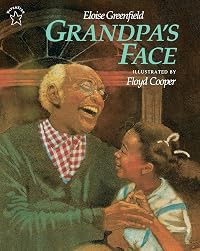
Seeing her beloved grandfather making a mean face while he rehearses for one of his plays, Tamika becomes afraid that someday she will lose his love and he will make that mean face at her.Tags
Recommendations





Member Reviews
I like this book because it showcases the idea of unconditional love. This book is the story of Tamika and her grandpa. While her grandpa is practicing for a play, Tamika sees her grandpa make a face she's never seen before, a mean one. Tamika then decides to misbehave to try to get Grandpa to make the face again. Grandpa then explains that he loves her too much to make that face at her. This book can show kids the importance of love and what unconditional love means.
Universal appeal. An amateur actor is so convincing he frightens his granddaughter. But because she has patient parents and because he knows the value of a tender talk-walk, everything's all better right quick. Greenfield is always worth reading.
I liked the story "Grandpa's Face" for three reasons. First, the characters in the story are believable and well developed. It shows the strong bond between a granddaughter and grandfather that many students in a class may relate to. "Sometimes Tamika and Grandpa would go out together, just the two of them." Second, the illustrations enhance the story by giving readers a visualization of what Grandpa and Tamika enjoy doing together. Third, this story pushes readers to think about the power of facial expressions and how they can make a person feel. When Grandpa has a mean facial expression when practicing for a play, Tamika is worried that he will one day look at her this way. After talking with Grandpa she understands the difference show more between playing pretend. The big idea in this story is love, telling the people you care about how you feel when you're happy or sad. show less
Summary:
This book is about a young African American girl named Tamika who loves her grandfather very much. She especially loves his face and all the expressions he makes. No matter what expression her grandfather has, she always feels loved. One day, Tamika walked in on her grandpa rehearsing his lines for a play. She saw him make another face, a "mean" face, and she got scared and walked out. She did not like that face and she didn't know how to feel about her grandfather now. At the dinner table, Tamika began to misbehave. She accidentally tipped her cup of water over and it spilled on her grandfathers lap. He got up and asked her what was wrong with her and went to change his shirt. He then took her on a walk and asked her what was show more wrong. She told him about the face she saw him make and told him she didn't like it. He told her he was only acting and he could never make that face at her, no matter what. Tamika felt much better now.
Personal Reaction:
I love this book because my grandfather was my favorite. He was the opposite of Tamika's grandfather. He was always stern but very funny. I loved him and while most people were afraid of him, I never was. More children today are around their grandparents a lot. This book is good for the classroom because many children can relate to Tamika.
Classroom Extension Ideas:
1. In the classroom, children can learn about facial expressions and talk about which expressions they like most.
2. This book would be appropriate to read for Grandparents day. show less
This book is about a young African American girl named Tamika who loves her grandfather very much. She especially loves his face and all the expressions he makes. No matter what expression her grandfather has, she always feels loved. One day, Tamika walked in on her grandpa rehearsing his lines for a play. She saw him make another face, a "mean" face, and she got scared and walked out. She did not like that face and she didn't know how to feel about her grandfather now. At the dinner table, Tamika began to misbehave. She accidentally tipped her cup of water over and it spilled on her grandfathers lap. He got up and asked her what was wrong with her and went to change his shirt. He then took her on a walk and asked her what was show more wrong. She told him about the face she saw him make and told him she didn't like it. He told her he was only acting and he could never make that face at her, no matter what. Tamika felt much better now.
Personal Reaction:
I love this book because my grandfather was my favorite. He was the opposite of Tamika's grandfather. He was always stern but very funny. I loved him and while most people were afraid of him, I never was. More children today are around their grandparents a lot. This book is good for the classroom because many children can relate to Tamika.
Classroom Extension Ideas:
1. In the classroom, children can learn about facial expressions and talk about which expressions they like most.
2. This book would be appropriate to read for Grandparents day. show less
A sweet story about a girl and her grandpa exploring what unconditional love is, how people emotions are reflected on their faces. We also see how Tamika's behavior is affected by her being upset. I think this story would be a great starting point to talk about emotions and how behavior is connected to them. Also, a great book to promote diversity in the classroom.
Tamika and her grandfather have a special relationship, but when Tamika sees Grandfather practicing a mean face for a play, she worries that someday he'll show that mean face to her. Captures the magic between grandchild and grandparent perfectly.
Tamika loves her grandpa. They do everything together; they are very close. Even when he is angry, Tamika knows that she is loved. However, when Tamika walks in on her grandpa practicing for a play, she sees him give an angry face that could never still hold love. She is terrified that she could make him this mad, and to see if he would ever give her this evil face, she purposely tries to make him angry. Tamika's grandpa sees her acting strange and talks to her. She confesses why she is being a bad girl, and he explains that no matter how mad he ever gets at her, he will still always love her.
I read this book to children as part of my service learning assignment, and they really liked it because they related it to their grandpa. It was show more funny because they showed me all of the mean faces their grandpa can make when he is very mad.
I could use this book as part of a lesson over Black History Month. We could share all of the different cultures and how they are all the same loving family to each other. We could talk about the importance of family and share personal examples between one another. show less
I read this book to children as part of my service learning assignment, and they really liked it because they related it to their grandpa. It was show more funny because they showed me all of the mean faces their grandpa can make when he is very mad.
I could use this book as part of a lesson over Black History Month. We could share all of the different cultures and how they are all the same loving family to each other. We could talk about the importance of family and share personal examples between one another. show less
Members
- Recently Added By
Author Information

55+ Works 7,179 Members
Eloise Greenfield was born in Parmele, North Carolina, on May 17, 1929. While she was still an infant, her family moved to Washington, D.C., where she has lived ever since. Ms. Greenfield studied piano as a child and teenager, before getting a full time civil service job. Her decision to write came from a lack of books on African Americans. There show more were far too few books that told the truth about African-American people. Ms. Greenfield wanted to change that. Greenfield has received many honors for her work, including the 1990 Recognition of Merit Award presented by the George G. Stone Center for Children's Books in Claremont, California for Honey, I Love; and an honorary degree from Wheelock College in Boston, Massachusetts. In addition to writing herself, Eloise Greenfield has found time to work with other writers. She headed the Adult Fiction and Children's Literature divisions of the D.C. Black Writers' Workshop (now defunct), a group whose goal was to encourage the writing and publishing of Africa-American literature. She has given free workshops on the writing of African-American literature for children, and, under grants from the D.C. Commission on the Arts and Humanities, has taught creative writing to elementary and junior high school students. Ms. Greenfield is also a member of the African-American Writers Guild. Greenfield has also received the Award for Excellence in Poetry for Children, given by the National Council of Teachers of English. In 1999 she became a member of the National Literary Hall of Fame for Writers of African Descent. She has received the Coretta Scott King Award for Africa Dream, the Carter G. Woodson Award for Rosa Parks, and the Irma Simonton Black Award for She Come Bringing Me That Little Baby Girl. For many of her books, she has received Notable Book citations from the American Library Association, the National Council of Teachers of English, and the National Council for the Social Studies. Ms. Greenfield has received, for the body of her work, the 1993 Lifetime Achievement Award from Moonstone, Inc., Philadelphia; and the 1993 Children's Literature and Social Responsibility Award from the Boston Educators for Social Responsibility. (Bowker Author Biography) show less
All Editions
Awards and Honors
Awards
Common Knowledge
- Dedication
- To my mother, Ramona, whom I love, to my grandfather C.D., whom I look up to, and to my aunt Emma who both inspired and encouraged me. -FC
- First words
- Tamika loved her grandpa.
- Last words
- (Click to show. Warning: May contain spoilers.)She was much too busy watching a wave of laughter as it spread across her grandpa's face.
Classifications
- Genres
- Children's Books, Picture Books
- DDC/MDS
- 306.85 — Society, government, & culture Social sciences, sociology & anthropology Social Behavior - Dating, Marriage, Divorce Marriage, partnerships, unions; family Family
- LCC
- PZ7 .G845 .G — Language and Literature Fiction and juvenile belles lettres Fiction and juvenile belles lettres Juvenile belles lettres
- BISAC
Statistics
- Members
- 653
- Popularity
- 44,497
- Reviews
- 25
- Rating
- (4.04)
- Languages
- English, Spanish
- Media
- Paper
- ISBNs
- 14
- ASINs
- 5