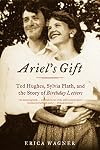
Ariel's Gift: Ted Hughes, Sylvia Plath, and the Story of Birthday Letters
by Erica Wagner
On This Page
Description
When Ted Hughes's Birthday Letters was published in 1998, it was greeted with astonishment and acclaim, immediately landing on the bestseller list. Few suspected that Hughes had been at work for a quarter of a century on this cycle of poems addressed to his first wife, Sylvia Plath. In Ariel's Gift, Erica Wagner explores the destructive relationship between these two poets through their lives and their writings. She provides a commentary to the poems in Birthday Letters, showing the events show more that shaped them and, crucially, showing how they draw upon Plath's own work. "Both narratively engaging and scholastically comprehensive."--Thomas Lynch, Los Angeles Times "Wagner has set the poems of Hughes's Birthday Letters in the context of his marriage to Plath with great delicacy."--Times Literary Supplement show lessTags
Recommendations
















Member Reviews
7.2/10
I picked this up after wading through the collected poems of Ted Hughes, in an effort to gain either more generosity or more understanding of the birthday letters. I can't say this has helped to change my opinion much: I still consider them an assortment of self-deluding camouflage.
I don't believe that Ted Hughes was responsible for Sylvia Plath's suicide any more than I believe the birthday letters can explain their marriage, Plath's mental illness, Hughes's infidelities, Plath's suicide, roughly in that order. In the modern parlance: it is what it is. No one can dictate the heart's desires.
BUT ...
I don't much care for the self-deluded twaddle that slides dangerously close to juvenile justification; Hughes was his own show more apologist, and whether or not he did it well, that was enough. Wagner doesn't shed any more light on the "letters" except to give off the scent that she was more than a little on Hughes's side of the story. On the surface, the book appears even-handed; the undercurrent gives a different narrative. At the very least, the title is a misdirection to all those who wish a more measured view of what has been written up already. show less
I picked this up after wading through the collected poems of Ted Hughes, in an effort to gain either more generosity or more understanding of the birthday letters. I can't say this has helped to change my opinion much: I still consider them an assortment of self-deluding camouflage.
I don't believe that Ted Hughes was responsible for Sylvia Plath's suicide any more than I believe the birthday letters can explain their marriage, Plath's mental illness, Hughes's infidelities, Plath's suicide, roughly in that order. In the modern parlance: it is what it is. No one can dictate the heart's desires.
BUT ...
I don't much care for the self-deluded twaddle that slides dangerously close to juvenile justification; Hughes was his own show more apologist, and whether or not he did it well, that was enough. Wagner doesn't shed any more light on the "letters" except to give off the scent that she was more than a little on Hughes's side of the story. On the surface, the book appears even-handed; the undercurrent gives a different narrative. At the very least, the title is a misdirection to all those who wish a more measured view of what has been written up already. show less
(Original Review, 2002)
It's interesting that noted feminist Germaine Greer said of both Plath and Hughes that, 'she saw him coming' and that 'most people wouldn't have been taken in by her'. It is very easy to censure especially when you know very little of the background. Sylvia Plath was mentally ill and had already almost succeeded in killing herself before she left had the States for Cambridge. A police search for her failed to find her because she had taken an overdose and laid down underneath the floor of her mother's home. She came round and banged her head and was heard by her brother. Otherwise she would most certainly have died undiscovered. Plath and Hughes had a mutually supportive marriage for several years but she was show more bipolar, possessive, extremely suspicious, and destructive. Hughes clearly didn't know what to do for the best and apparently there was talk of reconciliation almost to the end. Whether her suicide was intended is also questionable because had the person living in the flat below not been knocked out by the town gas Plath killed herself with, he would have let in the visitor who was due to call early in the morning and Plath would perhaps have been saved. As for Assia Wevill she set out to seduce him and went about bragging at work how easy it had been. Although extremely beautiful, she was said to be a lost soul, a lady who seduced her way out of Israel, marrying an army sergeant and leaving him at the first opportunity soon after they had left Israel and settled in Canada. Greer said of the two women, 'some women are destructive and when they find that they cannot damage the men in their lives, end up destroying themselves'. Whilst nobody would deny that Hughes was an adulterer, he certainly wouldn't be the first to have sought the arms of another as an escape from a mentally ill, highly possessive and intense wife. Having seen his wife kill himself, it is hardly surprising that he spent the rest of his life wracked with guilt and unable to devote himself to the woman who led him astray.
Judge not lest ye be judged. show less
It's interesting that noted feminist Germaine Greer said of both Plath and Hughes that, 'she saw him coming' and that 'most people wouldn't have been taken in by her'. It is very easy to censure especially when you know very little of the background. Sylvia Plath was mentally ill and had already almost succeeded in killing herself before she left had the States for Cambridge. A police search for her failed to find her because she had taken an overdose and laid down underneath the floor of her mother's home. She came round and banged her head and was heard by her brother. Otherwise she would most certainly have died undiscovered. Plath and Hughes had a mutually supportive marriage for several years but she was show more bipolar, possessive, extremely suspicious, and destructive. Hughes clearly didn't know what to do for the best and apparently there was talk of reconciliation almost to the end. Whether her suicide was intended is also questionable because had the person living in the flat below not been knocked out by the town gas Plath killed herself with, he would have let in the visitor who was due to call early in the morning and Plath would perhaps have been saved. As for Assia Wevill she set out to seduce him and went about bragging at work how easy it had been. Although extremely beautiful, she was said to be a lost soul, a lady who seduced her way out of Israel, marrying an army sergeant and leaving him at the first opportunity soon after they had left Israel and settled in Canada. Greer said of the two women, 'some women are destructive and when they find that they cannot damage the men in their lives, end up destroying themselves'. Whilst nobody would deny that Hughes was an adulterer, he certainly wouldn't be the first to have sought the arms of another as an escape from a mentally ill, highly possessive and intense wife. Having seen his wife kill himself, it is hardly surprising that he spent the rest of his life wracked with guilt and unable to devote himself to the woman who led him astray.
Judge not lest ye be judged. show less
Ratings
Members
- Recently Added By
Author Information

8+ Works 400 Members
Work Relationships
Was inspired by
Common Knowledge
- People/Characters
- Sylvia Plath; Ted Hughes
- Original language
- English
Classifications
Statistics
- Members
- 207
- Popularity
- 157,352
- Reviews
- 2
- Rating
- (3.60)
- Languages
- English, Italian
- Media
- Paper, Ebook
- ISBNs
- 6
- ASINs
- 2