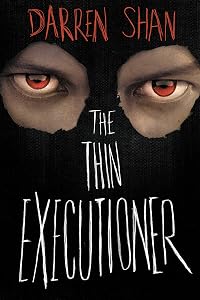
The Thin Executioner
by Darren Shan
On This Page
Description
In a nation of warriors where weakness is shunned and all crimes, no matter how minor, are punishable by beheading, young Jebel Rum, along with a slave who is fated to be sacrificed, sets forth on a quest to petition the Fire God for invincibility, but when the long and arduous journey is over, Jebel has learned much about fairness and the value of life.Tags
Recommendations







Member Reviews
Among the Um Aineh, being the son of the executioner is almost as good as being the son of the king. In a world of warriors where strength and honor are valued above all, even the youngest son of the executioner, Jebel Rum, can't get the respect he thinks he deserves with a tiny frame. He sets off on a quest to save his honor, a quest that will require him to travel the length of Makhras with a slave by his side, a slave he must sacrifice to Sabbah Eid. In return he'll be granted invincibility that will allow him to beat any man in competition or combat and gain the confidence and respect of his father and his people.
The society in which Jebel has been raised is exceedingly violent. The executioner is an exalted member of society in the show more way that movie stars are exalted in ours. They are not only men who mete out "justice," but also the providers of entertainment. Anyone convicted of any crime is executed; the Um Aineh have no jails and don't really hold much regard for human life. And their slaves aren't even considered human. Slaves live in their own section of the city where the living conditions are very degraded, can be beaten without recourse, and can be sentenced to death at the wish of their owner for any reason or none at all. Tel Hesani volunteers to accompany Jebel on his quest, knowing he will be executed at the end of it, to free his wife and children from this existence.
Once Jebel and Tel Hesani are on the road, Jebel depends on Tel Hesani's knowledge of the world and other people in it to survive, but still treats him with disdain. Because Jebel is eager to spend time with people like himself, meaning not slaves like Tel Hesani, they end up in quite a few compromising situations. The trials and tribulations of traveling through Makhras add up quickly, much more quickly than the change of heart I was expecting from Jebel. Tel Hesani saves him time and time again, and yet he's still valued as slightly more than a piece of shit by Jebel. About halfway through the book, I had to set it aside. Jebel's attitude is a lot to take. It isn't until Jebel and Tel Hesani are separated and Jebel gets to experience the life of a slave for himself that his ideas about slavery, human life, and Tel Hesani begin to change. When they're finally reunited, they continue on the quest, but Jebel (finally) seriously doubts whether he'll be able to kill Tel Hesani in the name of a god he's not sure is real in exchange for supernatural powers that may or may not exist.
The Thin Executioner is a long book, and I think that a lot of the obstacles Jebel and Tel Hesani meet on their way to Sabbah Eid could have been cut out without risking important plot points or character development. Still, it can be a gripping story. I had a hard time being in Jebel's head for so much of the book when he was such a self-centered jerk, but the payout is worth it in the end. If like me, you're suffering from post-Mockingjay pre-Monsters of Men malaise, The Thin Executioner just might soothe your gratuitous-violence-with-a-message seeking soul for a little while.
If LibraryThing is to be believed, Shan dedicated this book to the country of Jordan "which inspired much of this book's setting and plot, and whose landmarks provided the names of all the characters (with three exceptions) and places" (my ARC doesn't have the dedications page). Jebel also describes his crush as "slim and curvy, with long legs, even longer hair, dazzling brown eyes and teeth so white they might have been carved from shards of the moon. Her skin was a beautiful dark brown color" (2).* He also repeatedly describes the off-putting paleness of Tel Hesani's people. Based on these three things and a vague memory of a description of Jebel himself, I'm thinking Jebel and the rest of the Um Aineh are middle eastern, making this a fantasy book featuring POC! A rare and wonderful thing!
Book source: ARC provided by publisher via yalsa-bk.
* All quotes and page numbers are taken from an Advanced Reading Copy and do not necessarily match the published copy. show less
The society in which Jebel has been raised is exceedingly violent. The executioner is an exalted member of society in the show more way that movie stars are exalted in ours. They are not only men who mete out "justice," but also the providers of entertainment. Anyone convicted of any crime is executed; the Um Aineh have no jails and don't really hold much regard for human life. And their slaves aren't even considered human. Slaves live in their own section of the city where the living conditions are very degraded, can be beaten without recourse, and can be sentenced to death at the wish of their owner for any reason or none at all. Tel Hesani volunteers to accompany Jebel on his quest, knowing he will be executed at the end of it, to free his wife and children from this existence.
Once Jebel and Tel Hesani are on the road, Jebel depends on Tel Hesani's knowledge of the world and other people in it to survive, but still treats him with disdain. Because Jebel is eager to spend time with people like himself, meaning not slaves like Tel Hesani, they end up in quite a few compromising situations. The trials and tribulations of traveling through Makhras add up quickly, much more quickly than the change of heart I was expecting from Jebel. Tel Hesani saves him time and time again, and yet he's still valued as slightly more than a piece of shit by Jebel. About halfway through the book, I had to set it aside. Jebel's attitude is a lot to take. It isn't until Jebel and Tel Hesani are separated and Jebel gets to experience the life of a slave for himself that his ideas about slavery, human life, and Tel Hesani begin to change. When they're finally reunited, they continue on the quest, but Jebel (finally) seriously doubts whether he'll be able to kill Tel Hesani in the name of a god he's not sure is real in exchange for supernatural powers that may or may not exist.
The Thin Executioner is a long book, and I think that a lot of the obstacles Jebel and Tel Hesani meet on their way to Sabbah Eid could have been cut out without risking important plot points or character development. Still, it can be a gripping story. I had a hard time being in Jebel's head for so much of the book when he was such a self-centered jerk, but the payout is worth it in the end. If like me, you're suffering from post-Mockingjay pre-Monsters of Men malaise, The Thin Executioner just might soothe your gratuitous-violence-with-a-message seeking soul for a little while.
If LibraryThing is to be believed, Shan dedicated this book to the country of Jordan "which inspired much of this book's setting and plot, and whose landmarks provided the names of all the characters (with three exceptions) and places" (my ARC doesn't have the dedications page). Jebel also describes his crush as "slim and curvy, with long legs, even longer hair, dazzling brown eyes and teeth so white they might have been carved from shards of the moon. Her skin was a beautiful dark brown color" (2).* He also repeatedly describes the off-putting paleness of Tel Hesani's people. Based on these three things and a vague memory of a description of Jebel himself, I'm thinking Jebel and the rest of the Um Aineh are middle eastern, making this a fantasy book featuring POC! A rare and wonderful thing!
Book source: ARC provided by publisher via yalsa-bk.
* All quotes and page numbers are taken from an Advanced Reading Copy and do not necessarily match the published copy. show less
The Thin Executioner has been sitting on my bookshelf for a while now. I decided to pick it up since I haven't seen many reviews of it. And just as the summary says, this story really was a lot like The Adventures of Huckleberry Finn. I liked it, but not all of it.
Jebel Rum is the runt of his family. His father, the greatest executioner in Wadi, is about to retire and is placing his two older sons in a battle to determine the new executioner. Jebel is disgraced, his father gave a speech to everyone in Wadi, and Jebel's name wasn't even mentioned. To earn back his honor and clear his name, Jebel sets out to quest for Tubaygat, where he will petition a god, sacrifice a slave, and be granted invincibility.
I hated Jebel Rum from the show more start. He was so full of himself and had no respect for his slave. It's not entirely his fault, since he was taught that slaves can never be equals. But as Jebel and Tel Hesani (his humble and caring slave) travel the treacherous eight-ten month journey, Jebel starts to think of Tel Hesani... as a friend. Jebel changes a lot - for the better. I started to like him as he realized his teachings and harsh upbringings were wrong.
Up until about 400 or so pages, I was almost certain I would give The Thin Executioner two or three stars. There was too much blood and gore. I usually like those types of books, but this one was so extreme, in certain places I felt like puking. But the story has a beautiful ending, one that nearly brought me to tears, one that I didn't know the famed blood and gore author Darren Shan was capable of. Overall, you're in for a story that can sometimes be predictable, but will definitely leave you smiling.
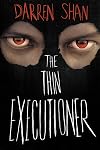
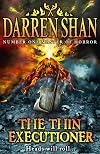
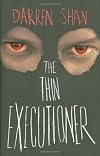
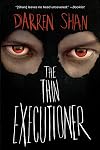
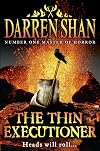
The cover is very creepy. Not so much in the image. But when you have the book in your hands, those eyes are almost lifelike. However, it does resemble an executioner's mask, so it's a cover wholly related to the story. show less
Jebel Rum is the runt of his family. His father, the greatest executioner in Wadi, is about to retire and is placing his two older sons in a battle to determine the new executioner. Jebel is disgraced, his father gave a speech to everyone in Wadi, and Jebel's name wasn't even mentioned. To earn back his honor and clear his name, Jebel sets out to quest for Tubaygat, where he will petition a god, sacrifice a slave, and be granted invincibility.
I hated Jebel Rum from the show more start. He was so full of himself and had no respect for his slave. It's not entirely his fault, since he was taught that slaves can never be equals. But as Jebel and Tel Hesani (his humble and caring slave) travel the treacherous eight-ten month journey, Jebel starts to think of Tel Hesani... as a friend. Jebel changes a lot - for the better. I started to like him as he realized his teachings and harsh upbringings were wrong.
Up until about 400 or so pages, I was almost certain I would give The Thin Executioner two or three stars. There was too much blood and gore. I usually like those types of books, but this one was so extreme, in certain places I felt like puking. But the story has a beautiful ending, one that nearly brought me to tears, one that I didn't know the famed blood and gore author Darren Shan was capable of. Overall, you're in for a story that can sometimes be predictable, but will definitely leave you smiling.
The cover is very creepy. Not so much in the image. But when you have the book in your hands, those eyes are almost lifelike. However, it does resemble an executioner's mask, so it's a cover wholly related to the story. show less
Let me start off saying i love darren shan's books! i love how they are filled with adventure gore and humor! that being said this book is good but it dosen't stand up to the standards of his others. One of the things i disiked was the charcter tel hesani he was waaaaay to perfect. I mean there is no way in this whole book that he would say something to make you dislike him! Also i didn't understand why he put 'Bush' (George w bush) and 'Blair' (tony blair in the books. It seems odd because this wasnt a political statement book at least thats not what i got from it! and it just seemed an odd way to throw your veiws into a book as such. It almost seemed tricky too me but maybe i'm reading too much into it! that being said i loved the show more adventure too the book and all the little villiages they saw! The ending was also a twist and very good. Some of the book did drag on but for the most part good adventure! the only reason i didn't give this book 4 stars is because i know darren shan wrote better than this. so three stars! show less
Reviewed by Randstostipher "tallnlankyrn" Nguyen for TeensReadToo.com
Regardless of his size, Jebel Rum has always wanted to be the successor of his father as the executioner for his tribe, a profession that is somewhat honored and entertaining. It doesn't help when you have two older brothers who would be better fitted for the job. To make things worse, Jebel's dreams are quickly crushed when his own father does not see him as a contender.
What is Jebel's solution to this problem? Find the god who will give him the power of invincibility, which will ultimately help him win the tournament against his brothers that will make him the executioner. Along with Jebel on his travels is the slave who decided to go with him, Tel Hesani, who must show more be sacrificed to the god in order to obtain a better life for his family.
THE THIN EXECUTIONER is full of weird but somewhat relatable teen angst, a journey that not only will prove difficult for Jebel but also will allow him to grow stronger. It also includes an accomplice who becomes more than what people at that time would think of as an object. Jebel will soon discover that what lays outside his tribe is something worth experiencing.
Away from the vampires and demons, Darren Shan crafts a unique and compelling story that will take readers into a whole new world they would never have imagined. Jebel is one of those characters that gives a bad impression in the beginning. Of course, his non-ethical, guiltless personality is not his fault, as such traits are actually embedded in the minds of those in his tribe.
However, Jebel's growth throughout the novel to the very end allows readers to be as comfortable with him as they are with Tel Hesani, the more likeable character who most readers will automatically respect. Both characters will endure a difficult and at times deadly journey, and in the end Jebel, Tel Hesani, and even the reader will be rewarded with a conclusion that is unusual but all the more satisfying. show less
Regardless of his size, Jebel Rum has always wanted to be the successor of his father as the executioner for his tribe, a profession that is somewhat honored and entertaining. It doesn't help when you have two older brothers who would be better fitted for the job. To make things worse, Jebel's dreams are quickly crushed when his own father does not see him as a contender.
What is Jebel's solution to this problem? Find the god who will give him the power of invincibility, which will ultimately help him win the tournament against his brothers that will make him the executioner. Along with Jebel on his travels is the slave who decided to go with him, Tel Hesani, who must show more be sacrificed to the god in order to obtain a better life for his family.
THE THIN EXECUTIONER is full of weird but somewhat relatable teen angst, a journey that not only will prove difficult for Jebel but also will allow him to grow stronger. It also includes an accomplice who becomes more than what people at that time would think of as an object. Jebel will soon discover that what lays outside his tribe is something worth experiencing.
Away from the vampires and demons, Darren Shan crafts a unique and compelling story that will take readers into a whole new world they would never have imagined. Jebel is one of those characters that gives a bad impression in the beginning. Of course, his non-ethical, guiltless personality is not his fault, as such traits are actually embedded in the minds of those in his tribe.
However, Jebel's growth throughout the novel to the very end allows readers to be as comfortable with him as they are with Tel Hesani, the more likeable character who most readers will automatically respect. Both characters will endure a difficult and at times deadly journey, and in the end Jebel, Tel Hesani, and even the reader will be rewarded with a conclusion that is unusual but all the more satisfying. show less
I read this book in one long sitting, on a train.
This one is great. I've read about eighteen of Shan's work, and I could see resemblance and difference aplenty. There was little over the top salughter such as in the demonata, more positivity than in the Darren shan series, but you still got that "Oh" moment of someone being horrible. I simply cannot recommend this book enough.
This one is great. I've read about eighteen of Shan's work, and I could see resemblance and difference aplenty. There was little over the top salughter such as in the demonata, more positivity than in the Darren shan series, but you still got that "Oh" moment of someone being horrible. I simply cannot recommend this book enough.
A relatively straight-forward YA hero's journey and ultimately rather predictable. Well written and rather graphic in its violence, but an interesting set of cultures and world. I enjoyed and will read more of the author's work.
I liked this book. Darren Shan is a good story teller. In this book we read about Jebel Rum and his quest to rpove himself to his father, brothers and all his people. Jebel decides to seek nealry limitless power by questing to the home of the Fire God and and once there to sacrifice a slave. Of course, the journey changes Jebel as he experiences the world beyond his own sheltered upbringing.
Reading this book has brought, once more to mind, the idea that we read the same stories over and over again. We must be missing something, so that we continue to look for clues within the stories we read. I wonder if we find the answers we are looking for if we will still find the need to read the same stories?
Reading this book has brought, once more to mind, the idea that we read the same stories over and over again. We must be missing something, so that we continue to look for clues within the stories we read. I wonder if we find the answers we are looking for if we will still find the need to read the same stories?
Members
- Recently Added By
Author Information

177+ Works 36,360 Members
Darren Shan was born in 1972 in London. At the age of 6 he moved with his parents and younger brother, to Limerick, Ireland, where he has lived ever since. Darren saw first literary success at age 15, as a runner-up in a television script-writing competition with a dark comedy titled A Day in the Morgue. He was 17 when he finished his first novel. show more Although it was never published, he found himself focusing more on novels than on short stories. In January 2000, Darren's first children's book, Cirque du Freak was published. The first book in a series titled The Saga of Darren Shan, or Cirque du Freak, as it's known in America, received rave reviews. His books have been children's bestsellers in America, Britain, Ireland, the Netherlands, Norway and other countries. In addition to his children's books he writes for adults as well and has had several adult books published including Procession of the Dead, Hell's Horizon, and City of the Snakes. Darren Shan spends most of his time in Limerick, Ireland. (Bowker Author Biography) show less
Common Knowledge
- Original publication date
- 2010-04-29
- Dedication
- For: Jebel Rum's beloved
OBEs (Order of the Bloody Entrails) to: The country of Jordan, which inspired much of this book's setting and plot, and whose landmarks provided the names of all the characters (with three exceptions) and places
Stella Paskins honed the editorial blade for the final time
The Um Little put their heads on the chopping block next to mine, as always
Classifications
Statistics
- Members
- 406
- Popularity
- 76,738
- Reviews
- 17
- Rating
- (3.95)
- Languages
- English, Hungarian
- Media
- Paper, Ebook
- ISBNs
- 11
- ASINs
- 4