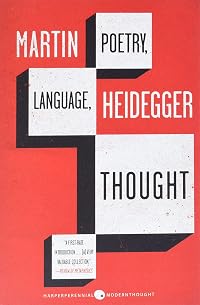
Poetry, Language, Thought
by Martin Heidegger
On This Page
Description
"Collects Martin Heidegger's pivotal writings on art, its role in human life and culture, and its relationship to thinking and truth"--Publisher description.Tags
Recommendations



Member Reviews
Seven essays on poetry and the arts from German philosopher Martin Heidegger (1889-1976) are collected here, including his key work on aesthetics, “The Origin of a Work of Art”. However, for the purposes of this review I will focus on his less well-known essay, “What Are Poets For?” Here are several direct Heidegger quotes followed by my microfiction serving as a tribute to what I take to be much of the spirit of this essay:
“Being, which holds all beings in the balance, thus always draws particular beings toward itself – toward itself at the center.”
“Everything that is ventured is, as such and such a being, admitted into the whole of beings, and reposes in the ground of the whole.”
“The widest orbit of beings becomes show more present in the heart’s inner space. The whole of the world achieves here an equally essential presence in all its drawings.”
“The objectness of the world remains reckoned in that manner of representation which deals with time and space as quanta of calculation, and which can know no more of the nature of time than of the nature of space.”
“The conversion of consciousness is an inner recalling of the immanence of the objects of representation into presence within the heart’s space.”
-------------------
The Poetry Bar
Thirsty, I enter a bar that’s dark, smoky and crowded, squeeze through and perch on a bar stool at the end closest the door, cross my arms on the counter and scan the faces of those around me. Many of the people are reading from sheets of paper, some reading silently, some muttering words aloud and still others reading to one another. The bartender approaches and asks me what I want, to which I, in turn, ask what he has on tap.
The bartender replies, “Most anything – Byron, Blake, Stevens, Frost, Browning, William Carlos Williams, you name it.”
So, it’s poetry rather than beer. I’m still thirsty but at least for now I tell him that I’ll take a Frost. The bartender obliges by handing me a copy of ‘Stopping by Woods on a Snowy Evening’.
I read the first stanza quickly then take my time reading the next three. I pause and look over at one of the crowded booths: six men with beards and black T-shirts are huddled together listening as their leader reads aloud from what I recognized as Alan Ginsburg’s ‘Howl’. The bartender was right – they do have most everything here.
I bend my head and begin to reread the first stanza of Frost when I hear great sobs from across the bar. A man with a ruddy complexion and a Scottish brogue is trying to recite Robert Burns but is having trouble because he keeps breaking down and crying. Another patron knocks roughly against me and then staggers through the door. Looking out the large front window I watch as he crosses the street, oblivious to cars and busses, as if lifted out of himself by an otherworldly ecstasy.
The bartender taps me on the elbow. When I turn he nods knowingly and tells me he always tries his best to keep an eye on anyone overdoing it. show less
The nature of poetry, which has now been ascertained very broadly--but not on that account vaguely, may here be kept firmly in mind as something worthy of questioning, something that still has to be thought through.
The above is lifted from The Origin of the Work of Art, the second piece and first essay of this bewildering collection. Overall Poetry, Language, Thought was the most difficult text I've finished since https://www.goodreads.com/book/show/218870.Language_Counter_Memory_Practice last summer. I read nearly every page four times. I feel as if i know all the components by name and function but have lost the instruction manual. Thus I dither.
The second essay What Are Poets For left my reason blinded, a darkened room where I could show more appreciate Holderlin but make no sense of anything further. Building Dwelling Thinking with the deliberate absence of commas was my favorite. Afterwards there is 1950 letter from Heidegger to a young student reprinted towards the end. He advises. Practice needs craft. Stay on the path, in genuine need, and learn the craft of thinking, unswerving, yet erring.
Sage advice, this reader hopes to continue.
Following Beckett I aspire to fail better. show less
The above is lifted from The Origin of the Work of Art, the second piece and first essay of this bewildering collection. Overall Poetry, Language, Thought was the most difficult text I've finished since https://www.goodreads.com/book/show/218870.Language_Counter_Memory_Practice last summer. I read nearly every page four times. I feel as if i know all the components by name and function but have lost the instruction manual. Thus I dither.
The second essay What Are Poets For left my reason blinded, a darkened room where I could show more appreciate Holderlin but make no sense of anything further. Building Dwelling Thinking with the deliberate absence of commas was my favorite. Afterwards there is 1950 letter from Heidegger to a young student reprinted towards the end. He advises. Practice needs craft. Stay on the path, in genuine need, and learn the craft of thinking, unswerving, yet erring.
Sage advice, this reader hopes to continue.
Following Beckett I aspire to fail better. show less
Seven essays on poetry and the arts from German philosopher Martin Heidegger (1889-1976) are collected here, including his key work on aesthetics, The Origin of a Work of Art. However, for the purposes of this review I will focus on his less well-known essay, What Are Poets For?” Here are several direct Heidegger quotes followed by my micro-fiction serving as a tribute to what I take to be much of the spirit of this essay:
“Being, which holds all beings in the balance, thus always draws particular beings toward itself – toward itself at the center.”
“Everything that is ventured is, as such and such a being, admitted into the whole of beings, and reposes in the ground of the whole.”
“The widest orbit of beings becomes present show more in the heart’s inner space. The whole of the world achieves here an equally essential presence in all its drawings.”
“The objectness of the world remains reckoned in that manner of representation which deals with time and space as quanta of calculation, and which can know no more of the nature of time than of the nature of space.”
“The conversion of consciousness is an inner recalling of the immanence of the objects of representation into presence within the heart’s space.”
-------------------
THE POETRY BAR
Thirsty, I enter a bar that’s dark, smoky and crowded, squeeze through and perch on a bar stool at the end closest the door, cross my arms on the counter and scan the faces of those around me. Many of the people are reading from sheets of paper, some reading silently, some muttering words aloud and still others reading to one another. The bartender approaches and asks me what I want, to which I, in turn, ask what he has on tap.
The bartender replies, “Most anything – Byron, Blake, Stevens, Frost, Browning, William Carlos Williams, you name it.”
So, it’s poetry rather than beer. I’m still thirsty but at least for now I tell him that I’ll take a Frost. The bartender obliges by handing me a copy of ‘Stopping by Woods on a Snowy Evening’.
I read the first stanza quickly then take my time reading the next three. I pause and look over at one of the crowded booths: six men with beards and black T-shirts are huddled together listening as their leader reads aloud from what I recognized as Alan Ginsburg’s ‘Howl’. The bartender was right – they do have most everything here.
I bend my head and begin to reread the first stanza of Frost when I hear great sobs from across the bar. A man with a ruddy complexion and a Scottish brogue is trying to recite Robert Burns but is having trouble because he keeps breaking down and crying. Another patron knocks roughly against me and then staggers through the door. Looking out the large front window I watch as he crosses the street, oblivious to cars and busses, as if lifted out of himself by an otherworldly ecstasy.
The bartender taps me on the elbow. When I turn he nods knowingly and tells me he always tries his best to keep an eye on anyone overdoing it. show less
This has to be another of my all-time changed-my-life in terms of looking at things books. I like that it begins with poetry and the commentary on art and ends with commentary on, and some pieces of, poetry.
Presents Heiddegger's aesthetic view of Being and Dasein. Curiously, he moves from "poetry" and the purpose of a poet, to construction, and the building of dwellings.
How in the world could one possibly give a star-based rating to anything by Heidegger? I did attempt a bit of discussion here:https://zwieblein.bearblog.dev/the-flash-bang-of-quick-reading/
translators intro and Chap 2 for class
Members
- Recently Added By
Author Information

463+ Works 23,599 Members
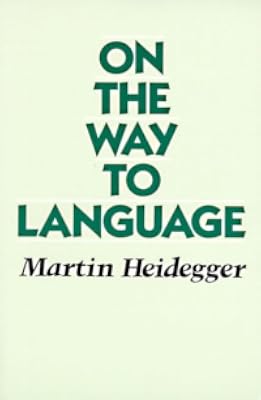
Martin Heidegger was born in Messkirch, Baden, Germany on September 22, 1889. He studied Roman Catholic theology and philosophy at the University of Frieburg before joining the faculty at Frieburg as a teacher in 1915. Eight years later Heidegger took a teaching position at Marburg. He taught there until 1928 and then went back to Frieburg as a show more professor of philosophy. As a philosopher, Heidegger developed existential phenomenology. He is still widely regarded as one of the most original philosophers of the 20th century. Influenced by other philosophers of his time, Heidegger wrote the book, Being in Time, in 1927. In this work, which is considered one of the most important philosophical works of our time, Heidegger asks and answers the question "What is it, to be?" Other books written by Heidegger include Basic Writings, a collection of Heidegger's most popular writings; Nietzsche, an inquiry into the central issues of Friedrich Nietzsche's philosophy; On the Way to Language, Heidegger's central ideas on the origin, nature and significance of language; and What is Called Thinking, a systematic presentation of Heidegger's later philosophy. Since the 1960s, Heidegger's influence has spread beyond continental Europe and into a number of English-speaking countries. Heidegger died in Messkirch on May 26, 1976. (Bowker Author Biography) show less
Some Editions
Series
Belongs to Publisher Series
Common Knowledge
- Canonical title
- Poetry, Language, Thought
- Original publication date
- 1950-1976 (original German) (original German); 1971 (English collection) (English collection)
- People/Characters
- Martin Heidegger
Classifications
- Genres
- Philosophy, Literature Studies and Criticism, Fiction and Literature, Nonfiction
- DDC/MDS
- 808.1 — Literature & rhetoric Literature, rhetoric & criticism Rhetoric and collections of literary texts from more than two literatures Rhetoric of poetry
- LCC
- PN1031 .H38 — Language and Literature Literature (General) Literature (General) Poetry Theory, philosophy, relations, etc.
- BISAC
Statistics
- Members
- 1,409
- Popularity
- 16,861
- Reviews
- 7
- Rating
- (4.22)
- Languages
- English
- Media
- Paper
- ISBNs
- 4
- ASINs
- 6