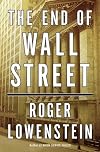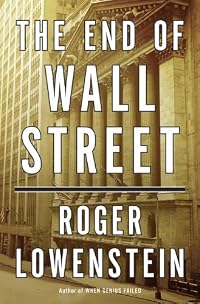
The End of Wall Street
by Roger Lowenstein
On This Page
Description
The roots of the mortgage bubble, the story of the Wall Street collapse, and the government's unprecedented response are captured in this blow-by-blow account of "the end of Wall Street" by one of our most trusted business journalists.Tags
Recommendations

Member Reviews
A highly readable narrative of the conditions that led to the crash, the reactions (or non-reactions) of major business and governmental actors, and the mop-up operations that handed public money to private interests. I wish his 'afterword' had been a bit more detailed; for instance, it's 2012, we're in a world of record corporate profits (again) and stagnant wages (again), most economic indicators show us slipping into recession (again)- only this time the U.S. government is already in huge debt. Not a very comfortable time, and Lowenstein's the kind of guy who could probably help explain it. Maybe in another book?
Two small faults: first, it's focused entirely on the U.S., which is a shame, but then, it would have been 800 pages long show more if he'd tried to describe the international repercussions of this shitstorm. Second, sometimes the stories are a bit too detailed, given how similar they are were. But it's so readable that I didn't mind that too much. show less
Two small faults: first, it's focused entirely on the U.S., which is a shame, but then, it would have been 800 pages long show more if he'd tried to describe the international repercussions of this shitstorm. Second, sometimes the stories are a bit too detailed, given how similar they are were. But it's so readable that I didn't mind that too much. show less
I have read a few books about our recent debacle and this one is excellent. It is also the most up to date. One important thing to think about this. Financial firms have taken on a much greater importance in our economy then they used to. Unfortunately, their negative actions have a much greater impact on us then the misdeeds of other sectors of the economy. When people like Jamie Dimon of JP Morgan complain about changes that will negatively impact his bank's profits, I say a big "who cares". You made so much more money then you deserved relative to your importance so that it is time that banking take its appropriate place in our economy. They have shown themselves to be bad examples of capitalism and deserve the negative consequences show more of any financial reforms that may come out of Congress. show less
Just a terrible, short-sighted, intellectually lazy book. As a review of the crisis, there are much better ones out there. And as far as analyzing this debacle, Lowenstein seems far too interested in laying blame at the door of the irresponsible schmucks who took the loans. No one in the public at large was counting on them for anything. We WERE counting on bank executives to be motivated by something other than short-sighted greed. His main interest in the book seems to be to take the blame off Wall Street as much as possible for what happened in the 2000s. He's an apologist.
Important, interesting and pretty compelling as a narrative. Extra points for the hidden being exposed.
The incompetence! - possible genuine, possibly arranged. Got the poor nice and fucked, again.
The incompetence! - possible genuine, possibly arranged. Got the poor nice and fucked, again.
Well written. It certainly provides an inside perspective on the financial melt-down events of 2008.
Lowenstein does a good job of taking the very complex and boiling it down to something accessible to most.
Lowenstein's credentials as a working reporter have been evident in his work. In "The End of Wall Street" he tells the tale of the recent financial melt down succently yet thouroughly.
Without "over editorialising" he allows the facts to speak for themselves.
An enjoyable entertaing read.
Without "over editorialising" he allows the facts to speak for themselves.
An enjoyable entertaing read.
Members
- Recently Added By
Author Information

10+ Works 3,955 Members
Roger Lowenstein, author of the bestselling Buffett: The Making of an American Capitalist, reported for The Wall Street Journal for over a decade and wrote the stock-market column "Heard on the Street" from 1989 to 1991 and the "Intrinsic Value" column from 1995 to 1997. He now writes a column in SmartMoney magazine and has written for The New show more York Times and The New Republic, among other publications. He has three children and lives in Westfield, New Jersey. (Bowker Author Biography) show less
Awards and Honors
Distinctions
Common Knowledge
- Canonical title
- The End of Wall Street
- Original publication date
- 2010
- Dedication
- To Judy, who saw me through this and more
- First words
- (Introduction) In the late summer of 2008, as Lehman Brothers teetered at the edge, a bell tolled for Wall Street.
(Prologue: Early Warning) It was early in 2006, on Lincoln's Birthday, that Bob Rodriguez had the dream.
Most of the booms of recent decades were financed by private sector companies such as technology promoters, or Wall Street banks, or oil drillers. - Last words
- (Click to show. Warning: May contain spoilers.)He survived to compete another day.
Classifications
Statistics
- Members
- 331
- Popularity
- 95,595
- Reviews
- 11
- Rating
- (3.78)
- Languages
- English
- Media
- Paper, Audiobook, Ebook
- ISBNs
- 9
- ASINs
- 5