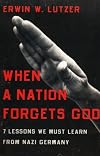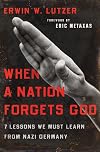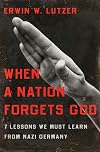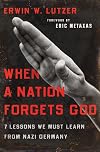
When a Nation Forgets God: 7 Lessons We Must Learn from Nazi Germany
by Erwin W. Lutzer
On This Page
Description
The people of Nazi Germany weren't any more barbaric, uncivilized, or depraved than any other Western nation of the early Twentieth Century, yet the Nazi regime will forever serve as an example of brutality and extreme racism run amok. What led so many people to such extreme ends? According to Dr. Lutzer, the German people's progression from civility to barbarity was not extraordinary, and more than a few benchmarks from their transition can be observed in present day American society. show more --from publisher description. show lessTags
Recommendations






































Member Reviews
I decided to reread this upon seeing the movie "Bonhoffer" last week. The movie was "okay." There was a 2013 version (Bonhoffer, Agent of Grace) that I thought was better. The 2024 version was more sanitized. Lutzer draws parallels between the moral decline in Germany and the erosion of ethical values in contemporary cultures. He identifies seven crucial lessons, including the consequences of ignoring moral absolutes, the power of propaganda, and the role of the church in resisting evil. Lutzer warns against complacency and encourages vigilance against the gradual undermining of religious and moral foundations. The author draws upon writings and speeches (sermons) by Hitler, Bonhoffer, and Niemoller. 160 pages
When a Nation Forgets God: 7 Lessons We Must Learn From Nazi Germany by Erwin Lutzer, compares the things that started Germany on the path to becoming Nazi Germany to things that are happening in America. The path that Germany took turns out to be eerily similar to the one America is taking.
The Germans wanted a political savior. Along came Hitler to fix the economy, take care of their children, and protect them from dangerous things and people(which in their view included Jews). They wanted someone who would make them feel patriotic again and proud of their country rather than humiliated as they felt after World War one. Hitler came along and did just that.
Many Christian went right along with it, and patriotism began to be substituted show more for Christianity, especially as Hitler couched patriotism in a Christian light. There was "positive Christianity" and a movement called, "God believers" where people could find that the state could be a good substitute for the church in many (or all) aspects of life.
I think that the parallels between the Germany of the 1930s-40s and America today are fascinating and instructive, and that we truly can learn lessons from the past. I just have a bit of a problem with Lutzer saying that, "We need to develop a 'theology of civil disobedience' ; that is, we need to think through this question: When do we tolerate the curtailment of our freedoms and at what point should we speak and act? " To me that statement seems along the lines of saying that wives need to develop a "theology of disobedience to husbands", or saying that children need to develop a "theology of disobedience to parents". I wish that Lutzer had worded that differently. Though I agree, of course, that there is a place for disobeying government if that government tells us to deny Christ, worship other gods, or have abortions to control the numbers of the population…etc. these things go against God's Word.
Also, Lutzer seems to view Dietrich Bonhoeffer as a martyr for the cause of Christianity. Though I do believe he was a Christian, I do not see historical evidence that he was killed because he was a Christian. Lutzer himself says that Bonhoeffer would, "eventually become a martyr for his part in a conspiracy to assassinate Hitler." I do not know if one can make a legitimate biblical case for assassinating a leader whom God has put over you. We need to remember that Nero (who was a pretty horrible and murderous man) was in charge when Paul wrote, "Let everyone be subject to the governing authorities, for there is no authority except that which God has established. The authorities that exist have been established by God." (Romans 13:1). We know that this does not mean that we obey them when they go against God's law, but I do not see that we can gain a biblical validation for making the murder of any political governor whom God has placed over us into a Christian act- no matter how bad the man is. This is probably not the idea that Lutzer meant to convey, I just felt as though I needed to address it.
Anyway, I do think that this is an interesting book overall, and I especially like how Lutzer points out that we do not need to "win" the ideological battles with our culture (thought we certainly do try), our homeland isn't here anyway. God's ultimate rule and victory is sure, though we need not see it now. We need to stand firm and obey God rather than man if man tells us to disobey God.
To me this book seemed like an abridgment of Lutzer's other book, "Hitler's Cross", which I liked quite well. I would recommend reading that book if you would like a fuller look into the Nazi Germany and modern America comparison, especially in its dealing in more detail with how corrupt churches became in Nazi Germany and how politicized, eventually losing any of the true Christianity they ever exhibited.
Many thanks to the folks at Moody Publishers for sending me a free review copy of this book (My review did not have to be favorable). show less
The Germans wanted a political savior. Along came Hitler to fix the economy, take care of their children, and protect them from dangerous things and people(which in their view included Jews). They wanted someone who would make them feel patriotic again and proud of their country rather than humiliated as they felt after World War one. Hitler came along and did just that.
Many Christian went right along with it, and patriotism began to be substituted show more for Christianity, especially as Hitler couched patriotism in a Christian light. There was "positive Christianity" and a movement called, "God believers" where people could find that the state could be a good substitute for the church in many (or all) aspects of life.
I think that the parallels between the Germany of the 1930s-40s and America today are fascinating and instructive, and that we truly can learn lessons from the past. I just have a bit of a problem with Lutzer saying that, "We need to develop a 'theology of civil disobedience' ; that is, we need to think through this question: When do we tolerate the curtailment of our freedoms and at what point should we speak and act? " To me that statement seems along the lines of saying that wives need to develop a "theology of disobedience to husbands", or saying that children need to develop a "theology of disobedience to parents". I wish that Lutzer had worded that differently. Though I agree, of course, that there is a place for disobeying government if that government tells us to deny Christ, worship other gods, or have abortions to control the numbers of the population…etc. these things go against God's Word.
Also, Lutzer seems to view Dietrich Bonhoeffer as a martyr for the cause of Christianity. Though I do believe he was a Christian, I do not see historical evidence that he was killed because he was a Christian. Lutzer himself says that Bonhoeffer would, "eventually become a martyr for his part in a conspiracy to assassinate Hitler." I do not know if one can make a legitimate biblical case for assassinating a leader whom God has put over you. We need to remember that Nero (who was a pretty horrible and murderous man) was in charge when Paul wrote, "Let everyone be subject to the governing authorities, for there is no authority except that which God has established. The authorities that exist have been established by God." (Romans 13:1). We know that this does not mean that we obey them when they go against God's law, but I do not see that we can gain a biblical validation for making the murder of any political governor whom God has placed over us into a Christian act- no matter how bad the man is. This is probably not the idea that Lutzer meant to convey, I just felt as though I needed to address it.
Anyway, I do think that this is an interesting book overall, and I especially like how Lutzer points out that we do not need to "win" the ideological battles with our culture (thought we certainly do try), our homeland isn't here anyway. God's ultimate rule and victory is sure, though we need not see it now. We need to stand firm and obey God rather than man if man tells us to disobey God.
To me this book seemed like an abridgment of Lutzer's other book, "Hitler's Cross", which I liked quite well. I would recommend reading that book if you would like a fuller look into the Nazi Germany and modern America comparison, especially in its dealing in more detail with how corrupt churches became in Nazi Germany and how politicized, eventually losing any of the true Christianity they ever exhibited.
Many thanks to the folks at Moody Publishers for sending me a free review copy of this book (My review did not have to be favorable). show less
This review can also be found on www.thispilgrimland.com THIS BOOK IS GREAT!!!! That should sum up my thoughts on this new publication from Erwin W. Lutzer, senior pastor of Moody Church, and Moody Publishers. Three sittings and 48 hours later I have now finished this stroke of genius. Lutzer writes, "I believe it is disingenuous when political opponents here in the United States call those who disagree with them "Nazis" or "Hitler." That alone told me this book was going to be different from the normal conservative speak that comes from so many in our churches today and that this book would not contain the finger-pointing and name-calling that I have quite frankly grown sick of. No, in a very tactful and succinct way, Lutzer in 141 show more pages points the reader to the facts, documents, and Christian writers who lived through the Nazi regime and uses their experiences and warning to parallel some of what many Americans see today as the abandonment of our countries inhibited history. In chapters named such as "When God is Separated from Government, Judgment Follows," "It's Always the Economy," & "That Which is Legal Might Also be Evil," Lutzer uses historical evidence to remind us that ideological and philosophical takeover is not done over night, but is rather a systematic and expertly crafted formula. This leads to his last chapter. As I stated above, what drew me into this book was Lutzer's refusal to point fingers at our contemporaries. That remained so until the final chapter. In the final chapter, Lutzer removes his gloves and begins throwing punches. Not at Obama or Pelosi. Not at Bush or Glenn Beck. Not at CNN or Fox News. No,Lutzer, and rightfully so, comes directly into the face of today's Christian. Building off of Dietrich Bonhoeffer's famous "Confess, Confess, Confess" radio address in Nazi Germany, Lutzer jumps into the face of today's Christian. He reminds us that the only way Nazi Germany was allowed to take place was because the Christians, primarily the pastors and preachers, in that area decided to bow to the Reich and hide the cross of our Lord Jesus Christ. Pointing out the compromise that is already taking place today in the church, Lutzer unabashedly calls these wolves in sheep's clothing to repentance. I personally pledged to myself to read this last chapter everyday for the next month because therein lies, outside of scripture, one of the most powerful sentences I have read in some time. Lutzer writes: "In an effort to be 'relevant,' we now face the temptation of being diverted from our mission and becoming involved doing what is good while bypassing what is best." Stop reading, back up, and read that sentence again. I personally read it three times to myself and three times to my wife I was so taken by those words. Lutzer's final plea is to return to the cross. In our teaching, preaching, praying, and living, return to the cross. He asks that we stop veiling the cross in nationalism (enough with the founding fathers argument), party lines, and protest. All of these things avert from our true message we are called to teach: Christ crucified. Lutzer points out that our railing and arguing all accomplish the goal of making the Christian seen, but that is not our goal. Our goal is to make the cross, not the Christian seen. Lutzer avoids making any doctrinal assertions in this book and any believer in the true gospel should be able to get on board with the message in this boo show less
Case 3 shelf 2
Ratings
Members
- Recently Added By
Author Information

258 Works 12,682 Members
Erwin W. Lutzer is pastor emeritus of The Moody Church in Chicago, where he served for over 35 years. A renowned theologian, Dr. Lutzer earned his BTh from Winnipeg Bible College, a ThM from Dallas Theological Seminary, an MA in philosophy from Loyola University, and an honorary LLD from the Simon Greenleaf, School of Law. He is an award-winning show more author and the featured speaker on three radio programs that can be heard on more than 700 radio stations in the United States and around the world. Dr. Lutzer and his wife, Rebecca, live in the Chicago area and have three grown children and eight grandchildren. show less
Classifications
Statistics
- Members
- 394
- Popularity
- 79,221
- Reviews
- 4
- Rating
- (4.38)
- Languages
- English
- Media
- Paper, Audiobook, Ebook
- ISBNs
- 4
- ASINs
- 3